

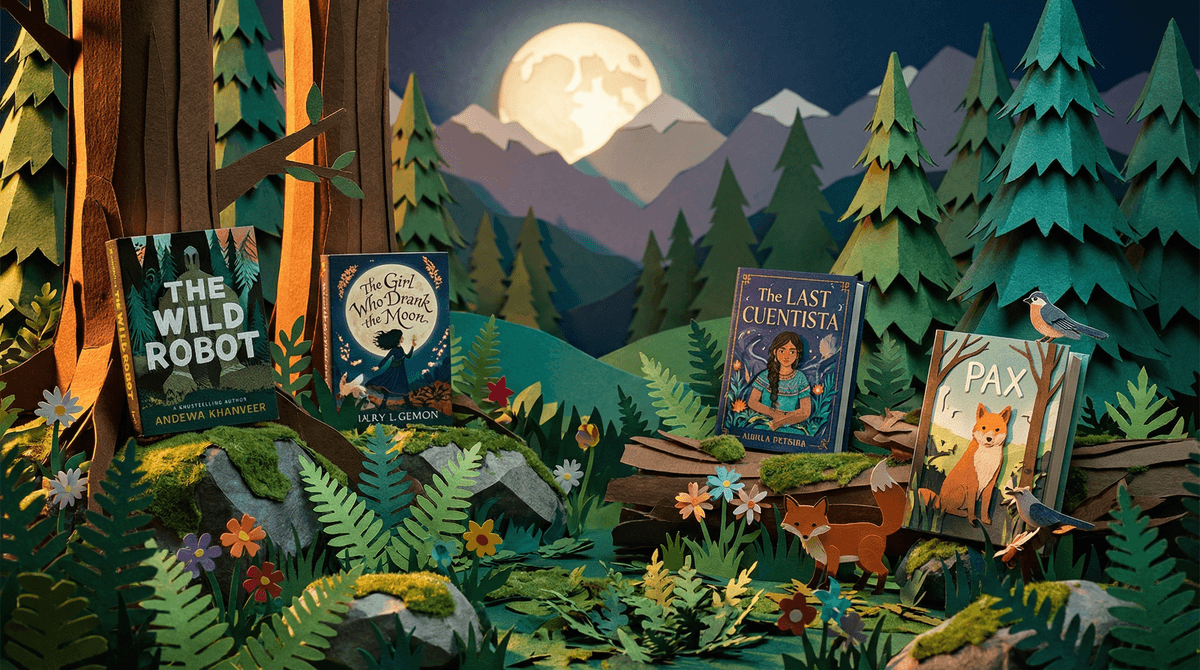
If your kid devoured The Wild Robot by Peter Brown and immediately asked "what's next?", you're in the right place. There's something magical about that story—a robot learning to survive on a wild island, forming unlikely friendships, and discovering what it means to belong. The good news? There's a whole universe of books that capture that same blend of heart, adventure, and characters who don't quite fit in but find their way anyway.
The challenge is that kids often describe what they loved in pretty vague terms ("I liked the robot!" or "It was cool!"), and you're left scrolling through Amazon reviews at 10pm trying to figure out if a book is actually similar or just has a robot on the cover. So let's break down what actually makes these books work and give you some real recommendations.
Understanding what hooks kids about Roz's story helps us find books they'll actually finish:
The outsider perspective - Roz doesn't understand the island at first, which mirrors how kids often feel navigating social situations, new schools, or family dynamics. She has to learn everything from scratch, and kids connect with that vulnerability.
Found family vibes - Roz's relationship with Brightbill the gosling (and later the whole island community) hits that sweet spot of chosen family. It's not about biological connection—it's about showing up and caring, which resonates deeply with middle grade readers.
Nature meets technology - The contrast between Roz's mechanical nature and the wild environment creates constant tension and problem-solving. Kids who love this are often drawn to both STEM concepts and environmental themes.
Gentle humor with real stakes - The books are funny without being silly, and emotional without being manipulative. There's actual danger and loss, but it's handled in an age-appropriate way.
For Ages 7-10 (Early Chapter Books)
The Last Cuentista by Donna Barr - A girl wakes from cryosleep on a spaceship where everyone's memories have been erased. She has to use stories to help people remember who they are. It's got that same "one person trying to preserve something precious in a strange environment" energy, plus it weaves in beautiful folklore.
Hatchet by Gary Paulsen - Classic survival story about a boy stranded in the Canadian wilderness after a plane crash. If your kid loved Roz learning to fish and build shelter, Brian's journey of figuring out how to survive with only a hatchet hits similar notes. Fair warning: it's more intense and realistic than The Wild Robot.
Pax by Sara Pennypacker - A boy and his pet fox are separated by war, and both must survive in the wild while trying to find each other. The dual perspective (human and animal) creates that same sense of different worlds trying to understand each other.
For Ages 9-12 (Middle Grade)
A Wolf Called Wander by Rosanne Parry - Told from a young wolf's perspective as he travels hundreds of miles to find a new home. If the nature writing and animal relationships in The Wild Robot worked for your kid, this delivers that in spades. Based on a true story, which adds extra appeal.
The Girl Who Drank the Moon by Kelly Barnhill - A witch accidentally gives a baby magical powers while rescuing her, then raises her alongside a wise swamp monster and a tiny dragon. It's more fantasy than The Wild Robot, but the found family and "raising a child who's different" themes are strong.
Echo by Pam Muñoz Ryan - Three interconnected stories across different time periods, all linked by a magical harmonica. Kids who loved how Roz's story expanded in the sequels often appreciate how Echo weaves together multiple narratives with music as the connecting thread.
The One and Only Ivan by Katherine Applegate - A gorilla living in a shopping mall reflects on his life and friendships. First-person animal narrator, themes of captivity and freedom, and unexpected friendships make this a natural companion to The Wild Robot. Also based on a true story.
For Ages 10-13 (Upper Middle Grade)
The Wild Beyond series by Piers Torday - In a world where animals are nearly extinct, a boy discovers he can talk to them. It's got environmental themes, animal communication, and that same sense of "what does it mean to be alive and connected to nature?"
Watership Down by Richard Adams - A group of rabbits must find a new home when their warren is threatened. This is more complex and darker than The Wild Robot, but for kids ready for it, the world-building, animal society, and survival themes are incredible. You can check if your kid is ready for the more intense moments .
.
The Thing About Jellyfish by Ali Benjamin - After her best friend dies, a girl stops speaking and becomes obsessed with proving a jellyfish caused it. It's contemporary realistic fiction, not fantasy, but the themes of processing grief, scientific curiosity, and finding your voice connect to Roz's emotional journey.
Reading level vs. interest level - Many of these books have accessible language but deal with complex themes like death, environmental destruction, or war. The Wild Robot does this well, and these recommendations follow suit, but you know your kid best. If they get anxious about animal death, maybe skip Watership Down for now.
Series potential - Some kids want to live in one world for multiple books (The Wild Robot has three books now), while others prefer standalone stories. Books like Pax and The One and Only Ivan are complete stories, while The Wild Beyond is a trilogy.
Audio book magic - Many of these (especially The Wild Robot itself) are exceptional as audiobooks. If you're doing family road trips or your kid listens while doing art or playing Minecraft, this is a great format. The One and Only Ivan won awards specifically for its audio production.
Discussion opportunities - These books naturally open up conversations about empathy, environmental responsibility, what makes someone a "real" parent, and how we treat those who are different. You don't need to force it, but if your kid wants to talk, these are rich texts for it.
The Wild Robot resonates because it's about transformation, belonging, and finding your place in a world that wasn't built for you—pretty much the middle grade experience in a nutshell. The books on this list share those themes while bringing their own unique perspectives and settings.
Start with what your kid specifically loved. If it was the survival and nature aspects, lean toward Hatchet or A Wolf Called Wander. If it was the robot/technology angle meeting nature, try The Last Cuentista. If it was the emotional core of found family and belonging, The One and Only Ivan or Pax are your best bets.
And here's the thing—not every book will land. Sometimes kids bounce off books that seem perfect on paper, and that's totally normal. The goal isn't to find a perfect replica of The Wild Robot, but to help them discover what specifically they loved about it and find more stories that scratch that same itch.
Ask better questions - Instead of "did you like The Wild Robot?", try "what was your favorite part?" or "which character did you think about the most?" Their answers will guide you to the right next book.
Visit your library - Most of these books are widely available, and librarians are genuinely excited to help with "if you liked this, try that" recommendations. They also know what's currently popular with local kids.
Consider book clubs or buddy reads - If your kid has friends who also loved The Wild Robot, reading the same book together adds a social element that can increase engagement, especially for reluctant readers.
Explore more book recommendations based on what your kid loves or find read-aloud options for family time.