

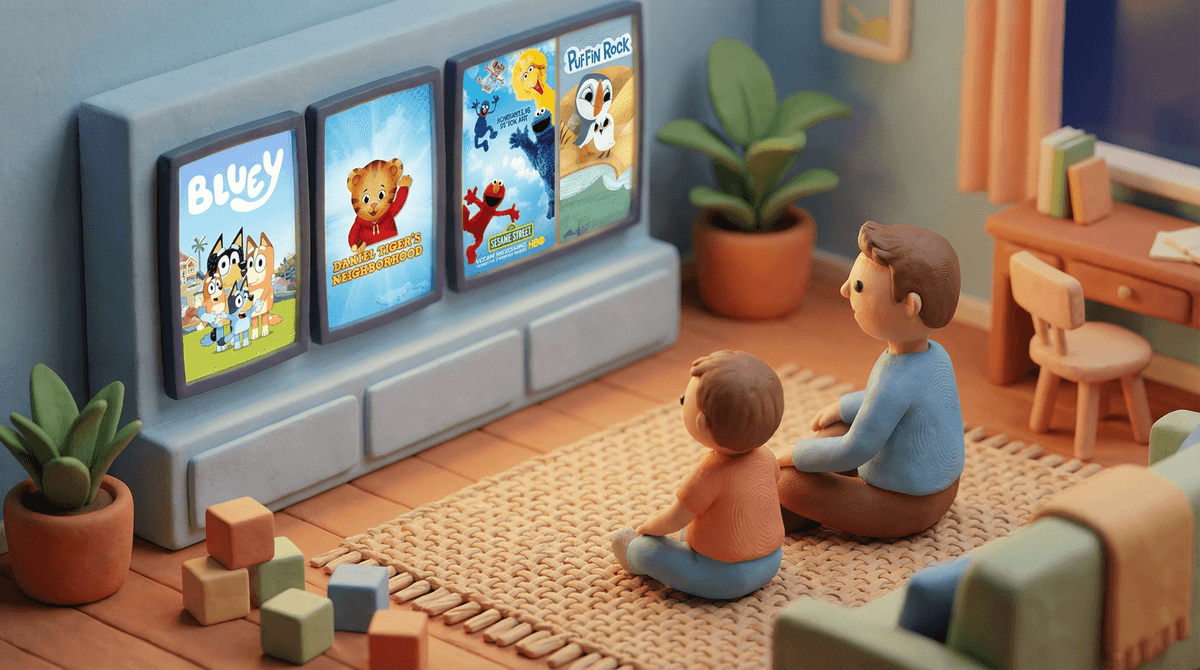
Look, I'm not going to pretend that screen time doesn't happen with preschoolers. It does. Sometimes you need to make dinner, take a work call, or just sit down for five minutes without someone asking you to be a baby dinosaur. The question isn't whether your 2-5 year old will watch TV—it's what they're watching and how much.
The good news? There are actually some genuinely excellent shows out there that respect your kid's intelligence, model healthy relationships, and might even teach them something. The bad news? There's also a metric ton of absolute garbage designed to hypnotize tiny humans into zombie-like states while algorithmically serving them toy commercials disguised as content.
So let's talk about what's actually worth your time—and theirs.
Before we get into specific recommendations, here's what separates the wheat from the chaff:
Pacing that respects developing brains. Good preschool shows don't rely on rapid cuts and constant stimulation. They give kids time to process what's happening.
Real emotional content. The best shows don't talk down to kids. They deal with actual feelings—disappointment, jealousy, excitement, fear—in age-appropriate ways.
Modeling positive behavior. Your kid is absorbing everything right now. Shows where characters work through problems, use their words, and treat each other with respect? That's the good stuff.
Learning that doesn't feel like learning. Literacy, numeracy, social-emotional skills, problem-solving—it can all be woven in naturally without feeling like a classroom lecture.
Bluey
Let's just get this out of the way: Bluey is the gold standard. This Australian show about a family of cartoon dogs manages to be genuinely funny for adults while modeling incredible parenting and sibling relationships. The dad, Bandit, is the father figure we all wish we had the energy to be. Episodes are only 7 minutes, the conflicts feel real, and honestly? You might tear up watching it. It's that good.
Ages: 2-5 (and honestly, up to 8)
Daniel Tiger's Neighborhood
Daniel Tiger is the spiritual successor to Mister Rogers' Neighborhood, and it carries that legacy well. The songs are genuinely helpful for teaching emotional regulation ("When you feel so mad that you want to roar, take a deep breath and count to four"). Yes, those songs will get stuck in your head. Yes, you'll find yourself singing them when you're frustrated at work. That's actually the point.
Ages: 2-4
Sesame Street
Sesame Street has been around for 50+ years for a reason. It's been refined and researched to death. The newer episodes maintain the educational rigor while updating for modern times. Plus, the celebrity appearances mean you might actually enjoy watching it. Is it as groundbreaking as it was in 1969? No. Is it still solid? Absolutely.
Ages: 2-5
Puffin Rock
This Irish show about a puffin family is the televisual equivalent of a warm blanket. Narrated by Chris O'Dowd, it's gentle, sweet, and teaches kids about nature without being preachy. It's not flashy, which is exactly the point. Puffin Rock is perfect for wind-down time or when your kid is already overstimulated.
Ages: 2-4
Elinor Wonders Why
From PBS Kids, Elinor Wonders Why teaches scientific thinking and observation skills through the adventures of a curious bunny. It's not as emotionally sophisticated as Bluey, but it's excellent for encouraging that "let's figure this out" mindset. If your kid is the type who asks "why" 47 times a day, this show celebrates that.
Ages: 3-5
These aren't going to change your life, but they're perfectly fine:
- Tumble Leaf: Beautiful stop-motion, teaches cause-and-effect and basic physics. A little slow for some kids, perfect for others.
- Octonauts: Ocean adventures with actual facts about sea creatures. More action-oriented than the shows above.
- Wild Kratts: Animal education with more adventure. Better for older preschoolers (4-5).
- Stinky and Dirty: About a garbage truck and backhoe who solve problems. Surprisingly charming.
Cocomelon: Look, I know it's wildly popular. I know it keeps kids glued to the screen. That's actually the problem. The pacing is designed to be hypnotic, with rapid scene changes and constant stimulation. Many parents report their kids become almost trance-like watching it and have meltdowns when it's turned off. There's emerging research suggesting this type of ultra-fast pacing may impact attention spans. Is it the worst thing ever? No. But there are better options.
Ryan's World: This started as a toy unboxing YouTube channel and has spawned a TV show. It's literally commercials for toys. That's it. That's the show.
Most YouTube Kids content: Even with parental controls, the quality is wildly inconsistent. Some is fine, much of it is algorithmically-generated garbage designed to game the system. If you're going with YouTube, curate specific channels rather than letting autoplay take over.
The American Academy of Pediatrics recommends:
- Under 18 months: Avoid screens except video chatting
- 18-24 months: High-quality programming only, watched together
- 2-5 years: No more than 1 hour per day of high-quality programming
Is this realistic every single day? For many families, no. But it's a useful North Star. The key words are "high-quality" and "together." Co-viewing matters. Talk about what's happening. Ask questions. Make it interactive rather than passive.
Not all screen time is created equal. A 20-minute episode of Bluey where you're sitting together, laughing, and talking about feelings? That's different from two hours of algorithmically-generated content designed to keep your kid clicking.
Choose shows that:
- Have real emotional content and character development
- Model the behavior you want to see
- Don't rely on hyperactive pacing
- Respect your kid's intelligence
And remember: the best screen time for preschoolers is time-limited, high-quality, and ideally watched together. But also, you're doing fine. Sometimes you need to make dinner, and Daniel Tiger is going to help you do that. That's okay.
Want more guidance on managing screen time with your preschooler? Learn about age-appropriate screen time limits or explore alternatives to screen time for young kids. And if you're trying to figure out whether your family's screen habits are typical for your community, Screenwise can help you understand that context.