

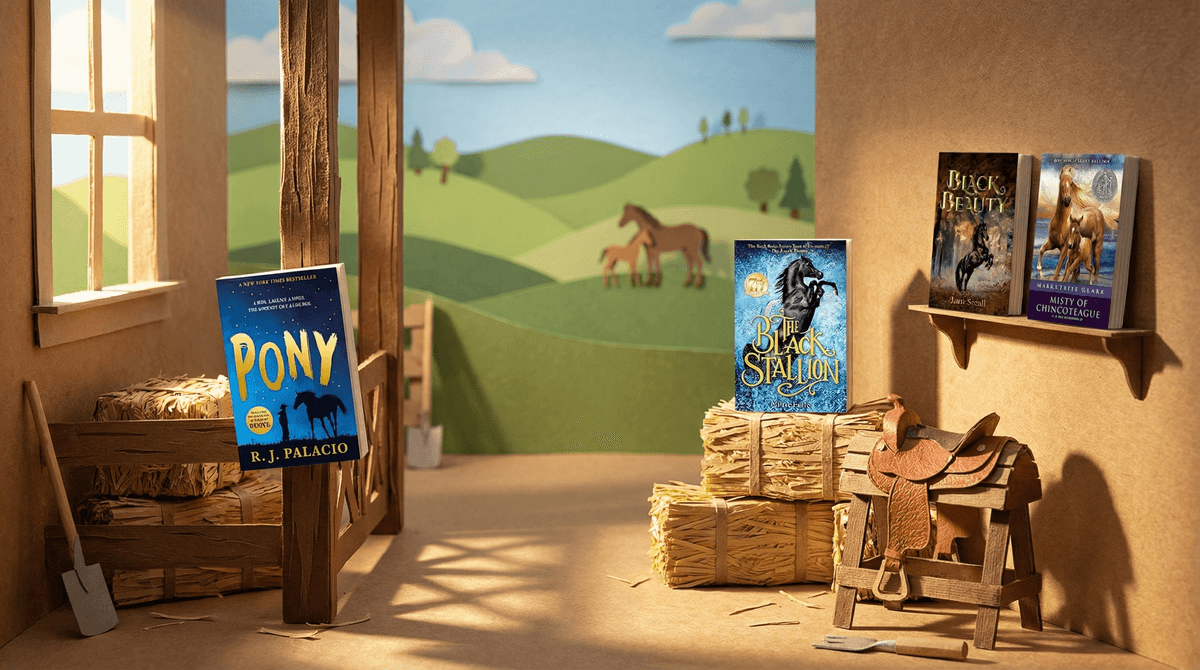
Horse books have been a staple of children's literature for generations—from the tear-inducing classic Black Beauty to modern favorites like the Pony Pals series. These stories center on the relationship between kids and horses, usually featuring themes of responsibility, perseverance, and the kind of deep emotional connection that comes from caring for a 1,200-pound animal that can't talk back but somehow understands everything.
Whether your kid is already begging for riding lessons or just discovered horses exist thanks to Spirit Untamed, equestrian books offer something unique: they're about earning trust, showing up every day, and learning that the most meaningful relationships require work, patience, and sometimes mucking out a stall.
And honestly? In a world where kids can get instant gratification from literally everything on a screen, there's something refreshing about stories where the main character has to actually show up and do the work to get the reward.
Horse books tap into something primal. For many kids—especially those around ages 8-12—these stories hit at exactly the right developmental moment when they're craving independence but still need structure, when they want to prove themselves capable of Big Responsibilities.
Horses in these books aren't just pets. They're partners. They require daily care, they have personalities and moods, and they won't just do what you want because you want it. Kids have to earn the relationship, which is wildly appealing to a demographic that's tired of being treated like they can't handle anything harder than loading the dishwasher.
Plus, let's be real: horses are objectively cool. They're powerful, beautiful, and a little bit dangerous. What's not to love?
Black Beauty by Anna Sewell (Ages 8+)
Yes, it's old (1877!). Yes, it will make your kid cry. But it's also one of the most effective empathy-building books ever written. Told from the horse's perspective, it shows the consequences of both kindness and cruelty in a way that lands hard. Fair warning: there are some genuinely upsetting scenes of animal mistreatment, so know your kid's sensitivity level.
Misty of Chincoteague by Marguerite Henry (Ages 7-10)
Based on a true story about wild ponies on an island off Virginia, this is the book that launched a thousand horse obsessions. It's gentler than Black Beauty, with a focus on determination and the dream of owning your own pony. The whole series is solid, and kids often tear through them all.
The Black Stallion by Walter Farley (Ages 8-12)
A boy and a wild horse survive a shipwreck together and form an unbreakable bond. It's adventure-heavy, which makes it great for kids who might not typically gravitate toward "animal books." The series has like 20 books, so if your kid gets hooked, you're set for a while.
Pony Pals series by Jeanne Betancourt (Ages 6-9)
These are perfect starter chapter books for younger readers. Three friends, three ponies, and a lot of low-stakes problem-solving. They're not going to win literary awards, but they're accessible, engaging, and build reading confidence.
Heartland series by Lauren Brooke (Ages 10-14)
This series follows a girl who helps heal traumatized horses on her family's ranch. It deals with heavier themes—grief, family conflict, healing—while still being fundamentally hopeful. Think of it as a stepping stone between middle grade and YA.
The Canterwood Crest series by Jessica Burkhart (Ages 10-14)
Boarding school + competitive riding + teen drama. If your kid loved Harry Potter but wishes there were more horses and fewer wands, this is the series. It's got all the classic YA elements: friendship drama, crushes, competition, and personal growth.
Here's the thing about horse books that makes them more than just "animal stories":
Responsibility isn't optional. In these books, the horse doesn't care if you're tired or busy or would rather be doing something else. It needs to be fed, groomed, exercised, and cared for. Every. Single. Day. That's a powerful message for kids who are used to things being done for them.
Trust is earned slowly. You can't force a horse to trust you. You have to show up consistently, read their body language, and prove you're safe. That's... actually a pretty sophisticated lesson about relationships in general.
Courage isn't the absence of fear. Pretty much every horse book has a moment where the protagonist is scared—of falling, of failing, of losing the horse they love—and has to do the scary thing anyway. That's the kind of courage kids actually need to practice.
Empathy extends beyond humans. Learning to read a horse's emotions, to understand what they need even when they can't tell you, builds a kind of emotional intelligence that translates to human relationships too.
Ages 6-8: Start with Pony Pals or picture books like Pony by R.J. Palacio. Keep it light and adventure-focused.
Ages 8-10: Misty of Chincoteague, The Black Stallion, or the early Heartland books work well. You can introduce Black Beauty if your kid can handle sad/difficult content.
Ages 10-14: Canterwood Crest, later Heartland books, and pretty much any of the classics. These kids can handle complex themes and longer series.
These books might make your kid want a horse. Just... be prepared for that. If actual horse ownership isn't in the cards (and let's be honest, for most of us it's not), consider riding lessons, volunteer opportunities at local stables, or even therapeutic riding programs. Sometimes the ask isn't really about owning a horse—it's about having that kind of responsibility and connection.
The gender thing: Yes, horse books are marketed heavily toward girls, and yes, most protagonists are female. But plenty of boys love these books too, especially the adventure-heavy ones like The Black Stallion. If you have a son who's interested, don't let outdated gender stereotypes get in the way of a good reading experience.
They're a gateway to other interests: Horse books often lead to interest in veterinary science, animal behavior, business (stable management is expensive!), and even history (the role of horses in warfare, transportation, agriculture). Follow those threads.
In an era where so much of kids' entertainment is passive consumption, horse books offer something different: stories about showing up, doing hard things, and earning meaningful relationships through consistent effort. They're not just escapism—though they're definitely that too—they're practice for the kind of persistence and empathy that actually matters.
And if your kid gets obsessed and starts leaving toy horses all over the house and making you learn the difference between a palomino and a buckskin? Congratulations, you've got a reader who's found their thing. That's worth celebrating, even if you personally could not care less about horses.
Want more book recommendations for your reader? Check out our guides on best chapter books for reluctant readers or building a reading habit in the age of screens.