

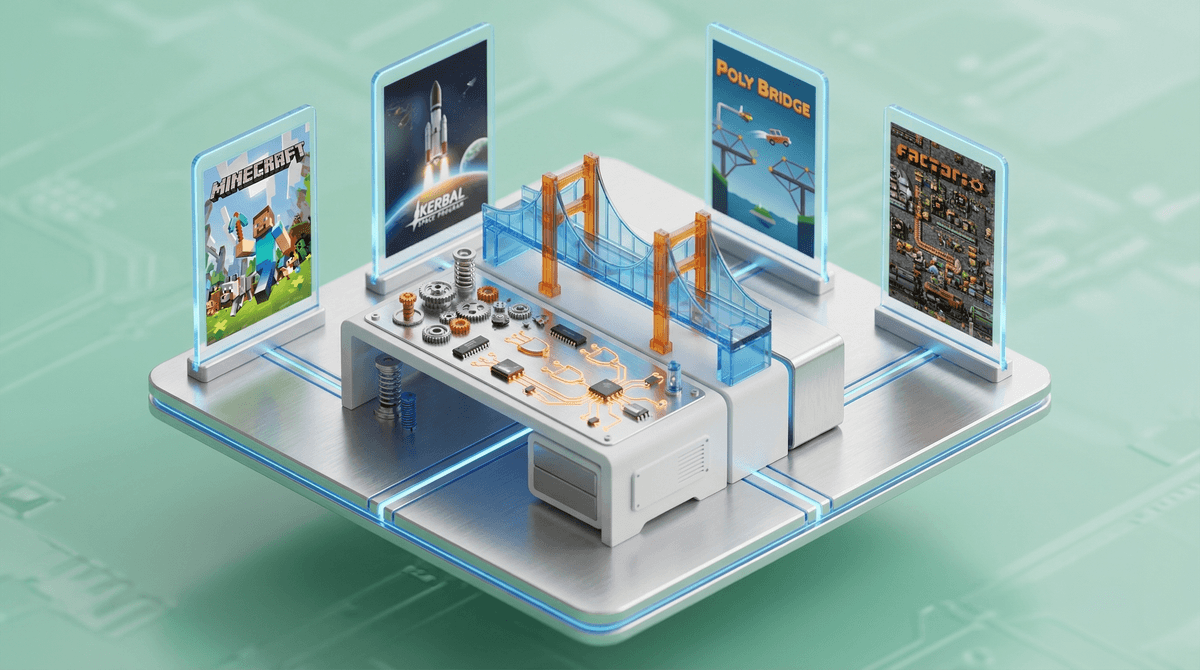
Look, we're not talking about forcing your kid to study thermodynamics while they're trying to have fun. Engineering learning games are the ones where kids naturally start thinking like engineers—testing ideas, iterating on designs, solving problems through trial and error, and occasionally blowing stuff up (digitally) to see what happens.
These are games where the core loop involves building systems, understanding cause and effect, and creative problem-solving. Think less "educational game that feels like homework" and more "wait, my kid just spent two hours designing a working elevator system and didn't even realize they were learning."
The best ones don't announce themselves as educational. They just happen to require the same thinking patterns that actual engineers use: planning, prototyping, debugging, and that beautiful moment when something you built actually works.
Here's the thing: whether your kid becomes an engineer or not (and let's be real, they'll probably change their career aspirations 47 times before high school), engineering thinking is problem-solving thinking. It's the ability to break down complex challenges, test solutions, learn from failures, and iterate.
Plus, we're seeing more kids gravitate toward these games naturally. The Minecraft generation is already wired for this stuff—they're building redstone computers and automated farms without anyone telling them to. The question isn't whether to encourage this kind of play, it's how to recognize the good stuff from the time-wasters.
Ages 5-8: Foundation Building
Minecraft (Ages 7+) Yeah, yeah, everyone recommends Minecraft. But here's why it actually belongs on this list: Creative mode is basically digital LEGOs, but Survival mode? That's where the engineering happens. Kids learn resource management, basic circuitry with redstone, and spatial reasoning. The redstone system alone is Turing-complete—meaning theoretically you could build a working computer in it (and people have).
The caveat: Minecraft can also become "wander around aimlessly and never finish anything" simulator. The engineering learning happens when kids set goals and work toward them. Setting up some structure around Minecraft time can help.
LEGO Builder's Journey (Ages 6+) This one's gorgeous and meditative. It's puzzle-based building with actual LEGO physics. Kids learn spatial reasoning and problem-solving without the overwhelm of open-world games. Each puzzle has constraints that force creative thinking—exactly how real engineering works.
Ages 8-12: Getting Complex
Kerbal Space Program (Ages 9+) This is the game where kids learn orbital mechanics by accidentally exploding a lot of cartoon aliens. It's legitimately used in some schools to teach physics. Your kid will learn about thrust-to-weight ratios, delta-v, and staging—all while giggling at the little green Kerbals' faces when things go wrong.
Fair warning: there's a learning curve. Kids who love this game LOVE it. Kids who don't click with it will bounce off hard. But for the ones who get into it, this is where real engineering thinking happens .
.
Poly Bridge (Ages 10+) Build bridges, test them with traffic, watch them collapse spectacularly, learn why. Rinse and repeat. It's pure engineering method: design, test, analyze failure, redesign. The physics are realistic enough to teach actual principles of structural engineering, but the presentation is playful enough that it doesn't feel like school.
Factorio (Ages 11+) This is the "my kid just spent 6 hours optimizing a conveyor belt system" game. You're building increasingly complex automated factories on an alien planet. It teaches systems thinking, optimization, and logistics at a level that honestly rivals some college engineering courses.
The catch: this game is WILDLY addictive. Like "one more hour turns into four more hours" addictive. It's also complex enough that younger kids will need support getting started. But for kids who love optimization puzzles? This is digital crack (the good kind).
Ages 12+: Real Engineering Concepts
Besiege (Ages 12+) Medieval engineering simulator where you build siege weapons and machines to complete objectives. The physics are realistic, the creativity is unlimited, and the community shares insane contraptions. Kids learn about mechanical advantage, projectile physics, and structural integrity while building flying machines and death robots.
Human Resource Machine (Ages 12+) This one teaches actual programming concepts through puzzles. You're programming a little office worker to complete tasks using a visual programming language. It's literally teaching assembly language concepts, but it's presented as a quirky puzzle game. If your kid shows any interest in coding, this is a brilliant gateway that teaches real computer science fundamentals.
Satisfactory (Ages 13+) Think Factorio but in first-person 3D. You're building massive automated factories on an alien world. The engineering concepts are the same—optimization, logistics, systems thinking—but the presentation feels more like exploration and less like pure optimization.
Can we talk about Minecraft redstone for a second? Because if your kid is into it, they're literally learning digital logic circuits. Redstone repeaters are signal boosters. Comparators are logic gates. Kids are building working calculators, combination locks, and automated farms using the same principles that power actual computer chips.
The Minecraft-to-engineering pipeline is real. There are college engineering students who trace their interest back to building elaborate redstone contraptions at age 10. If your kid is deep in the redstone world, encourage it. This is the good stuff.
Roblox deserves its own mention because the platform includes both playing games and creating them. Roblox Studio—the creation tool—teaches actual game development, scripting (in Lua), and 3D modeling. Some kids are making real money publishing games on the platform.
The engineering learning in Roblox comes from the creation side, not the playing side. If your kid is just consuming Roblox games, that's fine, but it's not really engineering education. If they're opening Roblox Studio and building their own games? That's where the learning happens. Here's how to encourage the creation side.
Here's the uncomfortable truth: real engineering learning in games takes time. You can't learn to build a working Factorio factory in 30 minutes. You can't master Kerbal Space Program in a few quick sessions.
This is where intentional parenting gets tricky. These aren't "quick hit" games. They're deep, complex systems that reward sustained engagement. So yeah, your kid might spend 3 hours on a Saturday building and testing bridge designs in Poly Bridge. And that might actually be... good?
The question isn't "how much time" but "what kind of engagement." Is your kid problem-solving, iterating, learning from failures? Or are they in zombie mode, grinding without thinking? The quality of engagement matters more than the clock.
Some of these games have multiplayer components. Factorio and Satisfactory can be played co-op. Minecraft obviously has multiplayer servers. Here's the thing: collaborative engineering can be amazing. Working with friends to solve complex problems, dividing tasks, coordinating systems—that's real teamwork.
But (you knew there was a but): multiplayer also means online interactions, which means all the usual concerns about who your kid is talking to and what they're exposed to. The standard multiplayer safety guidelines apply.
Start with what they already like. If your kid loves Minecraft, lean into the redstone. If they're into LEGO, try LEGO Builder's Journey or Besiege. Don't force the "educational" angle—just provide access to games that happen to teach engineering thinking.
Ask about their designs. "How did you make that work?" "What happens if you change this part?" "What would you do differently next time?" These questions reinforce engineering thinking without being annoying parent-y.
Embrace the failures. The best learning in these games comes from spectacular failures. When the bridge collapses or the rocket explodes, that's not wasted time—that's literally the engineering process. Failure is data.
Consider co-playing. Some of these games are genuinely fun for adults too. Factorio and Satisfactory have huge adult fanbases. Playing together means you can model problem-solving thinking and have actual conversations about the engineering concepts.
The best engineering learning games don't feel educational—they feel like play. They're the ones where kids lose track of time because they're so focused on making their design work. Where they voluntarily restart after a failure because they have a new idea to test. Where they explain their contraptions to you with genuine excitement.
Not every kid will love these games, and that's fine. But for the ones who do? You're watching real engineering thinking develop. The kind that transfers to school projects, life problems, and maybe—eventually—actual engineering careers.
Start here: If your kid is under 10 and not already into Minecraft, start with LEGO Builder's Journey or creative mode Minecraft. If they're 10+, try Poly Bridge or Kerbal Space Program. And if they're already deep in Minecraft redstone? Just get out of their way and let them cook.