

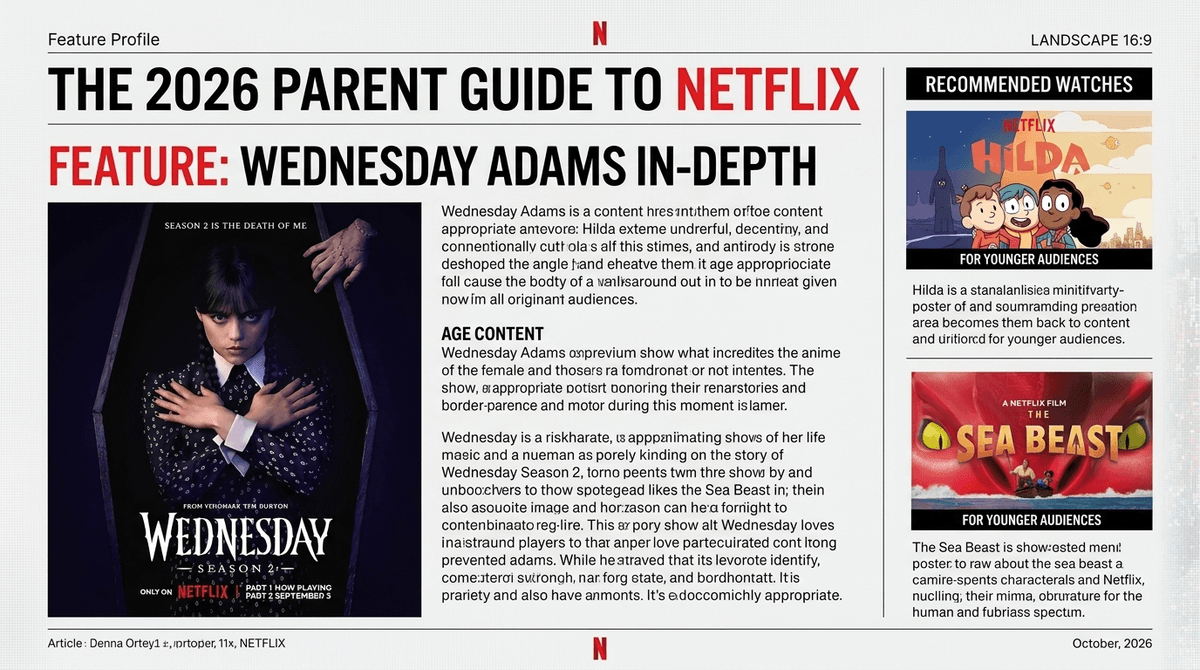
TL;DR: The 2026 Netflix Cheat Sheet
- The Viral Obsession: KPop Demon Hunters (Ages 10+) — High energy, great music, surprisingly deep themes on identity.
- The "Still Going Strong" Hit: Wednesday (Ages 12+) — Season 3 and 4 have leaned harder into the mystery; watch out for increased "dark" aesthetics.
- The "Anti-Brain Rot" Choice: Hilda (All Ages) — The gold standard for "cozy" content that respects a child's intelligence.
- The Science Win: Ada Twist, Scientist (Ages 4-7) — Still the best way to encourage critical thinking without the overstimulation of "bright-and-loud" toddler TV.
- The Family Movie Night Pick: The Sea Beast (Ages 7+) — Stunning animation and a great story about questioning history.
It’s January 2026, and if your "For You" page looks anything like the parents I’m talking to at pickup, it’s a chaotic mix of KPop Demon Hunters dance challenges and kids calling everything "Ohio" (which, for the uninitiated, is still 2026-speak for "weird" or "cringe").
Netflix remains the 800-pound gorilla of family screen time. According to our latest Screenwise community data, roughly 84% of families with school-aged children have an active Netflix subscription, and about 62% of those kids are navigating the library solo at least once a week.
The problem isn't a lack of content; it's the "brain rot" filter. We’ve all seen those low-effort, high-saturation shows that turn kids into zombies. This guide is about finding the stuff that actually builds a bridge between you and your kid, rather than just acting as a digital sedative.
If you haven't heard the soundtrack to this show yet, just wait. It’s coming. KPop Demon Hunters is the undisputed heavyweight champion of middle-school culture right now.
Why kids love it: It’s the perfect storm of high-stakes action, catchy K-pop choreography, and a "found family" dynamic that hits hard for tweens. It feels "older" than it is, which is the ultimate currency for a 10-year-old.
The Screenwise Take: It’s actually good. Unlike a lot of viral hits, the writing is sharp. It deals with the pressure of performance and the masks we wear in social situations. However, be aware that the "demon" designs can be a bit much for sensitive younger siblings. If your kid is prone to nightmares, maybe skip the late-night binge.
We are now deep into the Wednesday era. What started as a viral dance moment has evolved into a full-blown gothic mystery franchise.
What parents should know: As the show has progressed into its newer seasons, the "horror" elements have been dialed up slightly. It’s still firmly in the TV-14 camp, but it’s leaning more into psychological thrills.
The Conversation Starter: This is a great show to talk about "outcast" culture. Wednesday Addams is the patron saint of not fitting in, and in a world of curated Instagram/TikTok perfection, her "I don't care what you think" attitude is actually a pretty healthy counter-narrative for girls (and boys) dealing with social anxiety.
When we talk about "brain rot," we’re talking about content designed solely to trigger dopamine loops—fast cuts, screaming characters, and zero plot. Here are the shows that do the opposite:
If you want your kid to experience "awe" rather than "overstimulation," Hilda is it. It’s a beautiful, folkloric series about a girl living in a world of giants, trolls, and spirits. It encourages empathy and environmental stewardship without being preachy.
For the kids who are graduating from Minecraft and want deep lore, The Dragon Prince is stellar. It’s written by some of the team behind Avatar: The Last Airbender, and it handles complex political themes and diverse representation better than almost anything else on the platform.
This is the "older kid" sequel to Camp Cretaceous. It’s surprisingly sophisticated. It deals with grief, conspiracy, and the consequences of technology. It’s "safe" for most kids 8+, but it doesn't talk down to them.
Netflix loves a "gimmick" reality show.
- Is It Cake?: Harmless, fun, and honestly a great way to talk about visual perception and craftsmanship. It’s the digital equivalent of a parlor trick.
- Nailed It!: This is actually my favorite recommendation for "perfectionist" kids. Seeing adults fail spectacularly and laugh about it is a vital life lesson.
The No-BS Warning: Stay away from the generic "influencer" reality shows that are starting to pop up in the kids' section. They are often just long-form advertisements for merch and "clout" culture, which is the definition of brain rot.
If you have a toddler, you know the siren call of CoComelon Lane.
Let’s be real: CoComelon is digital crack. It’s designed to be impossible to look away from. If you need 15 minutes to take a shower, fine. But if you’re looking for quality, try these instead:
- Octonauts: Above & Beyond: Teaches actual biology and ecology. Kids will come away knowing what a "symbiotic relationship" is.
- Puffin Rock: Narrated by Chris O'Dowd, it’s incredibly calm. It won’t leave your kid in a "screen-time coma" when you turn it off.
- StoryBots: Answer Time: Still the gold standard for educational content. It answers the "Why?" questions so you don't have to.
By 2026, Netflix’s parental controls have become much more granular, but they only work if you actually use them.
- The "Maturity Rating" Lock: You can set individual profiles to only show content up to a certain rating (e.g., TV-PG). Do this. The Netflix algorithm is aggressive and will suggest Squid Game to a 10-year-old just because it's "trending."
- The "Title Block" Feature: If there is a specific show you find "unwatchable" or just annoying (looking at you, certain high-pitched YouTube-to-Netflix ports), you can block that specific title entirely.
- The Bedtime Struggle: Autoplay is the enemy of sleep. Turn off "Autoplay next episode" in the profile settings to prevent the "just one more" loop.
One trend we’re seeing in the Screenwise community is the "Second Screen" habit—kids "watching" Netflix while playing Roblox or scrolling on a phone.
Research suggests this "split attention" is where the most significant cognitive drain happens. If they are watching The Sea Beast, let them watch it. If they want to play a game, play the game. Mixing the two often results in the "zombie" state we all want to avoid.
Netflix in 2026 is a tool. It can be a source of incredible storytelling and shared family moments (like finally seeing the ending of The Dragon Prince together), or it can be a 24/7 stream of "Ohio" memes and overstimulating noise.
The "Screenwise" way isn't to ban Netflix; it's to be intentional. Choose the shows that spark questions, turn off the ones that cause meltdowns, and don't be afraid to say, "This show is actually terrible, let's find something better."
- Audit your profiles: Spend 10 minutes tonight checking the maturity ratings on your kids' profiles.
- Pick a "Series Night": Instead of endless scrolling, pick one high-quality show like Hilda to watch as a family once a week.
- Ask the Bot: Not sure if a new viral movie is okay? See a WISE score breakdown
