

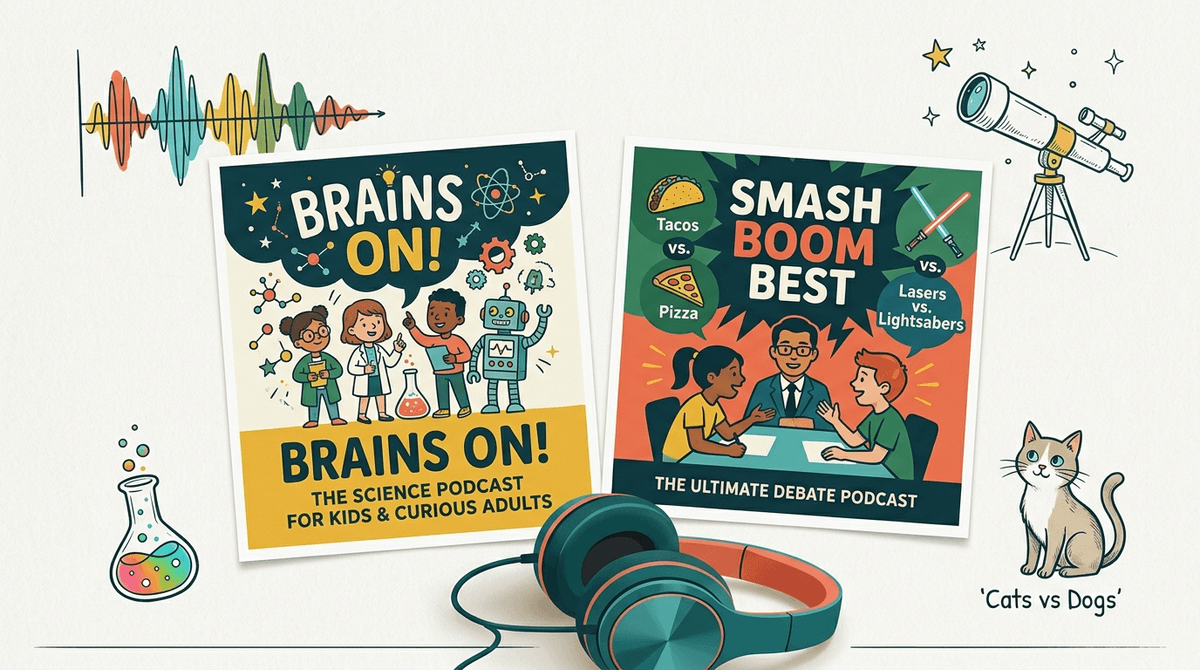
TL;DR: If you’re looking to swap the YouTube "brain rot" for something that actually builds brain cells, Brains On! is the gold standard. Start with "The Science of Farts" for the little ones, "Cats vs. Dogs" for the elementary crew, and "The Mystery of Dreams" for your preteens.
We’ve all been there: you’re twenty minutes into a road trip, or you’re trying to make dinner without someone's Roblox avatar screaming in the background, and you feel that familiar twinge of screen-time guilt. You want them entertained, but you’d prefer if their brains didn't turn to mush in the process.
Enter the world of science podcasts. Specifically, Brains On!.
If Wow in the World is the high-energy, slightly chaotic theater kid of the podcast world, Brains On! is the cool, smart friend who actually explains how the magic trick works without being a bore. Produced by American Public Media, it’s hosted by Molly Bloom and a rotating cast of kid co-hosts. It’s smart, it’s funny, and it treats kids like the capable thinkers they are.
But with over 200 episodes in the archives, where do you even start? Not every episode hits the same for a four-year-old as it does for an eleven-year-old. Here is the curated roadmap to getting your kids hooked, broken down by age and "vibe."
At this age, kids are obsessed with two things: their own bodies and animals. They don't need complex physics yet; they need to know why things smell and why their cat acts like a weirdo.
This is the ultimate gateway episode. If you want a kid to sit still for 20 minutes, tell them you’re going to listen to a professional scientist talk about gas. It’s hilarious, it’s informative, and it validates their favorite topic of conversation while teaching them about digestion and microbes.
Preschoolers are still figuring out how their bodies work. This episode explains the "autonomic nervous system" in a way that doesn't feel like a lecture. It’s relatable, physical, and features great sound effects that keep younger ears engaged.
For the kid who is obsessed with Octonauts or Wild Kratts, this is a winner. It taps into that natural wonder about the animal kingdom without getting too bogged down in heavy terminology.

This is the sweet spot for Brains On!. These kids are starting to develop specific interests—space, dinosaurs, Minecraft, or ocean life—and they want to be the "expert" in the room.
This is actually a two-part debate episode. It’s a fantastic introduction to the "debate" format (which the creators later spun off into Smash Boom Best). It teaches kids how to use facts to support an opinion, which is a massive win for critical thinking.
There is something inherently "cool" about the deep sea for this age group. It feels like aliens on Earth. This episode covers bioluminescence and the crushing pressure of the trenches. It pairs perfectly with a session of Abzû or just some focused LEGO building.
It sounds boring to an adult, but to a 7-year-old? Dirt is fascinating. This episode explores geology and the "living" aspect of soil. It’s a great one to listen to before heading out for a hike or some backyard gardening.
Check out our guide on the best educational YouTube channels for elementary kids
By the time they hit double digits, kids are looking for the "why" behind the "what." They’re starting to navigate social media, they’re curious about the future, and they have a higher tolerance for complex narratives.
Preteens are becoming more introspective. This episode dives into the psychology and neurology of sleep. It’s a bit more "heady" (pun intended) and deals with the subconscious, which usually sparks some pretty deep dinner-table conversations.
Since your preteen is likely already using ChatGPT for homework help (or at least knows about it), this is essential listening. It demystifies how large language models work and helps them understand that AI isn't "magic"—it's math.
If you’ve ever had a fight about "five more minutes" on Fortnite or TikTok, this is the episode for your family. It explains the reward system in the brain in a non-judgmental way. Instead of you saying "screens are bad," the podcast explains the science of why they are so addictive. It puts you and your kid on the same team against the "dopamine loop."
We talk a lot at Screenwise about "active" vs. "passive" consumption. Most kids' media is designed to be passive—bright colors, fast cuts, and minimal thinking required.
Podcasts like Brains On! are a different beast. They require active listening. Your child has to visualize the black hole, the giant squid, or the farting bacteria. This builds cognitive muscles that YouTube Shorts simply doesn't touch.
Plus, it’s a "co-listening" opportunity. Unlike a Nintendo Switch game where they’re in their own world, a podcast can be played over the car speakers or a Bluetooth speaker in the kitchen. It gives you a shared language.
While Brains On! is generally "squeaky clean," here are a few things to keep in mind:
- Sensitivity: Some episodes deal with "scary" topics like germs, climate change, or extinction. For highly sensitive kids (especially in the 4-6 range), you might want to pre-listen to episodes about the "End of the Dinosaurs" or "Global Warming."
- Complexity: If an episode is too complex, your kid will just tune out. If you see them glazing over, don't be afraid to skip to a more "active" episode like a debate or a "Mystery Sound" segment.
- The "Mystery Sound": Every episode features a "Mystery Sound" where kids have to guess what a weird noise is. This is the best part for younger kids—it keeps them engaged through the more technical middle sections.
The best way to use these episodes isn't to just "set it and forget it." Use it as a springboard.
- The "I Didn't Know That" Rule: After an episode, tell your kid one thing you learned. It shows them that learning is a lifelong process, not just something they have to do for school.
- Submit a Question: Brains On! thrives on kid questions. If the episode sparks a "But why...?" moment, help them record a voice memo and send it in. It makes them feel like part of the scientific community.
- The "Mystery Sound" Challenge: Try to guess the mystery sound before they reveal it. Winner gets to pick the next episode (or the next snack).
Brains On! is one of the few pieces of media that actually lives up to the "educational" label without being a total drag. It respects kids' intelligence, leans into their natural curiosity, and provides a much-needed break from the visual overstimulation of modern apps.
If you’re just starting out, don't overthink it. Pick a topic they already love—whether it's Minecraft (they have an episode on the science of blocks!) or animals—and hit play.