

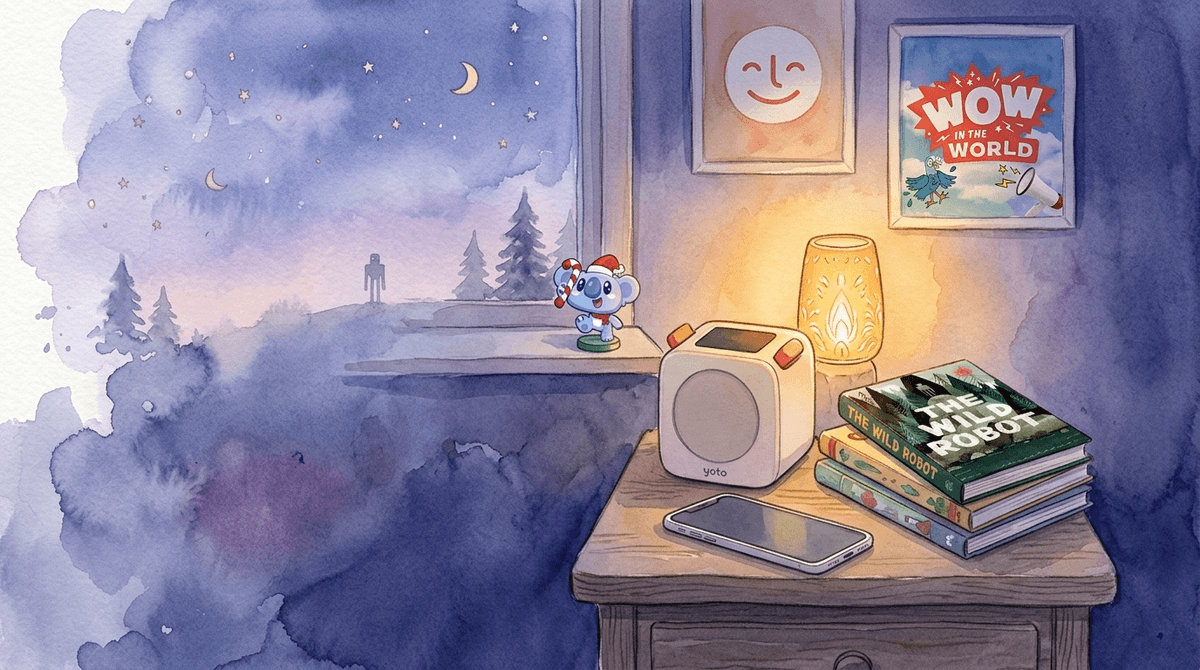
TL;DR: Bedtime is the final boss of parenting. We’re moving away from high-stimulation tablets and toward "low-glow" or "no-glow" tech.
Top Recommendations:
- Best Audio Hardware: Yoto Player (The gold standard for screen-free autonomy)
- Best AI Story Generator: ChatGPT or Bedtime AI (For hyper-personalized "Ohio" stories)
- Best Sleep App: Moshi (Specifically designed for the drift-off)
- Best Podcast: Phoebe Reads a Mystery (For older kids) or Sleep Tight Stories
- Best Modern Read-Aloud: The Wild Robot by Peter Brown
The 8:00 PM struggle is a universal parent experience. You want them to sleep; they want to know if a Skibidi Toilet could actually beat a Wither in Minecraft.
For years, the "digital bedtime story" meant handing over an iPad and hoping they didn't end up in a YouTube Kids rabbit hole. But we’ve learned a lot about blue light and dopamine loops since then. The "New Nighttime Routine" isn't about banning tech—it’s about choosing tech that whispers instead of screams.
According to recent community data, over 65% of intentional parents are actively replacing "watchable" bedtime content with "listenable" content to reduce overstimulation. Here is how to navigate the shift from paperbacks to the new world of audio and AI.
If you want to reclaim your evening without a screen-induced meltdown, audio is the move. It engages the imagination (the "theatre of the mind") without the blue light that suppresses melatonin.
The Yoto has a bit of a cult following for a reason. It uses physical cards to play stories, which gives kids the tactile "I’m in control" feeling they usually get from a remote, but without the pixels. You can find everything from Disney classics to Percy Jackson. Ages 3-12
Similar to the Yoto, but uses little figurines (Tonies) instead of cards. It’s softer, more durable, and generally better for the toddler/preschool set. If your kid is obsessed with Paw Patrol, this is their gateway drug to audiobooks. Ages 2-6
Unlike a standard audiobook, Moshi stories are engineered to be boring—in a good way. They start engaging and slowly decrease in tempo and volume until your kid is out. It’s the ultimate "set it and forget it" tool for parents of kids who "can't turn their brains off." Ages 3-10
Find more screen-free audio options
We’ve all been there: your kid wants a story about a "skating unicorn named Jeff who lives in Ohio and eats only tacos." You’re exhausted. Your brain is fried. Enter AI.
Using AI for bedtime stories is the ultimate parenting hack for 2026. You can prompt it to include your child’s name, their favorite stuffed animal, and a specific moral lesson you’ve been trying to hammer home (like "why we don't hit the dog"). Pro-tip: Ask it to write in the style of Dr. Seuss or a classic fairy tale to keep the "vibe" right. Ages: All
There are now dedicated apps that take the ChatGPT engine and wrap it in a kid-safe interface. These apps often allow you to generate an image of the character and then read the story aloud using a soothing, synthesized voice. It’s personalized, it’s fast, and it makes you look like a creative genius. Ages 4-10
Podcasts are the bridge for older kids who feel they’ve outgrown "kiddie" stories but still need a wind-down ritual.
While this can be high-energy, their "Mind 5" segments or older episodes are great for kids who like to learn while they drift off. It’s science-heavy but funny enough that they don’t realize they’re being educated. Ages 5-12
If your kid is into Percy Jackson, this National Geographic Kids podcast is a home run. It retells Greek myths in a way that is kid-friendly but doesn't pull punches on the weirdness of the gods. Ages 7-12
This is exactly what it sounds like. Calming, melodic voices reading stories that are just long enough to get them through the "I need a glass of water" phase and into actual sleep. Ages 3-8
Sometimes the best tech is no tech. If you’re sticking to the physical book (respect), these are the ones currently dominating the "intentional parent" circles because they lead to great conversations.
- The Wild Robot by Peter Brown: It touches on AI, nature, and what it means to be a family. It’s the rare book that a 6-year-old and a 10-year-old will both actually listen to.
- Wings of Fire: If you have a kid who loves Roblox or Dragon Adventures, this series is their "hook" into long-form reading.
- Wonder by R.J. Palacio: Still the gold standard for teaching empathy.
Preschool (Ages 2-5): Stick to tactile audio like the Toniebox. At this age, the physical act of placing a character on the box helps with fine motor skills and gives them a sense of agency. Avoid AI-generated voices here; they need the human cadence of a recorded narrator or you.
Elementary (Ages 6-10): This is the sweet spot for Yoto Player and AI-generated stories. They think the AI is "cool" (especially if you make it say something "Ohio" or "Sigma" in a funny context), and they’re old enough to handle the responsibility of a podcast.
Middle School (Ages 11-13): They likely want their own Spotify account. This is a great time to introduce "Sleep Playlists" or sophisticated audiobooks like The Hunger Games to keep them off TikTok before bed.
When you move into AI and apps, there are two things to watch:
- Data Privacy in AI: When using ChatGPT to write stories, don't put in your child’s full name or address. Use a nickname. Most AI models "learn" from your prompts, and while it’s unlikely Jeff the Skating Unicorn will become a security risk, it’s good digital hygiene.
- The "One More" Loop: Even audio apps can be addictive. If you’re using an app like Calm or Headspace, use the "Sleep Timer" function so the audio doesn't play all night, which can actually disrupt deep sleep cycles.
Read our guide on setting up privacy for AI apps
You might hear people talk about "brain rot" content—those high-speed, brightly colored, nonsensical videos (think Skibidi Toilet or certain YouTube shorts).
The danger of using these for bedtime isn't just the content; it's the pacing. Bedtime stories, whether AI or paperback, should be slow. If an app or a podcast has loud "stings," heavy sound effects, or frantic energy, it’s not a bedtime story—it’s entertainment. For sleep, we want monotone. We want boring.
The goal of the modern nighttime routine isn't to be a Luddite; it’s to be a curator.
If you use ChatGPT to write a story about your kid saving a village from a "cringe" monster, you’re winning. If you use a Yoto Player to let them choose their own adventure without a screen, you’re winning.
Tech at bedtime doesn't have to be the enemy of sleep. It can be the bridge to it—provided we choose the "low-glow" path.
- Audit the Glow: Look at your kid’s current bedtime tech. If it has a backlit screen, consider swapping it for an audio-only device.
- Try an AI Story tonight: Open ChatGPT and type: "Write a 5-minute bedtime story for a 7-year-old about a kid who finds a magic Minecraft sword in their backyard. Make it very soothing and end with the kid falling asleep."
- Check the Community Stats: See what other parents in your grade are using for bedtime by finishing your Screenwise Profile.