

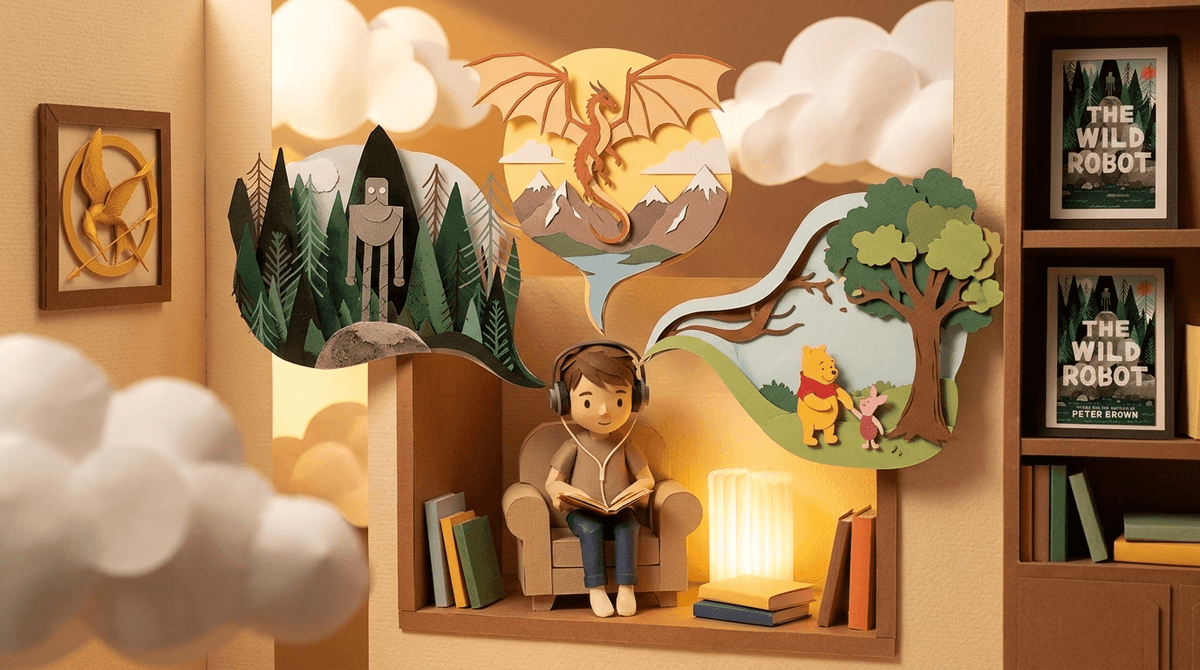
TL;DR: No, audiobooks do not count as "screen time" in the way we usually worry about it. Experts generally view them as a high-quality, "green light" activity because they engage the brain's language processing centers without the dopamine-loop visuals or blue light of traditional screens. They are the ultimate "loophole" for keeping kids entertained during car rides or quiet time without the post-iPad meltdown.
Top Recommendations:
- Best for Littles (Ages 3-6): Winnie the Pooh or Bluey: 5-Minute Stories
- Best for Middle Grade (Ages 7-12): The Wild Robot by Peter Brown or Wings of Fire
- Best for Teens: Project Hail Mary or The Hunger Games
- Best Platforms: Libby (Free with library card!), Audible, and Yoto
The "screen time" debate usually feels like a losing game of Whac-A-Mole. You finally get them off Roblox, and then they’re begging for YouTube. You try to pivot to something educational, and suddenly they’re watching a 20-minute video of someone unboxing "Skibidi Toilet" toys in a basement in Ohio. It’s exhausting.
But then there’s the audiobook loophole.
It’s that magical middle ground where a kid is technically using a device, but they aren’t staring at a glowing rectangle with their jaw hanging open. They’re building a fort, drawing, or staring out a car window while a narrator describes a dragon battle.
If you’ve been feeling guilty about the hours your kid spends with headphones on, take a breath. Audiobooks aren't just "not bad"—they’re actually a massive win for digital wellness.
When we talk about "screen time," we’re usually worried about two things: the physiological impact (blue light, eye strain, sedentary "zombie" posture) and the psychological impact (rapid-fire dopamine hits, algorithmic rabbit holes, and the "brain rot" of low-quality content).
Audiobooks bypass almost all of these concerns:
- Imagination over Stimulation: When a kid watches MrBeast, the visuals are provided for them at a breakneck pace. When they listen to Harry Potter, their brain has to do the heavy lifting of "rendering" the world. They have to imagine what a Hippogriff looks like. That’s active cognitive work, not passive consumption.
- Vocabulary and Literacy: Research shows that listening to a story activates the same parts of the brain as reading one. For kids who struggle with decoding text (like those with dyslexia), audiobooks are a literal lifeline to grade-level content and complex vocabulary they might not be able to read manually yet.
- The Wind-Down Factor: Unlike a tablet, which suppresses melatonin and keeps kids wired, an audiobook is a fantastic tool for the "bedtime struggle." It gives their brain something to focus on so they don't get stuck in a loop of "I’m not tired" thoughts, without the stimulating light of a TV.
Learn more about the science of auditory learning vs. visual processing
The biggest hurdle to the "audiobooks don't count" rule is the device itself. If your kid is listening to Spotify on an iPad, they are exactly two taps away from Minecraft.
If you want audiobooks to truly be a screen-free experience, consider dedicated hardware:
This is the gold standard for intentional parents right now. It uses physical cards to play stories and music. There is no camera, no microphone, and no "screen" in the traditional sense (just a pixelated clock/icon display). It puts the child in control of their "media" without giving them access to the open internet.
Similar to the Yoto, but uses little figurines (Tonies) to trigger the audio. It’s much more durable for toddlers, though the content library is a bit more limited to "branded" characters like Disney and Paw Patrol.
If you are using a phone or tablet, Libby is the "no-BS" way to get audiobooks for free. You just hook up your library card and borrow digital copies. Pro-tip: Put the device in "Guided Access" mode (on iPhone) so your kid can’t leave the app and wander into the App Store.
Not all audiobooks are created equal. Some are just "read-alouds," while others are full-cast "audio dramas" with sound effects that feel like a movie for your ears.
Ages 4-7: Building the Habit
At this age, you want stories with clear narration and engaging characters.
- The Mercy Watson Series: Hilarious, short, and the narrator is fantastic.
- Wow in the World: Okay, it’s a podcast, but it functions like an audiobook. It’s high-energy science that isn't annoying for parents to listen to.
- Frog and Toad Are Friends: Pure, classic, low-stimulation vibes.
Ages 8-12: The Golden Age of Listening
This is when kids can handle 10+ hour epic series. This is your secret weapon for long road trips.
- The Wild Robot by Peter Brown: A beautiful story about a robot stranded in the wilderness. It’s thoughtful and moving.
- Percy Jackson & The Olympians: The narrator, Jesse Bernstein, captures the snarky "middle schooler" voice perfectly. It’s a great bridge for kids who think books are "boring."
- Wings of Fire: If your kid is into lore and world-building, this series about dragon tribes is basically "Game of Thrones" for the elementary set (minus the "spicy" parts).
Ages 13+: The Teen Loophole
Teens are the hardest to pull away from TikTok. Audiobooks can help them reclaim their attention spans.
- Project Hail Mary by Andy Weir: The audiobook version of this is arguably better than the physical book because of how it handles the "alien" communication. It’s gripping sci-fi.
- The Hunger Games: The new versions narrated by Tatiana Maslany are incredible.
- Bravery Magazine: Great for non-fiction fans who want to hear about real-life "main characters" in history.
Get more audiobook recommendations based on your kid's interests
While audiobooks are "safe" from a digital wellness perspective, the content still matters. Just because it's a book doesn't mean it's appropriate for your specific kid.
- Earbud Safety: If your kid uses headphones, make sure they are "volume-limited." Kids have a tendency to crank the volume to drown out siblings, which can lead to permanent hearing damage. Look for brands that cap at 85dB.
- Content Maturity: YA (Young Adult) audiobooks can get very mature, very fast. Apps like Audible don't have great "parental filters," so you’ll want to check reviews on Common Sense Media or Screenwise before handing over a credit.
- The "Zombie" Check: Even though it’s audio, if your kid is wearing noise-canceling headphones for 6 hours straight and refusing to engage with the real world, it’s time for a break. Digital wellness is about balance, not just switching one medium for another.
If you’re trying to transition your kid from "YouTube time" to "Audiobook time," don't frame it as a punishment. Frame it as a "hack."
Try saying: "I noticed that after you watch YouTube, you usually feel kind of grumpy. We're going to try 'Audiobook Afternoons' while we do Legos. You get to hear the story, but your eyes get a break so you don't feel like a zombie later."
Or, for older kids: "I don't care if you 'read' with your eyes or your ears. If you want to listen to the new Hunger Games while you clean your room, that doesn't count against your screen time limit."
Audiobooks are the ultimate parenting "cheat code." They foster a love of storytelling, build massive vocabularies, and provide hours of entertainment without the "tech hangover" associated with iPads and gaming consoles.
If you’re looking for a way to reduce the "brain rot" in your house without starting a third world war over the Wi-Fi password, start building an audio library. It’s one of the few digital decisions you can make where the experts, the data, and your own sanity are all on the same side.
- Download Libby and connect your library card. It's the easiest $15/month you'll ever save.
- Check out the Yoto Player if you have kids under 10. It is a game-changer for independent play.
- Audit your "Screen Time" rules. Explicitly tell your kids that audiobooks are a "bonus" activity that doesn't count toward their daily limit. Watch how quickly they start "reading."
Check out our guide on the best podcasts for kids to find more screen-free audio options