

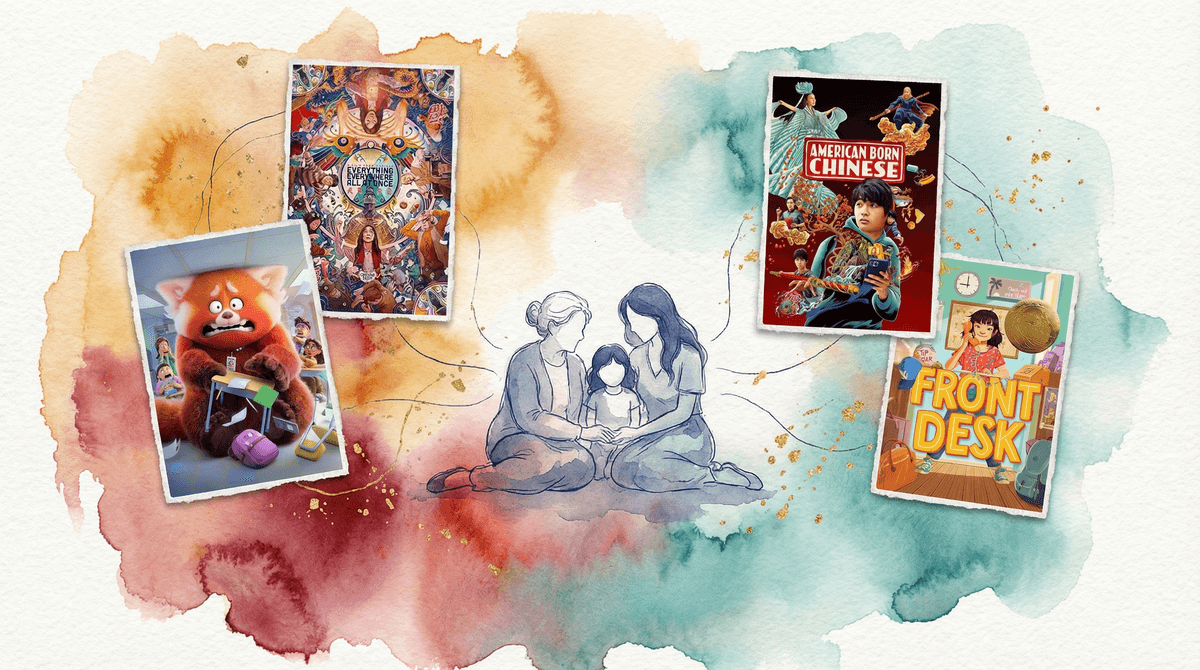
Look, we're talking about films, shows, and books that explore what it means to grow up between two worlds—the culture your family brought with them and the one you're growing up in. These are stories about kids translating at parent-teacher conferences, grandparents who don't speak English living in your house, the specific pressure of being a "model minority," and the complicated feelings of being too Asian for some spaces and not Asian enough for others.
This isn't just one story. It's Everything Everywhere All at Once, Turning Red, The Farewell, Pachinko, American Born Chinese, and dozens of books like Front Desk by Kelly Yang or The Astonishing Color of After by Emily X.R. Pan. It's stories where the main conflict isn't just "defeating the bad guy" but navigating family expectations, cultural identity, and figuring out who you are when you're living in the hyphen of "Asian-American."
Here's the thing: representation matters, but nuanced representation matters more. For decades, Asian characters in mainstream media were either martial arts masters, tech geniuses, or the nerdy sidekick. That's finally changing, and kids are getting to see Asian families as fully realized, complicated, messy, and real.
For Asian American kids, these stories can be incredibly validating. Finally seeing your specific family dynamics on screen—the guilt trips, the high expectations, the way your mom saves every plastic container—it hits different. It's the "wait, other people live like this too?" moment that can be genuinely profound.
For non-Asian kids, these stories build empathy and understanding. They're windows into experiences that might be very different from their own, which is exactly what good storytelling should do.
And honestly? A lot of these stories are just really good. Everything Everywhere All at Once won Best Picture for a reason. Turning Red captured the universal experience of being a tween girl while being deeply specific about Chinese-Canadian identity. These aren't "eat your vegetables" diversity content—they're compelling stories that happen to center Asian immigrant experiences.
Ages 6-9:
- Turning Red (PG) - Yes, it's about getting your period, but it's also about the pressure of being a "good daughter" and honoring your family while becoming yourself
- The Many Colors of Harpreet Singh by Supriya Kelkar - Picture book about a Sikh boy and his patka
- Raya and the Last Dragon - More fantasy than immigrant story, but Southeast Asian representation matters
Ages 10-13:
- American Born Chinese on Disney+ - The show adaptation is excellent and handles identity and mythology beautifully
- Front Desk series by Kelly Yang - Middle grade books about a girl whose family manages a motel, dealing with racism and economic hardship
- Starfish by Lisa Fipps - Not specifically about Asian identity, but features a biracial protagonist dealing with body image and family
Ages 14+:
- Everything Everywhere All at Once (R) - Genuinely one of the best films about mother-daughter relationships and immigrant sacrifice ever made. Yes, it's rated R, but mostly for language and some violence. Worth a conversation about whether your teen is ready.
- The Farewell (PG) - Stunning film about a Chinese family deciding not to tell their grandmother she's dying. Raises incredible questions about cultural differences in handling illness and death.
- Pachinko on Apple TV+ - Multi-generational story of a Korean family in Japan. Beautiful, heartbreaking, and mature.
- The Astonishing Color of After by Emily X.R. Pan - YA novel about grief, mental health, and Taiwanese-American identity
These stories can bring up big feelings. If your kid is Asian American, watching these might surface emotions they haven't had words for yet. The pressure to be perfect. The feeling of being caught between cultures. The specific kind of guilt that comes with disappointing your parents. Be ready for those conversations.
The "model minority" myth is harmful. Many of these stories explicitly address this—the expectation that Asian kids should be quiet, studious, and high-achieving. It's a stereotype that hurts Asian kids (by creating impossible pressure) and other minority groups (by being used as a wedge). Understanding this myth helps you talk about these stories with more depth.
Immigrant sacrifice is a heavy theme. A lot of these narratives center on parents who gave up everything for their kids to have better opportunities. That's real, and it's important, but it can also create enormous pressure on kids to "make it worth it." If your child seems overwhelmed by these themes, talk about it. The goal isn't to burden kids with debt to their parents—it's to build understanding and empathy.
Not all Asian experiences are the same. Chinese, Korean, Japanese, Filipino, Vietnamese, Indian, Pakistani, Bangladeshi—these are all distinct cultures with different histories, languages, and immigrant experiences. One story can't represent everyone. Use these as starting points for broader conversations about diversity within Asian communities.
Ask open-ended questions:
- "What did you notice about how the family talked to each other?"
- "Have you ever felt caught between two different expectations?"
- "What do you think the main character wanted most?"
Share your own experiences (if relevant). If you're an immigrant or child of immigrants, this is a great opportunity to share your story. If you're not, this is a chance to listen and learn alongside your kid.
Don't force the lesson. Sometimes a kid just wants to watch Turning Red because the animation is beautiful and the red panda is cool. That's fine! The representation is doing its work even without a deep discussion afterward.
Connect to current events thoughtfully. Anti-Asian hate crimes have risen significantly in recent years. These stories can be part of building empathy and understanding, but be age-appropriate and sensitive about connecting fiction to real-world violence.
Asian immigrant family stories aren't a genre—they're a long-overdue expansion of whose stories get told in mainstream media. They're giving Asian American kids mirrors to see themselves and giving all kids windows into experiences that build empathy and understanding.
The best part? A lot of these stories are just genuinely excellent. You're not sacrificing entertainment value for representation—you're getting both.
Start with one movie or book that feels right for your family's age and interests. Watch or read it together. See what conversations emerge. And remember: you don't need to have all the answers. Sometimes the most valuable thing is just creating space for your kids to process what they're seeing and feeling.
Explore more films and shows about identity and belonging or find age-appropriate books about diverse experiences.