

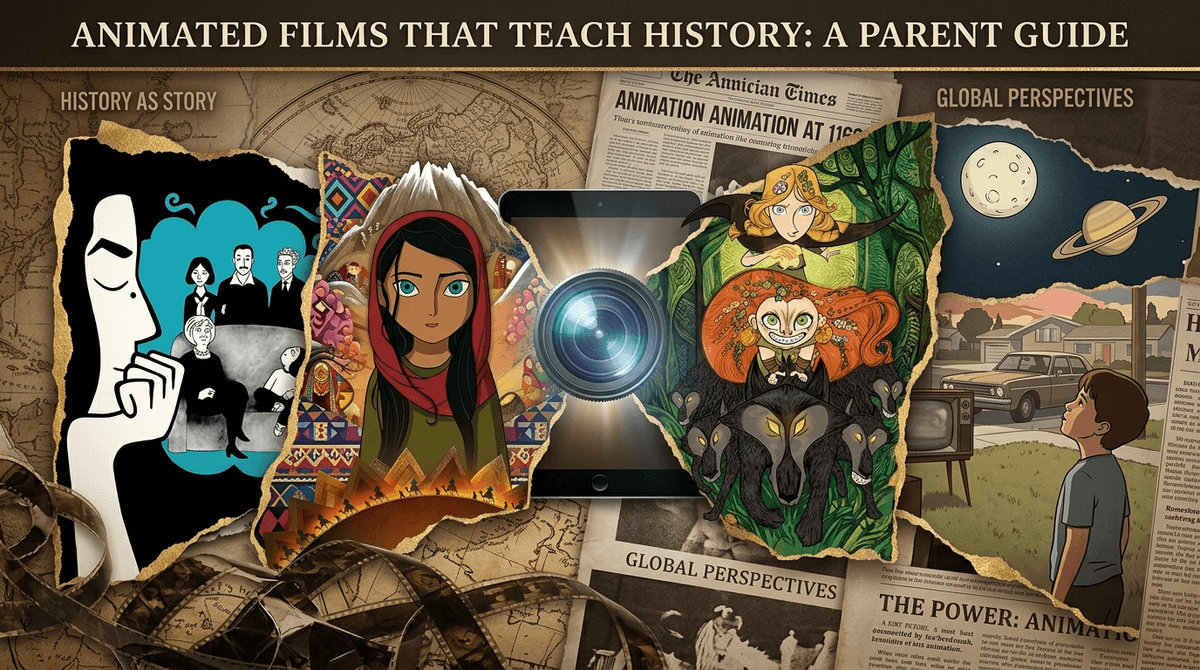
TL;DR: If you’re tired of the "brain rot" cycle of YouTube shorts and want to actually use screen time for something that sticks, skip the dry documentaries. These five films are the heavy hitters for turning history into something your kids will actually care about:
- For the 20th Century: Persepolis (Ages 12+)
- For Modern Conflict: The Breadwinner (Ages 11+)
- For the Space Race: Apollo 10 1/2 (Ages 10+)
- For European Folklore/History: Wolfwalkers (Ages 7+)
- For the Immigrant Experience: An American Tail (Ages 6+)
I get it. The second you say the word "educational," most kids' eyes glaze over faster than if you just told them Roblox was down for maintenance. We’re living in an era where "history" to a ten-year-old might just mean "that thing that happened before TikTok existed."
But here’s the thing: animation has this weirdly specific superpower. It can take massive, heavy, "how-do-I-even-explain-this-to-a-child" historical moments and turn them into something visual and visceral. It’s the difference between reading a paragraph about the Iranian Revolution and actually seeing a young girl try to buy an Iron Maiden cassette on the black market in Tehran.
We’re seeing a lot of parents in the Screenwise community moving toward "intentional co-viewing." Instead of just handing over the iPad so you can finish the dishes in peace (we’ve all been there, no judgment), these movies are designed to be watched together. They spark the kind of dinner-table questions that make you realize your kid is actually a lot deeper than their "Skibidi Toilet" obsession suggests.
Kids are visual learners, but more importantly, they are empathy-driven. A textbook tells you that the Taliban took over Afghanistan in the 90s. An animated film like The Breadwinner shows you a girl cutting her hair so she can buy bread for her family because women aren't allowed outside alone.
That stays with a kid. It moves history out of the "boring facts" category and into the "real people" category. Plus, animation allows for a bit of "magic realism" that helps soften the blow of some of history's darker corners without lying about them.
Learn more about how to choose age-appropriate historical media
If you have a middle schooler or a teen, this is the gold standard. It’s based on Marjane Satrapi’s graphic novel about growing up during the Iranian Revolution. It’s black and white, it’s stylish, and it’s incredibly funny despite being about, well, a revolution and a war. It captures that specific teenage rebellion—wanting to wear Nikes and listen to punk rock—while the world around you is becoming increasingly fundamentalist. It’s a perfect bridge to talk about religious freedom, government overreach, and what it’s like to be an outsider. Ages: 12+ (Some language and heavy themes).
Produced by Angelina Jolie and the studio behind Wolfwalkers, this movie is gorgeous but it doesn’t pull punches. It’s set in Kabul, Afghanistan, under Taliban rule. Parvana is an 11-year-old girl who has to dress as a boy to support her family after her father is arrested. It’s a masterclass in storytelling and a great way to talk about gender roles and the cost of conflict. It’s intense, so maybe save this for a night when you’re ready to actually talk afterward. Ages: 11+
Richard Linklater (the guy who did School of Rock) made this "love letter" to 1969 Houston. It’s rotoscoped (meaning they filmed live actors and then animated over them), which gives it a nostalgic, dreamlike feel. While it has a fantasy plot about a kid being recruited by NASA, the real meat is the "history of the everyday." It shows what it was like to grow up in the 60s—the lack of seatbelts, the constant TV news about Vietnam, and the collective obsession with the Moon Landing. It’s a "vibes" movie that teaches history through atmosphere. Ages: 10+
Don't let the "cute mice" fool you. This is one of the best depictions of the late 19th-century immigrant experience in New York City ever put to film. Fievel Mousekewitz is a Russian-Jewish mouse fleeing "cats" (a very thin metaphor for Cossack pogroms). It covers the sweatshops, the crowded tenements of the Lower East Side, and the crushing reality that the "streets paved with gold" were actually just mud and hard work. It’s a classic for a reason. Ages: 6+
On the surface, it’s a fantasy about girls who can turn into wolves. But look closer: it’s actually about the English colonization of Ireland in the 1600s. The "villain" is Lord Protector Oliver Cromwell (though he’s just called the Lord Protector in the film). It’s a stunning visual exploration of the conflict between "civilization" (the English) and "wildness" (the Irish), and how the forest was literally cleared to exert control over the people. It’s the most beautiful thing you’ll watch all year, period. Ages: 7+
This one is for the older kids—high schoolers, mostly. It’s a documentary, but it’s animated to protect the identity of the subject, Amin, who fled Afghanistan as a child. It’s a gripping, heart-wrenching look at the modern refugee crisis. It’s about the 80s and 90s, but it feels incredibly current. If your teen is always on TikTok seeing snippets of world news, this provides the deep-dive context they’re missing. Ages: 14+
Check out our guide on how to talk to teens about global news
When we're talking about history, we're often talking about the worst things humans have done to each other.
- The "Sadness" Factor: Movies like Grave of the Fireflies (about WWII Japan) are historically significant but are also famously some of the most depressing films ever made. I wouldn't recommend Grave of the Fireflies for a casual Friday night unless you want everyone in the house crying for three days. Know your kid’s emotional "red line."
- Visual Intensity: Animation can make violence feel less "real," but for some kids, it actually makes it more haunting. The Breadwinner has some scenes of physical punishment that might be a lot for sensitive 8-year-olds.
- Complexity: A movie like Persepolis requires some baseline knowledge of what a "Shah" is or why people were protesting. You might want to do a 2-minute "Wikipedia intro" before you hit play.
The goal isn't to quiz them on dates afterward. (Please, don't be that parent. No one likes a post-movie pop quiz.) The goal is to ask questions that bridge the gap between "then" and "now."
- The "What would you do?" question: "If you were Parvana in The Breadwinner, do you think you’d be brave enough to go outside?"
- The "What's different?" question: "In Apollo 10 1/2, did you notice how they didn't have cell phones? How do you think they found their friends at the park?"
- The "Why does this matter?" question: "Why do you think the English in Wolfwalkers were so afraid of the forest?"
If they start comparing the movie to something they saw on YouTube or a game they play like Minecraft, go with it. Those connections are where the learning actually happens.
Find movies that spark dinner table debates
We spend so much time worrying about "screen time" as a monolithic "bad thing." But screen time is just a delivery system. If the delivery system is giving them Persepolis instead of a 10-hour loop of "Ohio" memes, you’re winning.
History isn't just a list of names and dates; it's the story of how we got here. These films make those stories stick in a way that a textbook never will. So, grab some popcorn, dim the lights, and prepare for some questions that are a lot more interesting than "Can I have more Robux?"
Next Steps:
- Pick one movie from the list above based on your kid's age.
- Check where it's streaming (most are on Netflix, Disney+, or Apple TV).
- Watch it together. Seriously. Don't just "drop and go." The conversation is the whole point.
- If they're into a specific era, look for a book to follow up, like The Diary of a Young Girl by Anne Frank.