

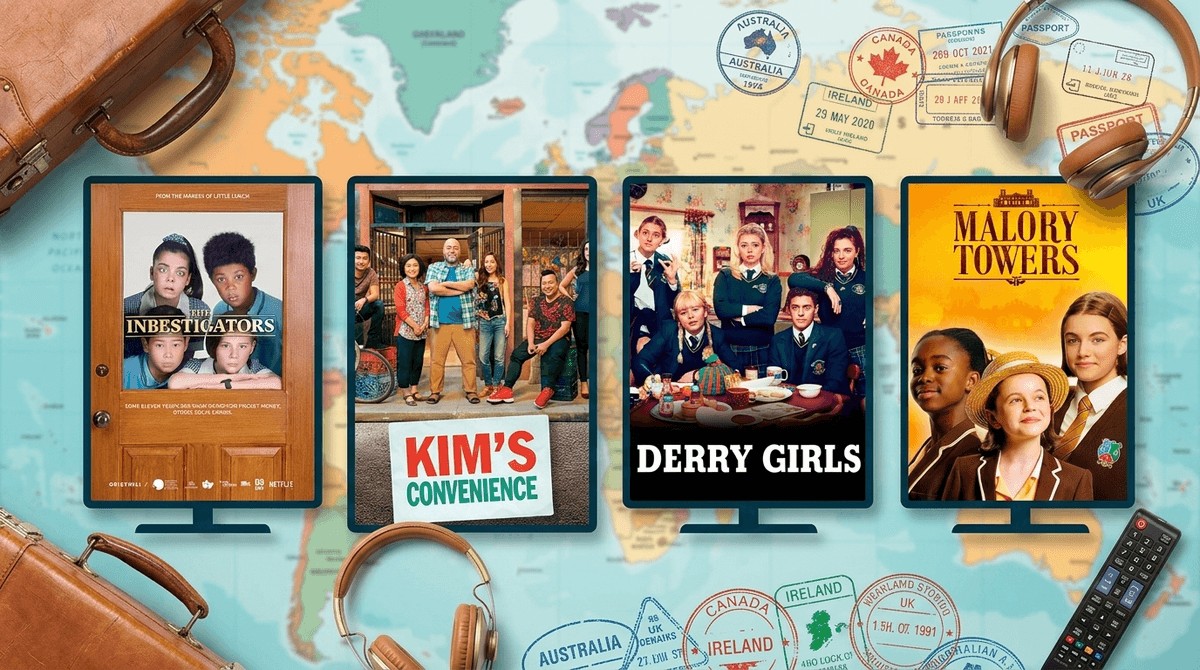
TL;DR: The Quick List If your living room has been on a 24/7 loop of the same three Disney Channel sitcoms and you’re starting to find the laugh tracks physically painful, it’s time to look abroad. International sitcoms offer a much-needed break from the "American Tween" formula while sneaking in some global perspective.
- Best for Elementary (6-9): The InBESTigators (Australia) and Little Lunch (Australia).
- Best for Tweens (10-12): Hardball (Australia) and Malory Towers (UK/Canada).
- Best for Families/Teens (13+): Kim's Convenience (Canada) and Derry Girls (Ireland).
Get an international watchlist based on your kid's favorite US shows
We’ve all been there. You’re in the kitchen, and from the living room, you hear that specific brand of high-pitched, over-acted "Oh no he didn't!" dialogue followed by a burst of canned laughter. Most American kids' sitcoms follow a very specific, very loud blueprint.
But there is a whole world of "Passport TV" that feels grounded, genuinely funny, and—this is the best part—doesn’t feel like total brain rot. International shows, particularly from Australia, Canada, and the UK, tend to treat kids like actual humans rather than hyperactive caricatures. They deal with friendship, failure, and family dynamics in ways that feel a lot more "real" than what we usually see on domestic networks.
Plus, if you have a kid who thinks everything is "mid" or "Ohio" (don't ask, or do—it basically means weird/bad), showing them a show where the slang is actually different can be a total reset.
Australia is currently the world leader in "shows that parents actually like watching with their kids." We all know Bluey is the GOAT, but the live-action stuff is just as good.
Think Sherlock Holmes but in a backyard shed. Four kids start a detective agency to solve "crimes" at their school—like who stole a solar-powered cricket or why the bake sale money is missing. It’s smart, the dry humor is top-tier, and it actually rewards kids for paying attention to logic. It’s the opposite of "loud" TV.
This is a mockumentary (think The Office) set entirely during the 15-minute snack break at an Australian primary school. It captures the absolute high-stakes drama of the playground—who gets the last piece of cake, the rules of tag, the tragedy of a dropped sandwich. It’s hilarious because it treats small kid problems with the gravity they feel in the moment.
When Mikey moves from New Zealand to Western Sydney, he discovers the cutthroat world of "handball" (the schoolyard game, not the Olympic sport). It’s a classic underdog story with great diverse representation and a heart of gold. It’s about grit and finding your "crew."
This is the age where kids start to pull away from "little kid" shows but aren't quite ready for the heavy themes of teen dramas.
While technically a "grown-up" sitcom that aired on CBC in Canada, it is remarkably family-friendly. It follows a Korean-Canadian family running a corner store in Toronto. The "Appa" and "Umma" characters are iconic. It deals with the immigrant experience, generational gaps, and church culture with a lot of love and zero preachiness. There’s some mild "sitcom" romance and occasional swearing, but it’s a great co-viewing choice.
Based on the classic Enid Blyton books, this is set at a girls' boarding school in post-WWII England. If your kid likes Harry Potter for the school vibes but doesn't need the magic, this is it. It’s wholesome but focuses heavily on character, integrity, and female friendship. It’s a "period piece" that doesn't feel stuffy.
Learn more about why Malory Towers is a great "gentle" show for tweens
If you have a high schooler, you know they’re probably already watching stuff that’s a bit more mature. These picks are brilliant but come with a "check the rating" warning for language.
Set in Northern Ireland during the 1990s (The Troubles), it follows a group of girls (and one "wee English fella") navigating Catholic high school. It is quite possibly the funniest show on Netflix. Parental Note: The language is heavy. They use the "F-word" like it’s punctuation. However, the themes of friendship and the absurdity of living a "normal" teenage life in a conflict zone are profound. It’s a history lesson hidden in a riotous comedy.
Yes, it’s Canadian! Most people forget that. While it starts a bit cynical, it becomes one of the most heartwarming shows ever made. It’s a masterclass in character growth and LGBTQ+ inclusion. Like Kim's Convenience, it’s an adult show that many teens will find hilarious and deeply moving.
You might be wondering, "Is a sitcom just a sitcom?" Not really. When we talk about "Digital Wellness," we’re often talking about the quality of the content, not just the minutes on the clock.
- Perspective Shifting: Seeing a school in Melbourne or a corner store in Toronto helps kids realize that their "normal" isn't the only "normal." It builds empathy and global curiosity.
- Vocabulary & Accents: It’s actually great for their brains to process different dialects and slang. (Just be prepared for them to start saying "reckon" or "mate" for a week).
- The Subtitle Secret: If you’re watching a non-English show (like the excellent French show Call My Agent for older teens), subtitles are a "stealth literacy" hack. They’re reading while they’re watching. Even with English-language international shows, turning on the captions helps kids parse unfamiliar accents.
Before you hit play, here are a few things to keep in mind:
- Pacing: International shows often have a slower "burn" than American ones. There are fewer jump cuts and less screaming. Your kid might find it "boring" for the first ten minutes. Encourage them to give it one full episode.
- Humor Styles: British and Australian humor is often drier and more self-deprecating. There’s less "look at me, I’m funny" and more situational awkwardness.
- Ratings vary: A "TV-PG" in the UK or Australia might allow for a bit more "colorful" language than a "TV-PG" in the US. Always do a quick vibe check first.
If you’re watching these together, use them as a springboard:
- "What’s different about their school compared to yours?"
- "Did you understand that joke? Why do you think they found that funny?"
- "I noticed they don't have school lockers there—everyone just carries their bags. That’s wild, right?"
Check out our guide on starting conversations about media with your kids
We live in a global content economy, yet most kids stay stuck in the same domestic "content silos." Breaking out of the Disney/Nickelodeon bubble isn't just about avoiding annoying theme songs—it's about showing your kids that humor is a universal language.
Start with The InBESTigators. It’s the easiest "win" for almost any age group. If they like that, move on to Hardball.
- Pick a "Passport Night": Once a week, watch a show from a different country.
- Check your settings: Make sure your Netflix or Hulu profiles are set up to allow the ratings for these shows.
- Use the Chatbot: If your kid has a very specific interest (like "soccer" or "baking"), Get an international recommendation in that niche.