

TL;DR
If you want the best educational bang for your buck (literally, because it’s free), Khan Academy Kids is the gold standard. It’s clean, research-backed, and doesn't use manipulative "poverty loops" to keep kids clicking. ABCmouse is the heavy hitter with a massive library, but the subscription cost and the "digital sticker book" reward system can feel more like a chore than a classroom. For a more open-ended, creative vibe, skip the drills and check out Pok Pok Play Room or Toca Boca World.
We’ve all been there: standing in the kitchen, trying to get dinner started, while a toddler or local preschooler is vibrating at a frequency only dogs can hear because they want to watch "Skibidi Toilet" on YouTube. In a moment of parental "intentionality" (and survival), we think, If they’re going to be on a screen, they might as well be learning their phonics, right?
Enter the EdTech giants. You’ve seen the ads. You’ve probably been targeted by the ABCmouse commercials during every episode of Bluey you’ve ever watched. But before you hand over your credit card for another monthly subscription, let’s talk about what’s actually happening behind the glass.
The edtech landscape for the under-8 crowd is a wild mix of genuine pedagogical genius and "educational" apps that are basically just Roblox with a thin coat of math paint.
The Subscription Powerhouse
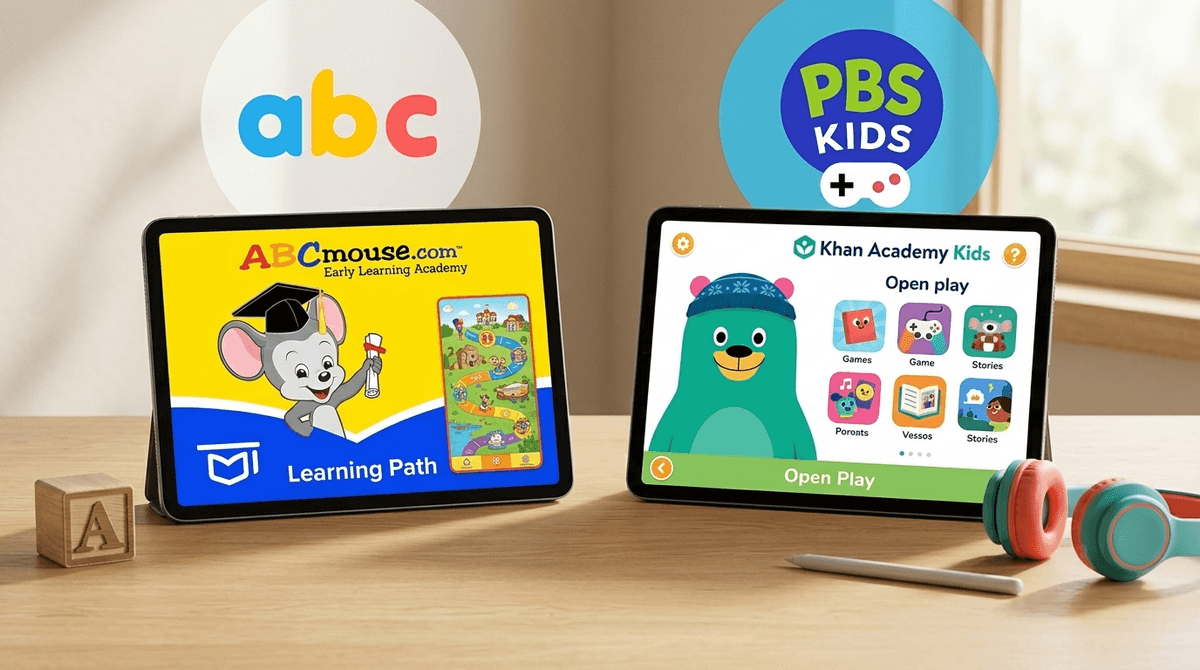
ABCmouse is the "incumbent." It’s been around forever, and its library is massive—over 10,000 activities. It uses a "Step-by-Step Learning Path," which is great for parents who want to set it and forget it.
The Good: It covers everything—reading, math, science, art. If your child thrives on structure and "leveling up," the path is very clear. It feels like a complete curriculum.
The No-BS Take: The user interface looks like it hasn't been updated since the first iPhone launched. It’s cluttered, and the "Ticket" system is a double-edged sword. Kids earn tickets for completing lessons, which they can spend on items for their virtual room or avatar. While this "gamification" keeps them coming back, it can also lead to "click-farming" where the kid is just rushing through a phonics game to get enough tickets for a virtual hamster. It’s the gateway drug to Robux culture.

The Non-Profit Hero
If ABCmouse is the flashy private school with a high tuition, Khan Academy Kids is the elite Montessori school that someone decided to make free for everyone.
The Good: It is 100% free. No ads, no subscriptions, no "buy this expansion pack to see the rest of the alphabet." The quality of the activities—developed with experts at Stanford—is arguably higher than anything else on the market. The characters (like Kodi the Bear) are actually charming rather than grating.
The No-BS Take: Because it doesn't rely on a "hamster wheel" of rewards, some kids might find it "boring" compared to the high-stimulus environment of other apps. It requires a bit more intrinsic motivation, or a parent sitting nearby to say, "Wow, look at that subtraction!"
Check out our full guide on why Khan Academy Kids is the GOAT
The mistake most of us make is thinking the choice is only between the two big names. The "Learning App" category is actually a spectrum ranging from "Digital Worksheet" to "Creative Sandbox."
This is the ultimate "safe" harbor. If your kid loves Daniel Tiger's Neighborhood or Wild Kratts, these games are fantastic. They are designed to teach social-emotional skills as much as academics. It’s free, it’s high-quality, and it’s the least likely to make your kid throw the iPad across the room in a fit of "Ohio" rage.
If your main goal is literacy, this is a sleeper hit. It uses the same addictive mechanics as the main Duolingo app but for learning to read. It’s punchy, fast-paced, and very effective for kids who have short attention spans.
The "Old Reliable" of the classroom. Most kindergarten teachers use Starfall. It’s not pretty, and the website looks like it belongs in 1998, but for teaching the relationship between letters and sounds (phonics), it is incredibly effective.
Once your kid hits 1st or 2nd grade, they will hear about Prodigy. It’s basically a fantasy RPG where you have to solve math problems to cast spells. Warning: This app is the king of "upselling." The free version is fine, but they will constantly nag your kid to get a "Premium Membership" to get better gear and pets. It can feel a bit predatory, but hey, if it gets them to do 50 multiplication problems on a Saturday, maybe it’s a win?
When we look at these apps, we need to ask: Is my kid actually learning, or are they just performing tasks to get a digital reward?
A lot of edtech is what I call "Digital Sticker Books." The kid clicks a button, a star pops up, a noise plays, and they move on. Their brain is getting a hit of dopamine, but they aren't actually processing the information.
- Active Learning: The app asks the child to draw a letter, solve a puzzle, or make a choice that affects the outcome. (Khan Academy Kids and Endless Reader are great at this.)
- Passive Learning: The app plays a video and then asks the kid to click the "A" three times. (ABCmouse has more of this than I’d like.)
- Ages 2-4: Stick to Khan Academy Kids or PBS Kids Games. At this age, "learning" should feel like play, not a curriculum. Avoid anything with heavy "ticket" or "coin" systems.
- Ages 5-6 (The Literacy Push): This is where Duolingo ABC and Starfall shine. If you want a deep library, Epic! is a must-have for digital books.
- Ages 7-8: They’re likely aging out of the "cute" apps. This is where Prodigy Math or even introductory coding on Scratch Jr. comes into play.
Even "educational" apps are businesses. ABCmouse is owned by Age of Learning, Inc., a massive for-profit company. They are very good at marketing to your parental guilt.
When you use a "free" app that isn't a non-profit (like Khan Academy Kids or PBS Kids), you have to ask how they’re making money. Often, it’s through data collection or aggressive upselling. Always check the privacy settings and, if possible, play the app yourself for 10 minutes. If you find yourself annoyed by the "Buy Now!" pop-ups, your kid will be too—or worse, they’ll be convinced they need it.
If you are looking for a solid, all-in-one learning tool and you don't want to think about it, download Khan Academy Kids. It’s the closest thing to a "perfect" edtech app we have right now.
If your child is specifically struggling in one area (like phonics) and needs a very rigid, incentivized path to stay focused, ABCmouse is a fine tool—just be prepared to manage the "I want more tickets" conversations and the monthly hit to your bank account.
But remember: no app, no matter how "educational," replaces 15 minutes of reading a physical book together or playing a "boardgame" like First Orchard. Use these tools as the "digital babysitter with a PhD" they are meant to be, but don't feel like you're failing if your kid would rather build a tower in Toca Boca World than do digital worksheets.
- Audit your subscriptions. Are you paying for ABCmouse but your kid only opens it once a month? Cancel it.
- Download Khan Academy Kids and set up a profile. It’s free, so there’s zero risk.
- Talk to your kid. Ask them why they like a certain app. If the answer is "I want to get the gold hat for my hamster," you know you’re dealing with a reward-loop issue rather than a learning success.
Take the Screenwise Survey to see how your family's edtech use compares to your community