

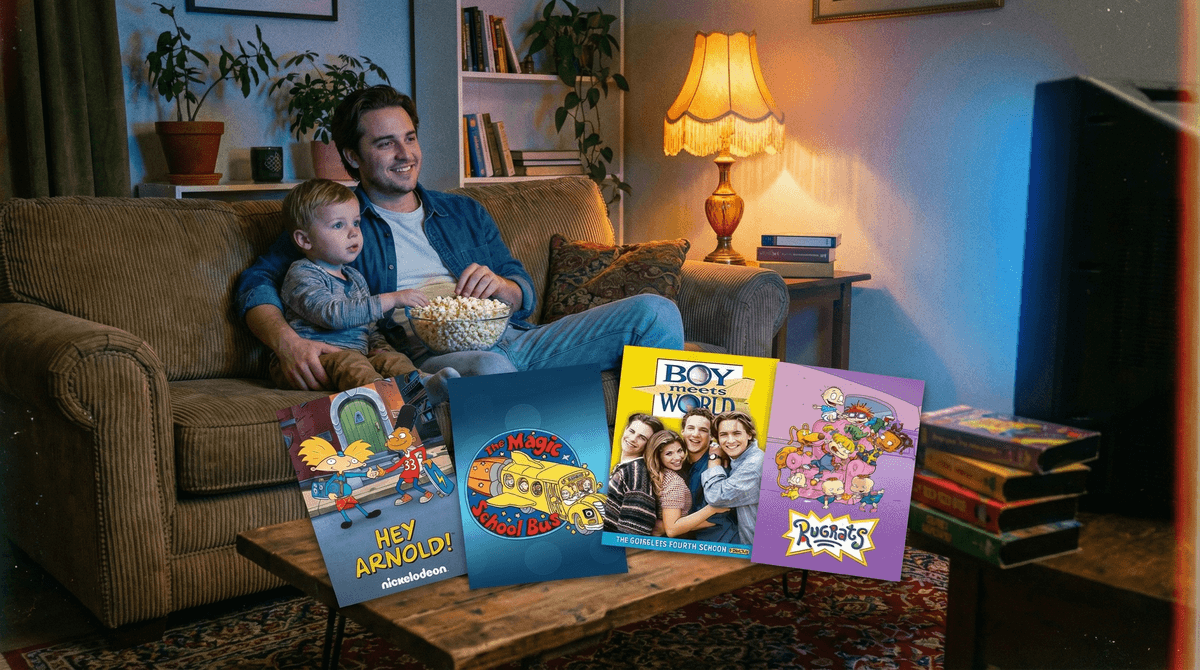
Look, we all have that moment. You're scrolling through streaming services, your kid is asking for "something new," and suddenly you see it: Hey Arnold! or The Magic School Bus or Boy Meets World. That warm fuzzy feeling hits. "I LOVED this show!" you think. "Let's watch it together!"
But then the doubt creeps in. Was this actually... good? Or was it just good because I was 9 and everything was good? Will my kid think I'm ancient? More importantly: are there jokes in here I didn't understand as a kid that are going to make this very awkward now?
This is your guide to navigating 90s TV nostalgia with your actual 2025 children. Some shows genuinely hold up. Some need context. And some—let's be honest—should stay in your memory where they're still perfect.
The Magic School Bus (Ages 5-10)
Verdict: Still excellent, and arguably better now
The Magic School Bus is legitimately good television. Ms. Frizzle is still iconic, the science is still solid (mostly), and the animation style that felt cutting-edge in 1994 now has a retro charm that kids actually think is cool. The educational content holds up because, you know, photosynthesis hasn't changed.
The only dated part? The technology episodes feel like historical documents. Watching them learn about CD-ROMs is unintentionally hilarious.
Pro tip: There's also a newer Netflix reboot (The Magic School Bus Rides Again) if you want updated animation, but the original has more personality.
Avatar: The Last Airbender (Ages 8+)
Verdict: Better than you remember
Yes, it premiered in 2005, but it's spiritually a 90s show, and honestly? Avatar: The Last Airbender might be the best "kids' show" ever made. Period. It deals with war, genocide, colonialism, disability, and found family in ways that work for kids AND adults.
This is the rare show where you'll both be genuinely invested. Your kid will love the bending and humor. You'll be crying about Uncle Iroh. Again.
The representation and cultural respect (it's based on Asian cultures, not just vaguely "Eastern") actually holds up to modern scrutiny. This is a rewatch that makes you look like a parenting genius.
Hey Arnold! (Ages 8-12)
Verdict: Surprisingly deep, occasionally needs a conversation
Hey Arnold! is way more melancholic than you remember. This show dealt with poverty, absent parents, gentrification, and urban decay in ways that were subtle enough for kids but real enough to matter.
It holds up because it was willing to be sad sometimes. Arnold's helping Stoop Kid or Mr. Hyunh find his daughter? Still hits. The football head jokes? Still funny.
Parent heads up: Some episodes have casual 90s attitudes about things like bullying (Helga's behavior toward Arnold would not fly now) and there are occasional outdated gender dynamics. These make for good conversation starters about how things have changed.
Batman: The Animated Series (Ages 10+)
Verdict: Legitimately sophisticated
Batman: The Animated Series was made for kids but written for adults, and it shows. The art deco aesthetic is timeless, the voice acting (hello, Mark Hamill as Joker) is phenomenal, and the storytelling is genuinely noir.
This show introduced Harley Quinn to the world. It won Emmys. It's darker than most modern kids' shows, so know your kid's tolerance for intensity, but it's not gratuitously violent—just atmospheric and sometimes genuinely scary.
Saved by the Bell (Ages 10+)
Verdict: A time capsule that needs context
Saved by the Bell is aggressively 90s in ways that are both charming and cringe. Zack Morris is, by modern standards, kind of a manipulative nightmare. The "very special episodes" about serious topics are hilariously heavy-handed.
But here's the thing: watching it WITH your kid and talking about how things have changed? That can actually be valuable. "Why do you think they thought this was okay?" is a better conversation than pretending the 90s were perfect.
Real talk: The treatment of female characters and the handful of episodes dealing with race are... not great. The "Jessie's addiction" caffeine pill episode is unintentionally comedy gold now, but the casual sexism isn't.
Rugrats (Ages 4-8)
Verdict: Still fun, but louder than you remember
Rugrats holds up pretty well for younger kids. The baby perspective is still creative, Angelica is still a perfect villain, and the humor works.
But: This show is LOUD. Like, aggressively loud. The color palette is intense. If you're overstimulated by modern kids' content, Rugrats might actually be worse than you remember. Also, some of the parent characters (looking at you, Didi's new-age parenting) are played for laughs in ways that feel mean now.
Boy Meets World (Ages 11+)
Verdict: Wholesome core, dated execution
Boy Meets World genuinely tried to tackle real issues—class differences, family struggles, growing up—and the Cory/Topanga/Shawn dynamic still works.
However: The show's treatment of women beyond Topanga is rough. The gay jokes haven't aged well. Some of the "comedy" around Topanga's appearance and Eric's later seasons are just... uncomfortable now.
Mr. Feeny, though? Still a legend. "Dream. Try. Do good." That part holds up.
Ren & Stimpy
Verdict: Nope
Remember thinking this was hilarious? It was also deeply, deeply inappropriate in ways that flew under the radar. The creator's later revelations about the show's subtext make it even worse. This one stays in the past.
Rocko's Modern Life
Verdict: For you, not for them (yet)
Rocko's Modern Life was always adult humor in a kids' show wrapper. Watching it now, you'll catch SO many jokes that went over your head. It's actually pretty funny! But it's not really for kids, despite being a cartoon. Save this for your own nostalgia watch after bedtime.
Most 90s live-action kids' shows (All That, Kenan & Kel, Are You Afraid of the Dark?) fall into a weird category: they're fun time capsules, but the pacing feels slow to kids raised on YouTube. The sketch comedy doesn't hit the same way. The "scary" stories are quaint.
They're not bad to watch together, but don't be surprised if your kid isn't as enchanted as you were. Attention spans and comedy styles have genuinely evolved.
The best 90s shows to rewatch with your kids are the ones that:
- Had actual substance beyond just being colorful and loud
- Treated kids as intelligent viewers who could handle complexity
- Focused on character and story rather than just gags
Shows like Avatar: The Last Airbender, The Magic School Bus, and Batman: The Animated Series hold up because they were actually good, not just because we were kids with low standards.
For everything else? Watch an episode by yourself first. You'll know pretty quickly if it's "charming retro" or "yikes, did we really watch this?"
The co-watching strategy: Start with one episode of something you loved. Watch your kid's reaction more than the screen. If they're genuinely engaged (not just being polite), keep going. If they're bored, it's okay to admit that maybe this one was better in your memory.
Use it as a conversation starter: The dated parts of 90s TV are actually useful for talking about how culture changes, what we've learned, and why representation matters. "Why do you think there were so few girls in leadership roles in these shows?" is a better question than trying to defend it.
Balance nostalgia with new: For every 90s show you introduce, let your kid show you something from their world. Maybe they'll get why you loved Hey Arnold!, and maybe you'll discover that Bluey is actually the superior kids' show (because it is).
The goal isn't to prove that "your generation's stuff was better." It's to share a piece of your childhood while acknowledging that good storytelling is timeless—and some things are better left in 1997.
Now if you'll excuse me, I'm going to go rewatch the Avatar finale and absolutely not cry about it.