

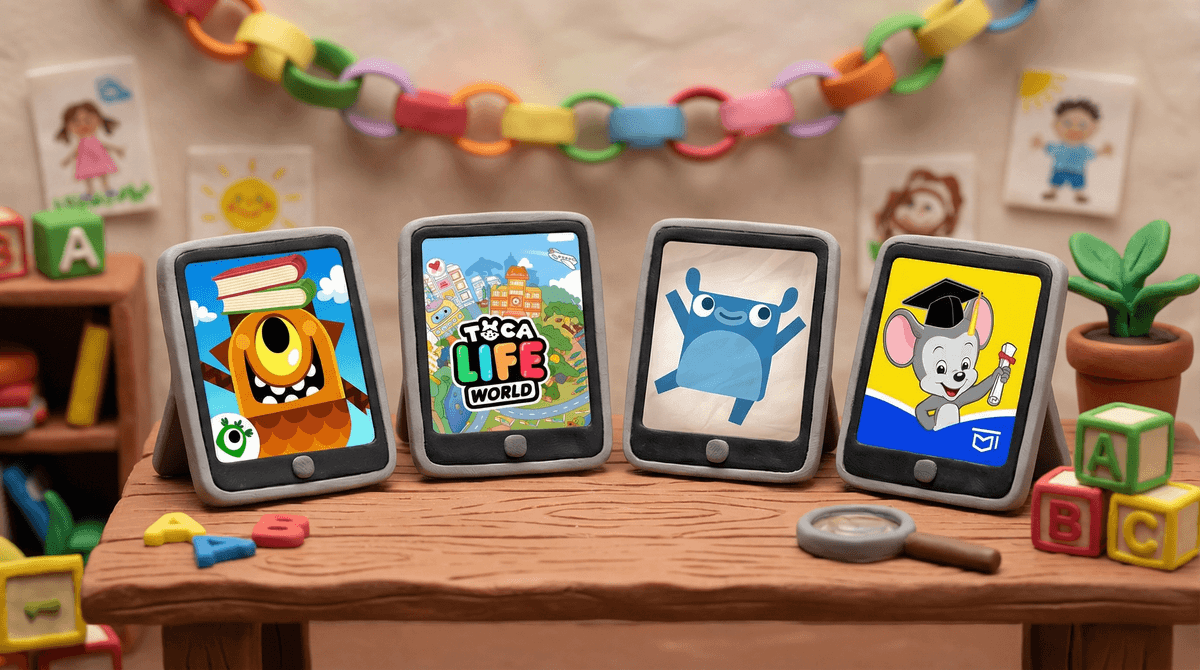
8 Teacher-Recommended Games to Help Your Kindergartener Thrive
Look, I get it. You're trying to figure out if screen time can actually help your kindergartener learn to read instead of just teaching them to yell "SKIBIDI" at random moments. The good news? There are actually some legitimately excellent educational games out there that teachers recommend—and that kids genuinely enjoy playing.
The key word here is purposeful. We're not talking about digital babysitting or games that are basically just flashy ads for in-app purchases. We're talking about games that build real skills: phonics, number sense, problem-solving, and that magical thing called "executive function" that helps kids focus and follow multi-step directions.
Kindergarten brains are wired for play-based learning. They're not sitting still for lectures—they're learning by doing, experimenting, and yes, sometimes failing spectacularly. Good educational games tap into this by making learning feel like discovery rather than drill-and-kill worksheets.
The research backs this up: interactive games that provide immediate feedback and adjust difficulty based on performance can genuinely support early literacy and math development. The trick is finding games that are actually designed with learning science in mind, not just slapping "educational" on a label and calling it a day.
Ages: 3-6 | Skills: Vocabulary, Letter Recognition, Phonics
This one's a classic for a reason. Kids drag letters into place to spell words, then watch delightful animations that demonstrate what each word means. No ads, no in-app purchases, no pressure. Just pure vocabulary building with adorable monster characters. Teachers love it because it builds phonemic awareness—the foundation of reading—without feeling like work.
Parent tip: This is perfect for that 15-minute window while you're making dinner. It's genuinely engaging enough that kids will stick with it.
2. Starfall
Ages: 4-7 | Skills: Reading, Phonics, Math Basics
Starfall has been around forever in internet years (since 2002), and it's still going strong because it works. The free version offers tons of phonics activities, sight word practice, and early math games. The paid membership ($35/year) unlocks more content, but honestly, the free stuff is plenty for most kindergarteners.
Teachers appreciate that it follows a systematic phonics approach—the kind that actually teaches kids how to decode words rather than just memorizing them. Plus, it's designed to be used independently once kids get the hang of it.
Ages: 3-7 | Skills: Phonics, Reading
This game was developed by the Usborne Foundation with reading experts, and it shows. Kids create a monster character and go on adventures while practicing phonics skills from letter sounds all the way through to full sentences. It covers the entire early reading journey in a genuinely fun way.
The first game is free, and it's substantial—we're talking hours of content. Teachers recommend it because it aligns with how reading is actually taught in schools (systematic synthetic phonics, if you want to get technical about it).
4. Prodigy Math
Ages: 6-12 | Skills: Math Concepts, Problem-Solving
Okay, so Prodigy is technically for grades 1-8, but advanced kindergarteners or kids approaching first grade can start here. It's basically Pokémon meets math practice—kids battle monsters and go on quests by solving math problems that adapt to their level.
The catch: The free version is great for learning, but the paid membership ($9.95/month) unlocks cosmetic items and pets. This is where you need to have a conversation about how free-to-play games work because your kid WILL ask for the premium version.
Teachers like it because it provides detailed progress reports and aligns with curriculum standards. Just be prepared for some "but everyone has the premium version" negotiations.
5. ABCmouse
Ages: 2-8 | Skills: Comprehensive Early Learning
ABCmouse is the comprehensive option—over 10,000 activities covering reading, math, science, and art. It follows a structured learning path with a reward system (tickets kids can use to buy virtual items for their avatar and room).
The subscription runs about $12.99/month, but they constantly have deals. Teachers recommend it for the breadth of content and the clear progression path. It's particularly good for kids who thrive with structure and like checking off accomplishments.
Real talk: Some kids find it a bit dry compared to more game-like options. It's very "school-y" in its approach, which is either a pro or a con depending on your kid.
Ages: 3-9 | Skills: Creativity, Problem-Solving, Executive Function
Okay, so Toca Boca games (Toca Kitchen, Toca Life World, etc.) aren't traditional "educational" games—there's no explicit reading or math practice. But teachers recommend them for building crucial skills like creative thinking, narrative development, and open-ended problem-solving.
Think of them as digital imaginative play. Kids create characters, build worlds, and tell stories. For kindergarteners who are learning to sequence events and understand cause-and-effect, this kind of play is genuinely valuable.
Parent tip: These are one-time purchases (usually $3-5 per game) with no ads or in-app purchases. Refreshing, right?
Ages: 2-8 | Skills: Various Academic and Social Skills
The PBS Kids Games app is completely free (yes, really) and features games based on their shows—Daniel Tiger, Wild Kratts, Odd Squad, etc. Each game targets specific skills, from emotional regulation to science concepts to early math.
Teachers love it because it's free, high-quality, and actually educational rather than just licensed character cash-grabs. The games are shorter (5-10 minutes each), which is perfect for kindergarten attention spans.
8. Osmo
Ages: 5-12 | Skills: Various, Including Spelling, Math, Creativity
Osmo is a bit different—it's a physical/digital hybrid system that uses an iPad and physical manipulatives. Kids use letter tiles, number blocks, or drawing to interact with games on the screen. The Kindergarten Osmo Kit includes games for phonics, counting, and problem-solving.
Teachers recommend it because it gets kids using their hands and thinking spatially, not just tapping a screen. It's also great for multiple kids to use together.
The investment: The base kit with mirror and games runs $80-100, which is definitely more than a $5 app. But it's reusable across multiple kids and ages, and the physical component makes it feel more like a toy than pure screen time.
Here's the thing: even the best educational game can turn into a battle if you're not thoughtful about how you introduce it. A few guidelines:
Set time limits upfront: "You can play two games" or "You have 20 minutes" is clearer than "okay, time to stop" after an indeterminate period. Use a visual timer if needed.
Play together sometimes: Especially at first, sit with your kindergartener and play together. You'll see what they're learning, they'll feel supported, and you can catch any frustration before it turns into a meltdown.
Don't make it a reward or punishment: These games work best when they're just part of the routine, not something kids have to "earn" by finishing homework or vegetables. That turns learning into a transaction.
Watch for frustration: If a game is consistently too hard or too easy, adjust it or switch to something else. The sweet spot is when kids are challenged but successful most of the time.
Balance with other activities: Even the best educational game shouldn't be the only way your kid practices reading or math. Books, board games, cooking together, playing outside—all of that matters too.
Let's address this head-on: you might feel weird about your kindergartener playing games on a screen, even educational ones. That's normal. We were raised with "TV rots your brain" messaging, and now we're supposed to believe screens can be educational?
Here's the nuance: context matters. A kindergartener passively watching unboxing videos on YouTube for two hours? That's not doing much for their development. That same kid spending 20 minutes on Teach Your Monster to Read, actively problem-solving and practicing phonics? That's genuinely useful.
The research shows that interactive, well-designed educational games can support learning—but they're not magic. They work best as one tool among many, not as a replacement for human interaction, physical play, and real-world experiences.
Educational games for kindergarteners can be legitimately helpful—but only if you're choosy about which ones and thoughtful about how you use them. The games on this list are teacher-recommended because they actually build skills, not just because they slap "educational" on the label.
Start with one or two that match your kid's interests and current skill level. See what sticks. And remember: the goal isn't to turn your kindergartener into a reading prodigy by age six. It's to support their learning in a way that feels fun and builds confidence.
Not sure which game is right for your kid? Find out which educational game is right for your kindergartener about your specific situation—we can help you figure out what makes sense for your family.
Want to understand how your family's screen time compares? Take the Screenwise survey to see how your approach stacks up against other families in your community and get personalized recommendations.
Curious about setting up healthy screen time habits? Check out our guide on screen time limits for elementary schoolers to think through what makes sense for your family.