

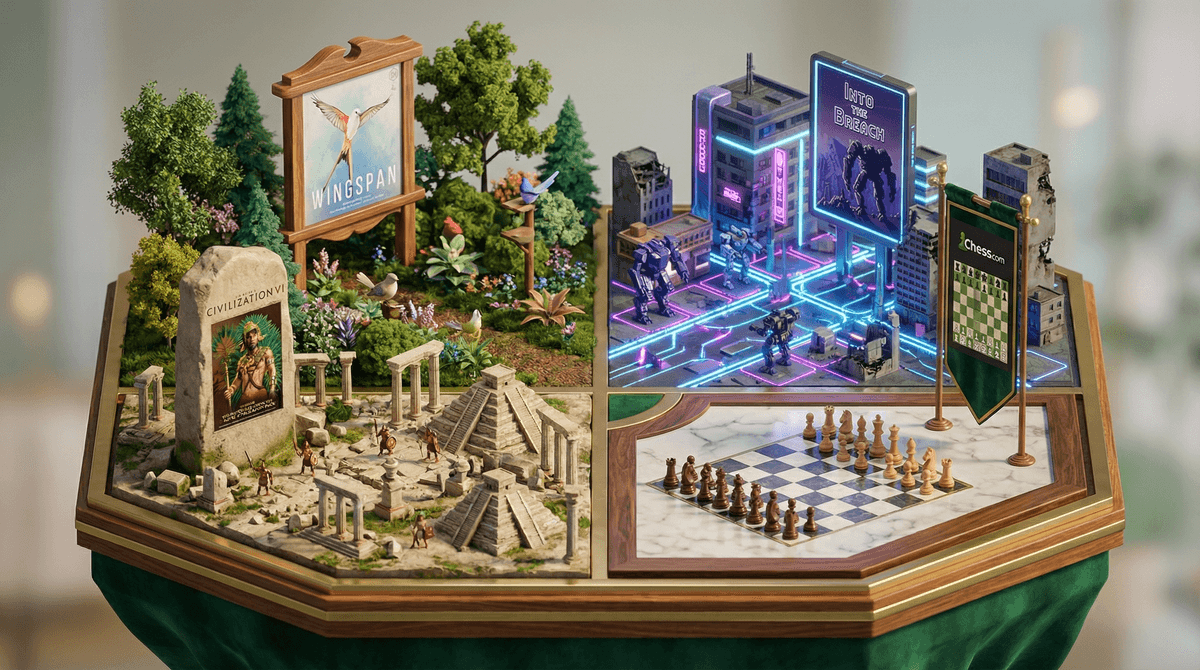
Look, I get it. When your kid asks for another game, your instinct might be to redirect them toward literally anything else. A book. Outside time. Staring at a wall. But here's the thing: not all games are created equal, and strategy games are genuinely different.
Strategy games require planning, critical thinking, resource management, and often delayed gratification—you know, all those executive function skills that therapists charge $200/hour to help develop. We're talking about games where button-mashing gets you nowhere, where you need to think three moves ahead, where losing teaches you something valuable about your approach.
The best strategy games create that perfect learning zone where kids are challenged but not frustrated, where they're building genuine cognitive skills while having enough fun that they don't realize they're basically doing brain calisthenics.
1. Chess (via Chess.com or Lichess apps) — Ages 6+
Yeah, I'm starting with the obvious one, but hear me out. Chess apps have completely transformed how kids learn this ancient game. Chess.com and Lichess offer adaptive puzzles, lessons that actually keep kids engaged, and the ability to play against opponents at their exact skill level.
The brain boost: Pattern recognition, strategic planning, consequence prediction, and learning to think from your opponent's perspective.
Parent tip: Start with the puzzle features, not full games. Kids build confidence solving chess problems before facing the pressure of a timed match.
2. Civilization VI — Ages 10+
Civilization VI is the gold standard of turn-based strategy. You're building an empire from the Stone Age to the Space Age, managing resources, conducting diplomacy, researching technologies, and yes, occasionally going to war.
The brain boost: Long-term planning (we're talking hundreds of turns), resource management, historical context, understanding trade-offs between competing priorities.
Parent reality check: Games can take HOURS. This is not a "quick 20 minutes before dinner" situation. But the depth of strategic thinking required is genuinely remarkable.
3. Into the Breach — Ages 10+
Into the Breach is like chess meets giant robots fighting kaiju. It's a turn-based tactics game where you can see exactly what the enemy will do next turn, so every move becomes a puzzle: How do I protect the most buildings with the fewest moves?
The brain boost: Spatial reasoning, prioritization under pressure, understanding cascading consequences, learning from failure (you will fail, repeatedly).
Why kids love it: Quick runs (20-30 minutes), immediate feedback on decisions, and the satisfaction of executing a perfect plan.
4. Slay the Spire — Ages 10+
Slay the Spire combines card game strategy with roguelike progression. You're building a deck as you climb a spire, and every choice matters—which cards to add, which to remove, which paths to take.
The brain boost: Probability assessment, synergy recognition (understanding how different elements work together), adaptive strategy, risk evaluation.
The hook: No two runs are identical, so kids develop flexible strategic thinking rather than memorizing one optimal path.
5. Wingspan (digital board game) — Ages 8+
Wingspan is a beautiful engine-building game about birds. Yes, birds. You're attracting birds to your wildlife preserve, and each bird has unique abilities that combo with others.
The brain boost: Set collection strategy, resource optimization, long-term engine building, and actual ornithology facts.
Bonus: The digital version handles all the fiddly rules, making it more accessible than the physical board game for younger players.
6. Fire Emblem: Three Houses — Ages 12+
Fire Emblem: Three Houses is tactical combat meets relationship building. You're teaching students at a military academy, building their skills, then leading them into strategic grid-based battles where if a character dies, they're gone permanently.
The brain boost: Tactical positioning, character development planning, understanding strengths and weaknesses, dealing with consequences of mistakes.
Content note: This is a war game with anime-style violence. Characters die (sometimes permanently depending on difficulty). But the strategic depth is incredible.
7. Factorio — Ages 10+
Factorio is about building automated factories on an alien planet. It starts simple—mine some ore, smelt it into plates—and evolves into managing sprawling production chains with conveyor belts, trains, and robots.
The brain boost: Systems thinking, logistics, optimization, debugging (figuring out why your factory isn't working), scaling solutions.
Warning: This game is ABSURDLY addictive. "Just one more optimization" turns into three hours. The community literally calls it "Cracktorio."
8. XCOM 2 — Ages 13+
XCOM 2 is tactical alien combat where you're commanding a resistance force. You manage both strategic base building and tactical turn-based missions where cover, positioning, and ability usage determine success or failure.
The brain boost: Risk assessment (that 95% hit chance can still miss), tactical positioning, resource management across multiple systems, graceful failure recovery.
Content reality: This is a mature-rated game with violence and some dark themes. It's tactical and strategic, not gratuitous, but it's definitely for older teens.
9. Hades — Ages 12+
Wait, isn't Hades an action game? Yes, but it's also deeply strategic. You're choosing builds (which abilities and upgrades to combine), learning enemy patterns, and making risk-reward decisions about which paths to take and which powerups to accept.
The brain boost: Build optimization, pattern recognition, adaptive strategy (adjusting your approach based on what upgrades you get), learning through iteration.
Why it works: Fast-paced enough to feel exciting, strategic enough to reward thinking, and the death-and-retry loop teaches resilience.
10. Stardew Valley — Ages 8+
Stardew Valley seems chill—you're just farming, right? But underneath the cozy exterior is serious strategic depth: crop planning, time management, resource optimization, relationship building, and long-term goal setting.
The brain boost: Planning and prioritization (you can't do everything in one day), delayed gratification (plant now, harvest later), resource management, goal setting.
The magic: It teaches strategic thinking without feeling like work. Kids are planning crop rotations and optimizing greenhouse layouts without realizing they're doing complex resource management.
Here's what separates these from mindless entertainment:
Meaningful choices: Every decision has consequences you need to think through. Button-mashing doesn't work.
Visible cause and effect: Kids can see how their strategic choices led to success or failure, which builds metacognitive awareness.
Skill progression: These games reward getting better at thinking, not just better at reflexes or memorization.
Failure as learning: Losing teaches you something concrete about what to try differently next time.
Complexity that scales: Most of these start accessible but have incredible depth for kids who want to optimize and improve.
Ages 6-8: Start with Chess apps, Wingspan, or Stardew Valley. These have gentler learning curves and more forgiving failure states.
Ages 9-11: Add Into the Breach, Factorio, or Civilization VI. These require more sustained attention and complex planning.
Ages 12+: Fire Emblem, Hades, and XCOM 2 become appropriate, though check content ratings against your family's comfort level with fantasy violence.
The real factor: Attention span and frustration tolerance matter more than age. A strategic 8-year-old might love Civilization VI, while a 12-year-old who gets easily frustrated might bounce off XCOM 2.
These take TIME: Strategy games aren't quick dopamine hits. Civilization VI campaigns can span days. Factorio bases evolve over weeks. This is actually a feature—kids are learning sustained engagement and long-term thinking.
Losing is the point: Your kid will lose. A lot. In Into the Breach, failure is how you learn. In XCOM 2, missions go sideways. In Slay the Spire, most runs end in defeat. This builds resilience and analytical thinking about what to try differently.
YouTube is part of the experience: Kids will watch strategy guides, and that's actually great. They're learning to seek out expertise, understand advanced concepts, and apply new strategies. This is self-directed learning.
Multiplayer vs. Single-player: Most of these are single-player, which means kids are competing against the game's challenges, not other players. This removes social pressure and toxicity concerns while maintaining the strategic depth.
The "just one more turn" problem: Strategy games can be incredibly engrossing. A Civilization VI player saying "just one more turn" is like an adult saying "just one more episode" on Netflix. You'll need clear boundaries about stopping points.
Here's what matters: these aren't vegetables disguised as dessert. They're genuinely fun games that happen to build critical thinking skills. Kids play them because they're engaging, challenging, and rewarding—not because they're "educational."
The strategy game kids who spend hours optimizing their Factorio factory or perfecting their Slay the Spire deck are developing the same skills that engineers, project managers, and systems thinkers use professionally. They're learning to break down complex problems, test hypotheses, and iterate on solutions.
Compare this to games that are just skinner boxes with flashy rewards, and the difference is stark.
If your kid is going to spend time gaming (and let's be real, they are), strategy games are among the best options. They're challenging without being punishing, engaging without being manipulative, and they build genuine cognitive skills.
Start here: If your kid hasn't played strategy games before, try Stardew Valley or a chess app. They're accessible entry points that teach strategic thinking without overwhelming complexity.
Level up: Once they're hooked on strategic thinking, Into the Breach and Slay the Spire offer incredible depth in shorter sessions.
Go deep: For kids ready for epic strategic experiences, Civilization VI and Factorio provide hundreds of hours of complex systems thinking.
And remember: Playing these games together is even better. Ask about their strategy, discuss their decisions, help them think through what went wrong. That metacognitive conversation—thinking about thinking—is where the real learning happens.
Want to explore more games that actually engage kids' brains? Check out our guide to cozy games or alternatives to Fortnite that offer different kinds of engagement.