Our reviews and ratings are 100% unbiased. Screenwise is a Bookshop.org affiliate and an Amazon Associate, so if you buy a book through one of our links, we may earn a commission. Bookshop.org purchases also support independent bookstores.
Screenwise Verdict
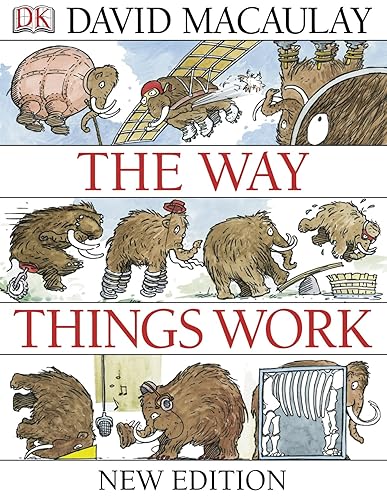
This is the undisputed heavyweight champion of visual engineering books. Even though it was published in 1988, the laws of physics haven't filed for an update yet. Macaulay uses a recurring gag with woolly mammoths to explain complex mechanics, which turns a potentially dry science lesson into something actually entertaining.
It’s a massive book, and the diagrams are incredibly detailed. For a kid who constantly asks 'how does that work?', this is the ultimate rabbit hole. Just be aware that since this is the 1988 edition, you won't find anything about touchscreens or Wi-Fi here. It’s all about the analog world—gears, levers, and engines—which is honestly a better place to start anyway.
Age Fit
Great for curious kids aged 7 and up. Younger kids will love the mammoth drawings, while older kids (and adults) will actually appreciate the brilliant engineering explanations.
WISE Breakdown
Wholesome
95
It’s pure, curiosity-driven education. The tone is humorous and gentle, using a recurring cast of woolly mammoths to demonstrate physical principles without any snark or inappropriate content.
Imaginative
92
David Macaulay’s ability to visualize complex mechanical systems through the lens of prehistoric mammoths is a masterclass in creative explanation. It encourages kids to see the 'hidden' world inside machines.
Safe
100
It's a non-fiction book from 1988. There are no safety risks, no digital tracking, and no content concerns beyond maybe a mammoth getting into a silly (non-violent) scrape.
Enriching
98
This is the gold standard for STEM literacy. It teaches the fundamental principles of physics and engineering that underpin almost all modern technology.
Parent Info
✓
Why It Might Be Great
The mammoth illustrations turn dry engineering concepts into visual stories that actually stick.
It builds a 'mechanical intuition' that helps kids understand how the physical world fits together.
Macaulay’s diagrams are so detailed that even adults will finally understand how a car differential works.
It rewards deep 'browsing'—you can open to any page and learn something fascinating in two minutes.
⚠
What to Watch For
This 1988 edition is pre-digital; you won't find explanations for smartphones, Wi-Fi, or modern computing here.
The text can be dense in sections, which might overwhelm younger readers if they try to tackle it all at once.
Conversation Starters
"Which mammoth 'experiment' was the funniest to you?"
"If you had to explain how a zipper works to someone who had never seen one, how would you do it?"
"Looking at the machines in our house, can you find any that use the levers or pulleys shown in the book?"