The "Origin Story" appeal
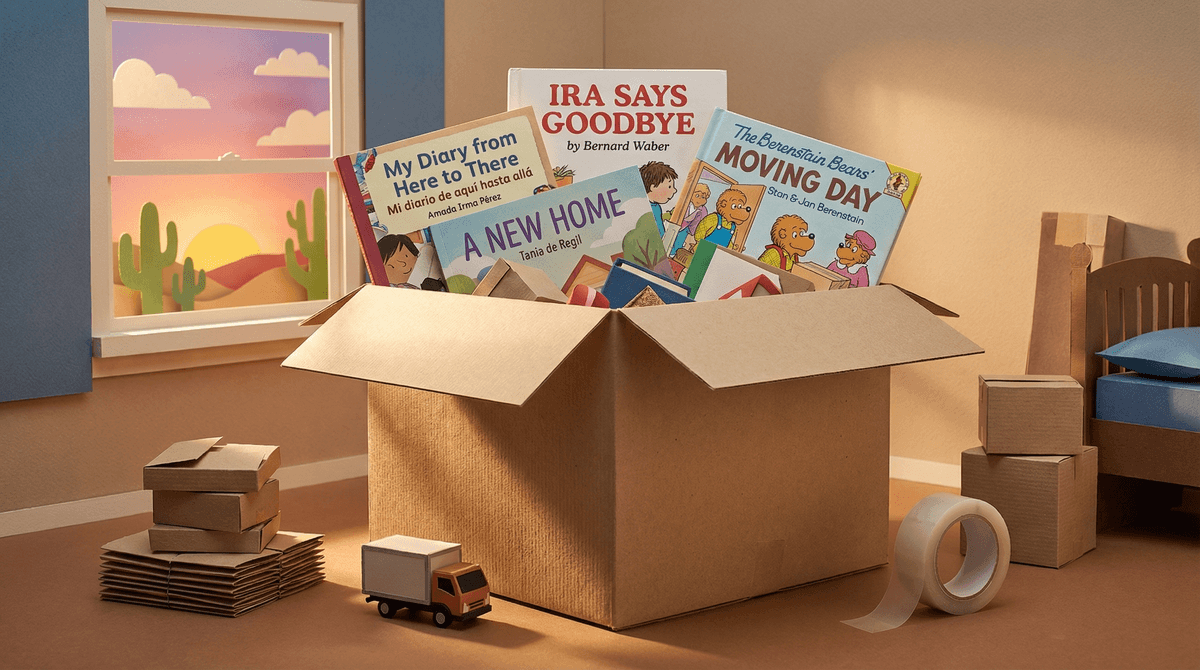
For kids who have already spent time in Bear Country, this book carries a weirdly high level of "lore" significance. Most of the 300+ books in the series take the iconic treehouse for granted, but Moving Day is the prequel that explains how they got there. If your child is already a fan of the family, seeing them live in a mountainside cave at the beginning of this book provides a narrative hook that other moving-specific stories lack. It turns a stressful life event into a background story for characters they already trust.
A procedural for preschoolers
This isn't a book you read for the prose or the whimsical imagery. It functions more like a training manual for a major life transition. Stan Berenstain focuses heavily on the logistics: the packing of the "everything-else" box, the sight of the empty room, and the actual mechanics of the moving truck.
While modern picture books often lean into abstract metaphors for change, this stays literal. That’s a strength if you’re trying to demystify the process for a four-year-old who thinks their toys are disappearing forever when they go into a cardboard box. It validates the "stuff" part of moving as much as the "feelings" part. If you’re looking for more variety in how to tackle this topic, our guide on Books About Moving: Stories to Help Kids Navigate Big Transitions covers titles that range from this kind of literalism to more emotional, character-driven narratives.
The 1981 aesthetic friction
You have to be prepared for the visual "brownness" of this era. The illustrations don't have the crisp, high-contrast digital look of a modern Mo Willems or Jon Klassen book. The colors are muted—lots of ochre, forest green, and wood tones—and the frames are often crowded with detail.
For some kids, this feels cozy and "vintage" in a way that’s calming. For others, particularly those used to the bright saturation of modern tablets or Disney+ animation, it can feel cluttered and slow. The pacing matches the art; it takes its time with the "goodbyes" and the travel. It doesn't rush to the resolution, which is helpful for a child who is currently stuck in the "sad goodbye" phase and isn't ready to hear how great the new house is going to be yet.
How to use the "First Time" format
Because this is part of the First Time Books series, it’s designed to be a conversation starter rather than a standalone masterpiece. The most effective way to read this isn't straight through at bedtime, but as a reference point while you’re actually packing.
- Use the "empty room" page to talk about what your child’s room will look like on moving day.
- Point out Brother Bear’s anxiety about new friends when you see a neighbor at the new place.
- Treat the bonus stickers (if your copy has them) as a reward for helping with a specific moving task.
If your kid liked the "procedural" feel of this—where a problem is introduced, analyzed, and solved through a series of clear steps—you’ll find the rest of the early Berenstain catalog hits that same itch. Just don't expect it to be the book they ask for every night once the boxes are finally unpacked.