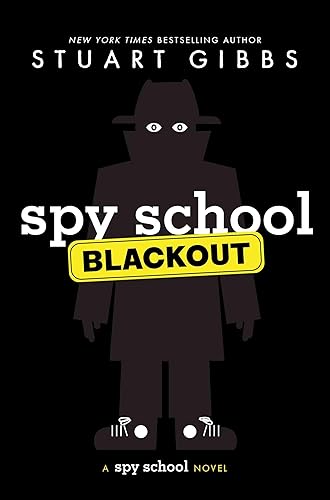
Spy School Blackout

Spy School Blackout

book

2025, Children's Books, Action & Adventure

WISE
89%

WISE Score

4.8

Amazon

Ben Ripley is back, and this time he’s saving the world without Google Maps or a working charger.

Amazon4.8
Common Sense Media

Where to Read

Our reviews and ratings are 100% unbiased, but as an Amazon Associate, Screenwise earns an affiliate fee if you buy a book or game by clicking one of our links. We don't get any credit if you just Google it instead :)

Screenwise Verdict

Look, by book thirteen, most series have completely lost the plot, but Stuart Gibbs keeps the engine humming.

Spy School Blackout is exactly what you want for your kid: it’s engaging, it’s clean, and it actually makes them want to turn off the iPad to find out what happens next. It’s not 'literary fiction,' but it’s high-quality entertainment that respects the reader's intelligence.

If your kid is already a fan, this is a no-brainer. If they aren't, start with book one, but know that this latest entry holds up the standard.

Age Fit

Perfect for the 8-12 crowd. If they're 13 or 14 and have been following the series, they'll still love it, but it might start feeling a bit young for a brand-new teenage reader.

WISE Breakdown
Wholesome
82

The series consistently models teamwork and resilience. Ben isn't a superhero; he's a kid who succeeds through logic and leaning on his friends. The humor is snarky but rarely mean-spirited.

Imaginative
88

The 'Blackout' premise forces the characters to solve high-tech problems with low-tech survival skills. The Indonesian setting with pirates and Komodo dragons adds a fresh, adventurous layer to the established spy formula.

Safe
95

It's a middle-grade novel. While there is 'peril'—sharks, assassins, and hackers—it is handled with a light touch. No graphic violence, no sexual content, and no language concerns beyond typical middle-school banter.

Enriching
80

Great for building vocabulary and interest in geography. It also prompts kids to think about our society's total dependence on the power grid and digital infrastructure without being preachy about it.

Parent Info
✓

Why It Might Be Great

  • It’s the ultimate 'reluctant reader' bait; the pacing is so fast kids actually forget they're reading.
  • The 'off-the-grid' survival theme is a great change of pace from the usual high-tech spy gadgets.
  • Stuart Gibbs knows how to write middle-school dynamics—the awkwardness and the friendships—without making it feel 'cringe'.
  • It sneaks in actual facts about Indonesia and cybersecurity while your kid thinks they're just reading about shark escapes.
⚠

What to Watch For

  • Typical action-movie violence: there are assassins and pirates, though nobody is getting 'John Wick' levels of hurt.
  • Ben and Erica’s ongoing 'will-they-won't-they' tension is a staple, but it stays very PG.

Conversation Starters

  • "If the power went out globally right now, what’s the first thing you’d realize you don't know how to do?"
  • "Why do you think Ben is a better spy than the adults even though he's just a kid?"
  • "Would you rather face a group of pirates or a giant lizard in the middle of the jungle?"

Deep Dive

Most middle-grade series start to smell like leftovers by book six. By book thirteen, you usually expect the author to be running on autopilot, but Stuart Gibbs has managed to keep the Spy School engine running hot. Spy School Blackout isn't just another entry in the catalog; it’s a vibe shift that takes the series’ best assets—Ben Ripley’s awkwardness and Erica Hale’s competence—and drops them into a survival scenario that feels genuinely urgent.

The "No-WiFi" Factor

The genius of this installment is the premise. By knocking out the global power grid, Gibbs strips away the high-tech gadgets that often act as a safety net in spy fiction. When the planes go down and the phones go dark, the characters have to rely on actual intelligence rather than Google.

For a generation of kids who haven't known a world without a search bar, there is something quietly thrilling about Ben having to navigate Indonesia using old-school logic and grit. It turns the book into a survival guide for the screen-obsessed without ever feeling like a lecture. The tech is gone, the stakes are physical, and the "very big lizards" are much scarier when you can't just look up how to escape them on YouTube.

Why Gibbs Still Owns This Genre

Gibbs is the gold standard for middle-grade action because he refuses to talk down to his audience. He knows these kids are smart. He weaves in details about cybersecurity and Indonesian geography that feel like insider info rather than a social studies lesson.

If your reader has already burned through the earlier books, they’ll appreciate how the Ben-and-Erica dynamic continues to evolve. It’s the slowest burn in kid-lit history, and it works because it mirrors the real-world pacing of middle-school crushes—lots of staring, very little talking, and a whole lot of second-guessing.

The Gibbs Ecosystem

If your kid finishes this and is desperate for more, you have two clear paths. If they liked the international travel and the "fish out of water" energy, they should circle back to the London-based missions if they haven't already.

However, if they’re starting to age out of the spy trope but still love a fast-paced mystery, the FunJungle series is the move. It swaps the CIA for a massive zoo/theme park and keeps that same dry humor.

Spy School Blackout proves that as long as Gibbs keeps finding ways to make Ben Ripley’s life miserable in exotic locations, we’re going to keep reading. It’s high-floor, high-ceiling entertainment that justifies its 4.8 Amazon rating by simply being a better-written ride than almost anything else on the shelf.

Ask Anything

Get a personalized guide on any topic