

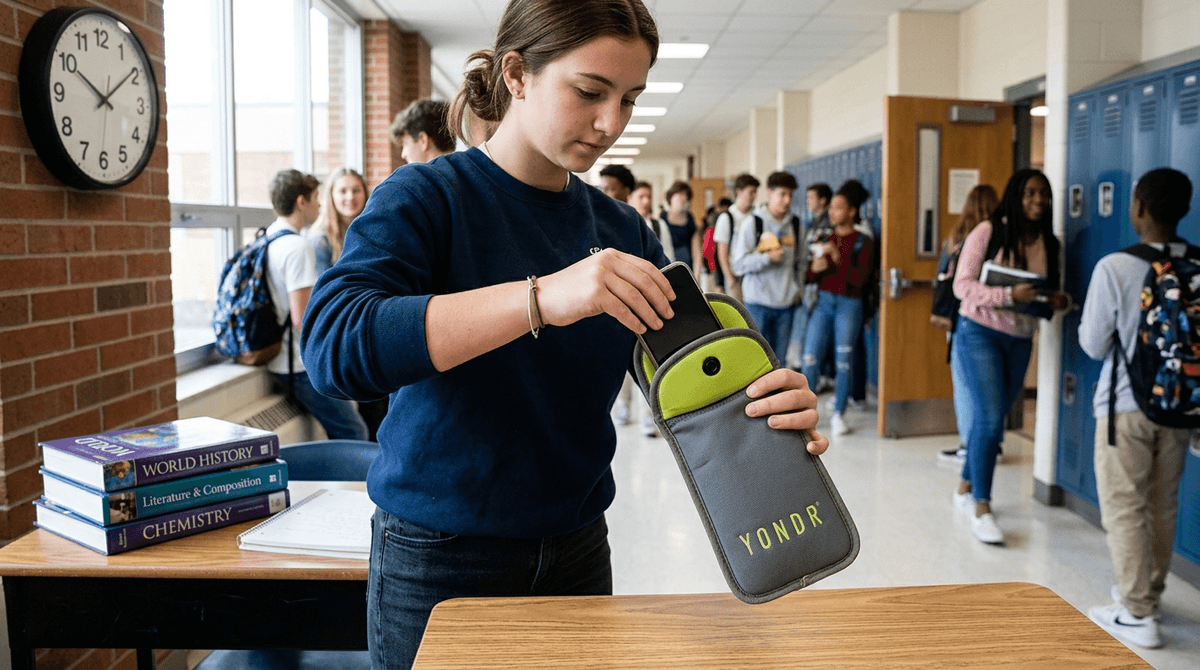
Yondr Pouches: The Reality of the School Phone Lockdown
If your kid's school just announced they're adopting Yondr pouches, you're probably feeling a mix of relief (finally, someone else is policing the screen time) and low-grade panic (how do I reach them if there's a lockdown?). Here's the straight truth: these magnetic fabric bags are currently the most effective blunt-force instrument schools have to kill classroom distractions. They work because they remove the willpower equation entirely—but the transition is going to be messy, the kids are going to complain, and you're going to have to relearn how to call the front office.
TL;DR: Yondr pouches are magnetically sealed bags that lock a student's phone away from the first bell to the last, effectively eliminating classroom scrolling and forcing kids to actually talk to each other at lunch. While they won't magically fix a district's test scores overnight, they completely reset the social baseline of a school—even if it means parents have to give up their 24/7 direct texting access. For families navigating this shift, our middle school digital guide offers a solid roadmap for handling the sudden change in daytime connectivity.
The mechanics of a Yondr pouch are dead simple. On the way into the building, students drop their phones (and smartwatches) into a neoprene pouch, tap it against a magnetic unlocking base, and snap it shut. The pouch stays with the student all day—which brilliantly eliminates the "the school lost my $1,000 iPhone" liability—but the device inside is completely inaccessible. On the way out the door at 3:00 PM, they tap the pouch on the unlocking base and get their digital life back.
It is a hardware solution to a software problem, and teachers absolutely love it. Instead of spending 40% of a geometry class playing whack-a-mole with kids hiding phones under their thighs, educators can actually just teach.
If you're wondering why districts are spending tens of thousands of dollars on fabric bags, just look at the math. According to Screenwise community data, kids are clocking an average of 4.2 hours of screen time on weekdays (jumping to 5 hours on weekends).
While 68% of kids in our ecosystem don't have a phone yet, the 22% who are carrying full smartphones (and the 10% with dumbphones) were letting those devices dictate the rhythm of the school day. By bagging the phones, schools are clawing back seven hours where digital independence—which our data shows 30% of kids are actively navigating—is forced on pause. It's a mandatory digital detox, five days a week.
Let's talk about the real reason parents fight this policy: the "what if" scenario. We've gotten entirely too used to having a direct line to our kids at 10:14 AM on a Tuesday.
Screenwise data shows that when kids do text, 25% of that traffic is going straight to family (compared to 15% texting friends and 5% in group chats). Giving up that tether is genuinely anxiety-inducing, especially in an era of school safety concerns. But here's the reality check: if there is an actual emergency, a kid texting you from under a desk doesn't make them safer, and it doesn't give you the ability to extract them.
The school office still exists. If you need to tell your kid that their dentist appointment moved or that grandma is picking them up, you have to call the secretary like it's 1998. It feels like a step backward, but it's the necessary trade-off for giving them a distraction-free environment.
Take a group of highly motivated teenagers and put a physical barrier between them and TikTok, and you will witness engineering genius.
The cat-and-mouse game is real. Kids will bring in heavy-duty neodymium magnets they bought online to pop the pins open in the bathroom. They'll employ the "burner phone" method—dropping an old, cracked iPhone 8 into the pouch at the front door while keeping their actual phone in their backpack. They will cut the fabric. They will smash the locking mechanism.
Schools know this. The first few months of a Yondr rollout are usually highly punitive as administration cracks down on the workarounds. If your kid gets caught busting a pouch, expect to be writing a check for the replacement (usually around $20-$30) and dealing with a detention.
The hardest part of the Yondr era isn't the school day itself—it's the 3:00 PM release valve.
When that pouch unlocks, your kid is going to get hit with seven hours of pent-up notifications, texts, and social media updates all at once. The car ride home might be dead silent while they process the digital backlog. Don't take it personally, and don't try to force a "how was your day?" conversation the exact second they get their device back. Give them 15 minutes to clear their lock screen before you expect human interaction.
If you're using tools like Apple Screen Time or Google Family Link, you might actually need to adjust your settings. Since they aren't burning through their app limits during lunch period anymore, you may find them wanting to heavily front-load their gaming or scrolling in the evening.
Q: Can students just rip the Yondr pouches open? They can, but it destroys the pouch and usually results in disciplinary action and a replacement fee. The pouches are made of durable material, so breaking them requires intentional effort (like a knife or a heavy tool), not just pulling hard.
Q: What happens if there's a school emergency and the phones are locked? In true emergencies, schools rely on their internal communication systems and law enforcement, not student cell phones. However, the pouches can be cut open with scissors if a student absolutely needs access to their device during a crisis, and some teachers are equipped with unlocking bases in their classrooms.
Q: Do Yondr pouches actually improve grades? The data is mixed on immediate test score spikes, but schools universally report massive improvements in classroom engagement, decreased behavioral referrals, and a much louder cafeteria because kids are actually talking to each other instead of scrolling.
Q: What if my kid needs their phone for a medical reason, like tracking blood sugar? Schools universally offer medical exemptions. Students who use their phones as continuous glucose monitors (CGMs) or for other documented medical needs are either given a pouch with a velcro closure or are entirely exempt from the policy via their IEP or 504 plan.
- Get help navigating the transition to middle school tech rules

- Check out our digital guide for middle school to see what other guardrails make sense at this age.
- If you're holding off on a smartphone entirely, explore the best alternatives to a fully loaded device.
- Review our high school digital guide for older teens navigating independence.