

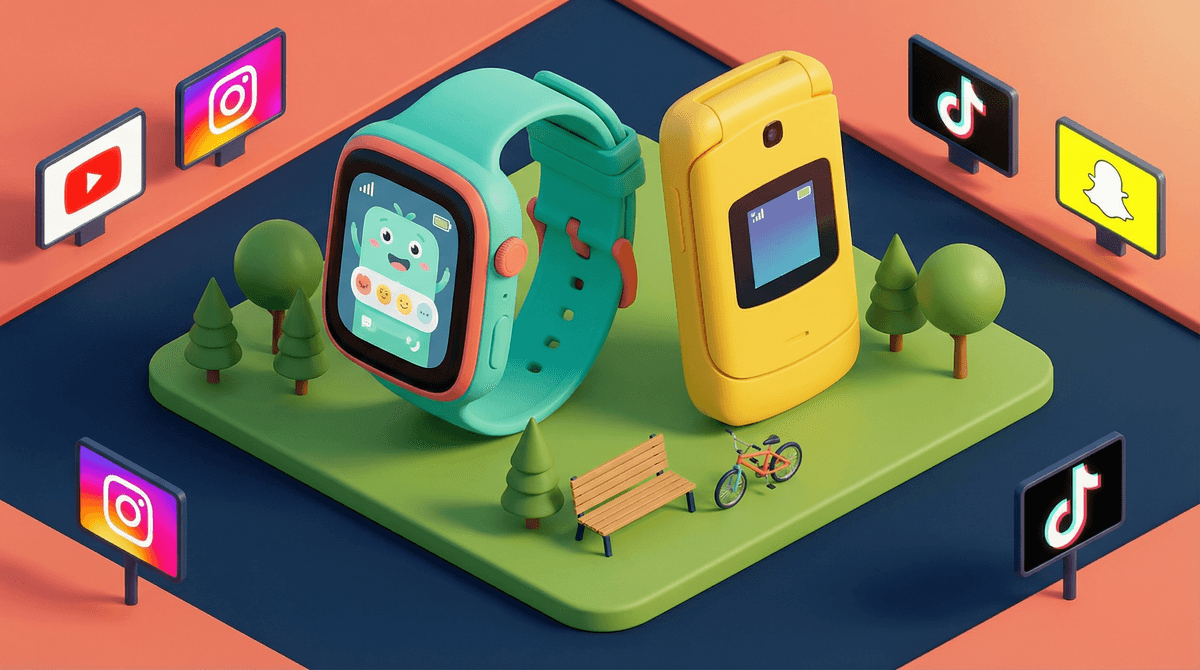
Beyond the Smartphone: What to Give Your Kid Instead
Look, I get it. Your kid wants a phone. All their friends have phones (allegedly). They need it for safety. For communication. For not being the only one left out of the group chat.
But here's the thing: 68% of families in our community aren't giving their kids smartphones yet. You're not alone in wanting to pump the brakes on handing a portal to infinite TikTok and Snapchat to your 10-year-old.
The good news? There are actually some solid middle-ground options that let kids stay connected without giving them unfettered access to the entire internet, social media, and whatever fresh hell is trending on YouTube Shorts this week.
When we talk about smartphone alternatives, we're looking at devices that solve the core problem parents care about (staying in touch with your kid) without creating new problems (doom-scrolling at 2am, group chat drama, or stumbling into the weird corners of Reddit).
The main categories:
- Smartwatches - Basically a phone on their wrist with limited functionality
- "Dumb phones" or basic phones - Call and text, that's it
- Tablets with restrictions - Internet access but stays at home
- Nothing at all - Sometimes the right answer is just... not yet
Let's break these down.
About 32% of kids in our community have some kind of smartwatch - whether it's a Fitbit (14%), Apple Watch (14%), or another brand (4%).
The appeal: Your kid can call or text you. You can track their location. They can't download TikTok or get lost in YouTube for three hours. It's like a leash, but make it tech.
The reality: Smartwatches are genuinely great for that transition phase where your kid needs to be reachable but isn't ready for smartphone responsibility. The Gizmo Watch and similar devices let parents control exactly who kids can contact - usually just family members.
The downside: They're not cheap. Battery life can be annoying. And kids will 100% complain that "it's not a real phone" because, well, it's not.
Best for: Ages 7-11, kids who are starting to have more independence (walking to a friend's house, staying after school) but definitely aren't ready for smartphone responsibility.
Here's something interesting: 10% of families in our community are going with basic phones instead of smartphones. And honestly? That's kind of genius.
These aren't your 2005 flip phones (though those exist too). Modern basic phones can call, text, and sometimes have limited internet for emergencies. What they can't do is run apps, access social media, or become a dopamine slot machine in your kid's pocket.
The appeal: Your kid can actually participate in group texts with friends. They have a real phone number. They can call you when practice ends. But they can't disappear into Instagram Reels for hours.
The reality: This is probably the most underrated option. It solves the actual problem (communication and safety) without creating the secondary problems (addiction, social media drama, content exposure).
The downside: Your kid will complain. A lot. They'll be the one with the "weird phone." And some modern conveniences (like using certain apps for school stuff) won't work.
Best for: Ages 11-14, kids who need real communication with friends but where you want to delay smartphone access. Also great for kids who've shown they're not ready for smartphone responsibility yet.
50% of kids in our community have unsupervised tablet access, while 35% have limited access. This is... a mixed bag.
The appeal: Tablets can do a lot of what smartphones do - video calls with grandparents, educational apps, Minecraft, watching shows. But they stay at home, so they're not a constant presence in your kid's life.
The reality: A tablet isn't really a smartphone alternative for communication and safety - it's more of a "controlled screen time device." But it can be part of your strategy if you're trying to delay phone ownership while still letting kids access some digital stuff.
The downside: If it has internet access, it has ALL the internet access. You need serious parental controls and consistent monitoring. And it doesn't solve the "I need to reach my kid when they're out" problem.
Best for: Younger kids (ages 6-10) who want to play games or watch shows, but as a home device with clear boundaries, not a communication tool.
70% of kids in our community aren't using devices for independent communication outside of family. And you know what? That's completely fine.
Sometimes the best smartphone alternative is... no device at all. If your kid isn't going places alone, doesn't need to coordinate with friends independently, and you're not comfortable with any device yet, that's a completely valid choice.
The reality check: Only 25% of kids in our community are texting with family, 15% with friends, and just 5% in group chats. The "everyone has a phone" narrative is usually exaggerated.
This is the big one, right? "But what if there's an emergency?"
Real talk: Kids survived for decades without phones. If your kid is at school, they have access to phones. If they're at a friend's house, there are adults with phones. If they're old enough to be places without adult supervision, that's when a communication device makes sense - and that's when a smartwatch or basic phone becomes genuinely useful.
The safety argument is valid, but it's also sometimes used to justify giving smartphones earlier than necessary. A smartwatch solves the safety concern without the smartphone risks.
Here's what to actually consider:
Age and independence: Is your kid going places alone? Walking to school? Going to friends' houses without you? That's when communication devices become genuinely useful.
Responsibility level: Have they shown they can follow rules about screen time with tablets or computers? Can they handle not losing things? These are decent predictors of phone readiness.
Social pressure: Yes, it's real. But also, learn more about how "everyone has one" is usually an exaggeration . In our community, 68% of kids don't have smartphones yet.
Your family values: Some families are comfortable with earlier tech adoption. Others want to delay as long as possible. Both are fine. The key is being intentional about it, not just caving to pressure.
There's no perfect answer here, but there are good options between "smartphone at age 8" and "no contact with the outside world until college."
For younger kids (7-10) who need to be reachable: A smartwatch is probably your best bet.
For tweens/young teens (11-14) who need real communication: A basic phone gives them independence without the smartphone chaos.
For kids who aren't ready for any of it: That's completely okay. You're not ruining their life by waiting.
The smartphone will come eventually. But every year you can delay it is a year where their brain develops without the constant dopamine hits, social comparison, and attention fragmentation that smartphones bring.
If you're trying to figure out what's right for your specific kid, explore device options for different ages or Get advice on your specific situation.
And if you're feeling pressure from your kid about getting a "real phone," you might want to read up on how to talk to kids about delayed phone ownership - because that conversation is coming, and it helps to be prepared.