

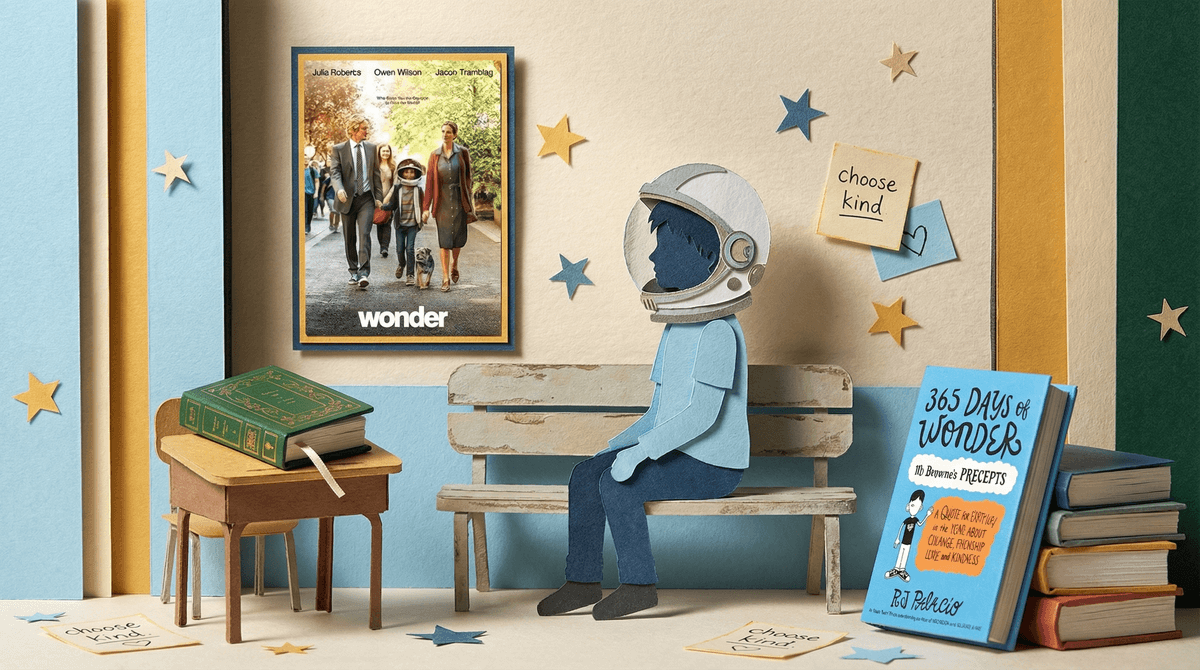
Wonder (the movie) is the 2017 film adaptation of R.J. Palacio's beloved novel that follows Auggie Pullman, a fifth-grader with facial differences caused by Treacher Collins syndrome, as he navigates his first year at mainstream school. Starring Jacob Tremblay, Julia Roberts, and Owen Wilson, it's become one of those rare family films that actually delivers on its promise to spark meaningful conversations.
The movie shifts perspectives throughout, showing not just Auggie's experience but also those of his sister Via, his friends, and even the kids who struggle with how to treat him. It's not a sanitized after-school special – there's real cruelty, complicated family dynamics, and the messy reality of how hard it can be to choose kindness when social survival feels at stake.
Here's the thing: most kids will encounter someone who looks or acts different from them, and most will also experience feeling like an outsider themselves at some point. Wonder tackles both sides of that equation without being preachy about it.
The movie has become somewhat of a cultural touchstone in elementary and middle schools. Many teachers show it (or assign the book) as part of social-emotional learning curriculum. Your kids' classmates have likely seen it, and phrases like "choose kind" have become shorthand in a lot of school communities.
But beyond the school adoption, Wonder resonates because it's honest about how complicated empathy can be. The character of Jack Will, who genuinely likes Auggie but also betrays him to fit in, is probably the most realistic portrayal of middle school social dynamics I've seen on screen. It gives kids permission to acknowledge that doing the right thing isn't always easy or instinctive.
Ages 7-9: The movie is rated PG, and most kids in this range can handle it, but be prepared for questions about Auggie's face and why people are mean to him. Some younger kids might find the bullying scenes upsetting – there's name-calling, exclusion, and one particularly rough Halloween incident. The emotional beats might also go over their heads; they'll get the surface story but might miss the more nuanced character arcs.
Ages 10-13: This is the sweet spot. Kids this age are living the social dynamics depicted in the film. They'll recognize the cafeteria politics, the shifting friend groups, and the pressure to choose between kindness and popularity. This is also the age where they can appreciate Via's storyline about being overlooked when a sibling needs more attention – something that resonates whether or not disability is involved.
Ages 14+: Older teens might find it a bit earnest, but it can still spark good discussions about how we treat people who are different and the long-term impact of our choices during those formative years.
The bullying is real but not graphic. Nobody gets physically hurt, but the emotional cruelty is portrayed authentically. Julian, the main antagonist, is written as a three-dimensional kid dealing with his own pressures, not a cartoon villain. If your child has experienced bullying , some scenes might hit close to home.
It's not just about the kid with differences. Via's storyline about feeling invisible in her own family is incredibly important. If you have multiple kids, especially if one has special needs or demands more attention, this movie opens the door to conversations about how everyone in the family is seen and valued.
The "choose kind" message is everywhere in the movie. Some parents find it heavy-handed; others appreciate having clear language to use with their kids. Your mileage may vary depending on your family's communication style.
There are some tough family moments. The parents (played by Roberts and Wilson) are portrayed as loving but imperfect. They snap at each other, they're exhausted, they don't always get it right. For some families, this is refreshing; for others who are dealing with similar challenges, it might feel too close to home.
Before watching: If your child hasn't been exposed to people with facial differences, consider looking up information about Treacher Collins syndrome together. Frame it matter-of-factly: some people are born with conditions that make their faces look different, and their faces work just fine, they just look different.
During or after: Ask open-ended questions:
- "What do you think was hardest for Auggie? For Via?"
- "Have you ever felt like Jack Will, wanting to do the right thing but also wanting to fit in?"
- "What would you do if a new kid like Auggie came to your school?"
Connect it to their world: If they play Roblox or other online games, talk about how we treat people we can't see too. The same "choose kind" principle applies in digital spaces where it's even easier to be cruel because of the distance and anonymity.
Don't force the lesson. If your kid just wants to watch and process, that's fine. Sometimes the best learning happens when we're not actively teaching.
Wonder is one of those rare family films that works on multiple levels. It's engaging enough to hold kids' attention, emotionally honest enough to resonate with their real experiences, and gentle enough to watch together without anyone feeling lectured.
Is it perfect? No. Some critics argue it centers the experience of being around disability rather than the disabled person's full humanity, and the "inspiration porn" critique is valid. But for many families, it's an accessible entry point into conversations about empathy, difference, and the small daily choices that define who we are.
The movie works best when it's part of an ongoing conversation, not a one-time lesson. If your family values are around kindness, inclusion, and looking beyond surface differences, Wonder gives you a shared language and reference point. And honestly, in a media landscape full of content that teaches kids to be snarky, ironic, or cynical, there's something valuable about a story that unabashedly asks them to be kind.
- Watch it together as a family movie night, maybe with a pause button handy for questions
- Read the book if your kids are into reading – it's even more detailed and includes additional perspectives
- Check out the Wonder book companion novels like "Auggie & Me" that explore other characters' stories
- Talk about how these themes show up online – cyberbullying, excluding people from group chats, and choosing kindness in comments
- Use Screenwise to explore other media that handles difference and empathy well, tailored to your kids' ages and interests