

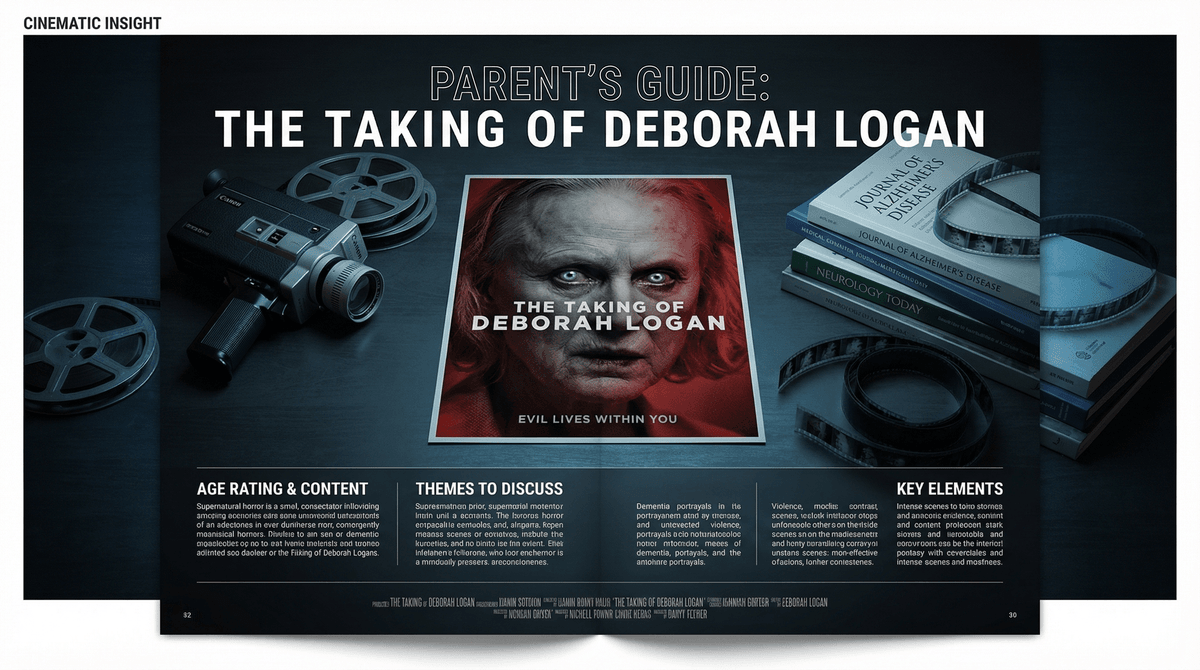
Why The Taking of Deborah Logan Is Terrifying: A Parent's Guide
TL;DR: This 2014 found-footage horror film is legitimately unsettling because it weaponizes a real fear—Alzheimer's disease—and twists it into supernatural body horror. It's not appropriate for kids or young teens, but older teens (16+) who can handle intense psychological horror might find it thought-provoking. If your teen watched it and is now freaked out, you're not alone in dealing with the aftermath.
Most horror movies are scary because of jump scares, gore, or supernatural threats that feel distant from reality. The Taking of Deborah Logan is terrifying because it starts with something devastatingly real: an elderly woman's descent into dementia, documented by a film crew making a thesis documentary about Alzheimer's.
For the first third of the movie, you're watching what feels like an actual documentary about cognitive decline. Deborah Logan forgets things, becomes confused, exhibits disturbing behavior changes. Her daughter Sarah is exhausted, frustrated, grieving the loss of her mother while that mother is still alive. This is the stuff that keeps adults up at night—the fear of losing ourselves or watching our parents disappear.
Then the movie pivots into supernatural horror, but by that point, you're already emotionally invested and deeply uncomfortable. The filmmakers essentially took your genuine empathy for dementia patients and their families and used it as a weapon against you.
The genius (and yes, it's genuinely well-crafted horror) of this movie is that you can't tell when the "real" dementia ends and the possession begins. Is Deborah wandering into the woods at night because of Alzheimer's, or because something else is controlling her? Are those disturbing drawings evidence of a fractured mind or supernatural influence?
This ambiguity is what makes it stick with you long after the credits roll. The movie doesn't just scare you—it makes you question your ability to distinguish between medical crisis and paranormal threat. For teens who might be processing their own experiences with grandparents' cognitive decline, this can hit way too close to home.
The body horror elements in the third act are genuinely disturbing. Without spoiling too much, the film goes to some dark places involving children, snakes, and Deborah's body contorting in ways that will absolutely haunt you. The infamous "tunnel scene" near the end is the kind of image that shows up uninvited in your brain at 2 AM.
Not for kids under 16, full stop. This isn't about gore or language—it's rated R but relatively restrained on both counts. The issue is psychological intensity and themes that younger viewers simply don't have the emotional framework to process.
Ages 16-17: Maybe, if they're into horror and can handle psychological intensity. Consider:
- Have they seen found-footage horror before? (The Blair Witch Project, Paranormal Activity)
- Do they have experience with elderly family members with dementia? (This could make it either more or less appropriate)
- Can they handle body horror? (Think The Thing vibes in the final act)
- Are they mature enough to discuss the ethical questions the movie raises about documentary filmmaking and exploitation?
Ages 18+: Still intense, but adults can better contextualize the fears it plays with.
If your teen already watched it: They might be dealing with some lingering unease, especially if they have grandparents with cognitive issues. The movie doesn't just scare—it makes you feel guilty for being scared of elderly people with dementia, which is a complicated emotional space.
Some conversation starters:
- "That movie used real fears about aging and illness to create horror. How did that feel different from other scary movies?"
- "The filmmakers in the movie kept filming even when they should have stopped. What do you think about that?"
- "Do you think it was respectful to people who actually have Alzheimer's, or did it cross a line?"
The found-footage format matters: If your teen gets motion sick or finds shaky-cam footage disorienting, this will be physically uncomfortable to watch. The cinematography is deliberately claustrophobic and disorienting.
It's not just jump scares: Some teens who handle typical horror movies fine will struggle with this because it's sustained dread rather than periodic scares. The movie makes you feel bad for being scared, which is emotionally exhausting.
Here's where it gets complicated: Is this movie exploitative of people with dementia, or does it actually create empathy by forcing viewers to witness the horror of cognitive decline?
The first act genuinely feels like it's trying to portray Alzheimer's with respect and realism. The scenes of Sarah trying to care for her mother while maintaining her own life are painfully accurate. But then the movie uses that realism as a springboard for supernatural horror, which could feel like it's saying "dementia isn't scary enough on its own—we need to add a demon."
Different families will have different tolerance for this. If you're currently caring for a parent with Alzheimer's, this movie might feel like it's trivializing your experience. If you're a teen trying to understand what your grandparent is going through, the first act might actually be educational (before it goes off the rails).
If your teen found this movie, they probably discovered it through:
- Horror movie recommendation lists (it's genuinely well-regarded in horror communities)
- Found-footage horror deep dives on YouTube
- TikTok horror movie discussions
- Friends sharing "the scariest movie I've ever seen" recommendations
The movie has developed a cult following precisely because it's not a mainstream horror franchise. Watching it feels like discovering something genuinely unsettling rather than consuming corporate horror content. For teens building their horror movie credentials, this is a "I can handle REAL horror" badge of honor.
If your teen is into psychological horror but you want something less intense:
- The Sixth Sense: Supernatural thriller that's spooky without being traumatizing (PG-13)
- A Quiet Place: Tense horror with family themes, less psychological damage (PG-13)
- Get Out: Smart horror that provokes discussion, but with clearer boundaries between reality and threat (R)
If they want more found-footage horror:
- Cloverfield: Monster movie format without the psychological intensity (PG-13)
- As Above, So Below: Claustrophobic found-footage that's scary but less emotionally manipulative (R)
For horror that deals with grief and loss in smarter ways:
- The Babadook: About processing grief, genuinely scary but more metaphorical (Not Rated, but R-equivalent)
- Hereditary: Actually, never mind, this is even more traumatizing. Skip this one unless they're 18+.
The Taking of Deborah Logan is scary because it exploits a genuine, universal fear: losing our minds or watching our loved ones lose theirs. It's well-made horror that will absolutely stick with you, but it's not appropriate for younger teens and might be too intense even for older ones.
If your teen has already seen it and is processing some uncomfortable feelings, that's normal. This movie is designed to make you feel unsettled long after it ends. Use it as an opportunity to talk about how horror movies work, what makes something "too far," and how we process fears about aging and illness in our culture.
And if they're asking to watch it? Consider whether they're ready for horror that doesn't offer easy resolution or clear boundaries between the real and the supernatural. Sometimes "not yet" is the right answer, and that's okay.
Want to dig deeper? Explore more horror movies for teens or learn about age-appropriate scary content.