

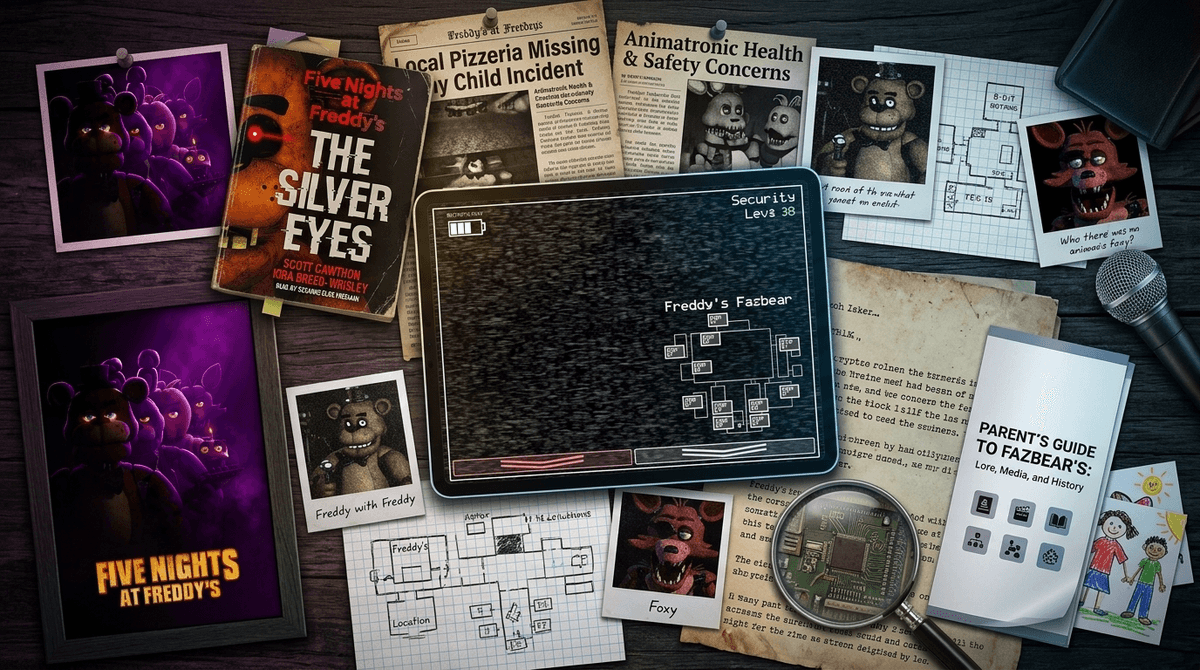
TL;DR: Five Nights at Freddy’s (FNAF) is a "mascot horror" franchise centered on surviving a night shift against possessed animatronics. Kids are obsessed because it combines manageable "safe" scares with an incredibly deep, hidden backstory (lore) that rewards research and community discussion. While the themes are dark, the games generally lack graphic gore, making it a gateway for kids into the horror genre.
Quick Links:
If you’ve spent any time around a middle schooler in the last decade, you’ve heard the names: Freddy Fazbear, Bonnie, Chica, and Foxy. You might have seen the plushies at Target or heard your kid rambling about "The Bite of '87" like it’s a historical event.
To the uninitiated, Five Nights at Freddy's looks like a clunky, low-budget indie game about a creepy Chuck E. Cheese knock-off. But to Gen Z and Gen Alpha, it is the defining mythology of their digital childhood. It’s not just a game; it’s a puzzle, a community, and a rite of passage.
The original premise is deceptively simple. You play as a night security guard at Freddy Fazbear’s Pizza. You sit in an office, monitor security cameras, and try to keep animatronic characters from entering your room and "stuffing you into a suit" (which is the game's polite way of saying they'll kill you).
The catch? You have limited power. If you use the lights or close the doors too much, the power cuts out, and you’re a sitting duck. It’s a game of resource management and tension rather than fast-twitch reflexes.
Since the first game launched in 2014, the franchise has exploded into nearly a dozen sequels, a massive series of FNAF books, and a major motion picture that basically broke the October box office.
Learn more about the different FNAF game versions and ratings
It’s easy to dismiss this as just "kids liking scary stuff," but the obsession goes way deeper than the jump scares.
1. The Lore: A Digital Mystery Box
FNAF is the king of "environmental storytelling." The creator, Scott Cawthon, rarely gives you the plot directly. Instead, the story is hidden in newspaper clippings on the walls, rare 8-bit minigames, and cryptic phone calls.
Kids love feeling like detectives. They spend hours watching "lore dumps" and theory videos to figure out the timeline. Who is the "Purple Guy"? Why are the animatronics possessed? This sense of mystery turns a simple horror game into a massive, collaborative puzzle.
2. "Safe" Horror
For many kids, FNAF is their first "scary" thing. It provides a controlled environment to experience fear. The jump scares are startling, but they aren't traumatizingly graphic. There’s no blood spraying across the screen; there’s just a loud noise and a robotic bear screaming in your face. It allows kids to test their bravery in a way that feels manageable.
3. The YouTube Ecosystem
FNAF wouldn't be what it is without YouTube. Creators like Markiplier became superstars by filming their terrified reactions to the game. More importantly, MatPat of Game Theory turned FNAF lore into a spectator sport. Kids often "play" the game vicariously through these creators before ever touching a controller themselves.
Check out our guide on how YouTube creators influence what your kids want to play
We have to talk about the movie. Released in 2023, it was a love letter to the fans and a bit of a head-scratcher for critics. If you watched it as an adult, you probably thought it was slow and the plot was nonsensical. But for kids? It was the Super Bowl.
The movie leans heavily into the lore, specifically the story of William Afton and the "ghost children." It’s rated PG-13, and honestly, it’s a "soft" PG-13. There’s some violence, but it’s mostly shadow-play and implication. It’s the perfect "first horror movie" for a 10-to-12-year-old who has already been primed by the games.
So, is it okay for your kid? Here is the breakdown based on what we see in the Screenwise community:
- Ages 7-9: This is where the obsession usually starts. At this age, kids often engage with the characters via Roblox clones or YouTube videos rather than playing the actual games. Some might find the jump scares too intense, leading to bedtime anxiety.
- Ages 10-12: The "Sweet Spot." Most kids this age handle the games just fine. They are usually more interested in the "theories" than the actual gameplay.
- Ages 13+: By this point, FNAF is often a nostalgia play or a social experience.
The "Vibe" Check: If your child is prone to nightmares or has a hard time distinguishing between digital fiction and reality, the dark themes (which involve the spirits of missing children) might be a bit much.
FNAF spawned an entire genre called "Mascot Horror"—games that take childhood-adjacent things (toys, daycare centers, fast food) and make them terrifying. If your kid likes FNAF, they are probably asking about these too:
- Poppy Playtime: Set in an abandoned toy factory. Huggy Wuggy is the star here. It’s arguably scarier and more polished than FNAF.
- Bendy and the Ink Machine: A creepy, 1930s-style animation studio comes to life. Excellent art style and a bit more "literary" in its horror.
- Hello Neighbor: A stealth horror game about breaking into your creepy neighbor's house. Less "supernatural" and more "suspenseful."
- Garten of Banban: Honestly? This one is a bit of a mess. It’s a clear attempt to capitalize on the FNAF/Poppy Playtime trend. It’s colorful and weird, but the quality is pretty low. It’s basically "brain rot" horror, but kids love the weird characters.
The most important thing to understand about FNAF is that it is a social currency.
When kids talk about Freddy or Springtrap at the lunch table, they are participating in a shared language. They are debating theories, sharing "fan art," and bonding over a shared interest.
The Darker Side: The creator of the series, Scott Cawthon, has been a lightning rod for controversy in the past regarding his political donations, which led to a brief "cancellation" and his retirement from the front-facing side of the franchise. For most kids, this is completely off their radar, but it’s something intentional parents might want to be aware of if they are sensitive to where their entertainment dollars go.
Read more about the Scott Cawthon controversy and the FNAF community response
Five Nights at Freddy's isn't just a jump-scare simulator. It’s a modern-day campfire story. It rewards curiosity, encourages community problem-solving (through theory-crafting), and provides a safe space for kids to explore the concept of "scary."
If your kid is obsessed, don't worry—they aren't becoming a horror-loving weirdo. They’re just engaging with a very complex, very interactive mystery.
Next Steps:
- Watch a "Let's Play": Spend 10 minutes watching Markiplier play the first game. You’ll quickly see exactly what the "scare factor" looks like.
- Ask about the "Lore": If you want to blow your kid's mind, ask them "Who is the Purple Guy?" and "What happened in the 1987 bite?" Be prepared for a 20-minute lecture.
- Check the Roblox settings: Many kids play FNAF through Roblox. Ensure your Roblox parental controls are set up to manage who they are chatting with while they play.