

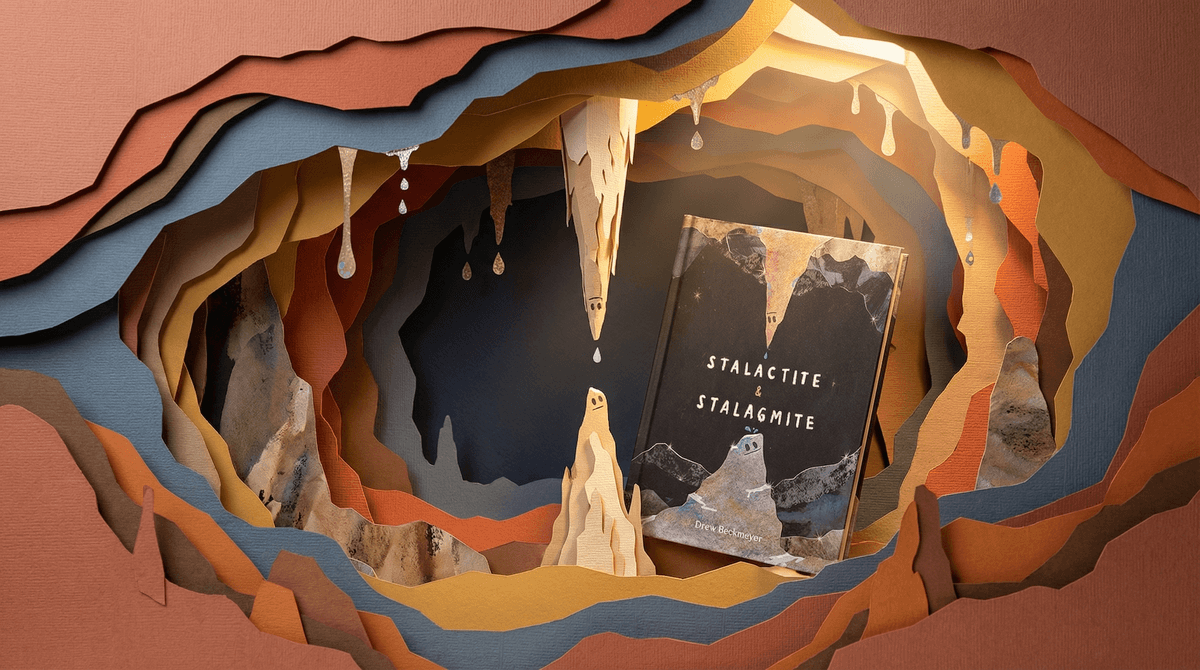
Stalactite & Stalagmite is a picture book by Drew Beckmeyer that tells the story of two cave formations who are slowly, impossibly slowly, growing toward each other over thousands of years. It's a love story told in geological time—which sounds like it could be the most boring concept ever, but somehow it's completely charming and oddly moving.
The book follows these two rock formations as they inch closer together, drop by mineral drop, year after year, century after century. They can't move or speak in any conventional way, but Beckmeyer gives them personality through minimal text and expressive illustrations. It's basically the world's slowest slow-burn romance, and it works beautifully.
Here's the thing about most kids' books: they're about immediate gratification, quick resolutions, problems solved by bedtime. Which is fine! Kids need those stories too. But Stalactite & Stalagmite does something rare—it teaches patience and perspective through actual geological processes.
The book doesn't talk down to kids about "being patient" or "good things take time." Instead, it just shows two formations existing, growing imperceptibly, waiting. And kids get it. They understand that these rocks are waiting for something important, something worth the wait.
The illustrations are simple but effective—mostly earth tones with these two formations rendered in a way that makes them feel like characters without being overly anthropomorphized. They're still clearly rocks. Just rocks with feelings and a very, very long game plan.
You'd think a book about rocks slowly growing would lose a 4-year-old's attention in about 30 seconds, but it doesn't. Kids are weirdly fascinated by deep time when you present it right.
The repetition works in the book's favor—each page shows incremental change, which creates a meditative rhythm. Young kids (ages 3-7) love the predictability and the building anticipation. Will they touch? When will they touch? The tension is real, even though we're talking about mineral deposits.
Older elementary kids (ages 7-10) appreciate the actual science of it. This book is a great jumping-off point for conversations about caves, minerals, how stalactites and stalagmites form (the book doesn't explicitly explain this, so you might need to learn more about cave formation to answer the inevitable questions), and the concept of geological time scales.
Plus, there's something inherently funny about a book where literally nothing happens quickly. Kids find that absurdity delightful.
This is a perfect counterbalance to the instant-gratification content that dominates so much of kids' digital media. While they're watching YouTube videos that change shots every 2.3 seconds or playing games with constant rewards and notifications, here's a book that says: sometimes the best things take thousands of years.
Reading level: The text is minimal and simple enough for early readers, but the concepts are sophisticated enough to grow with your kid. This is one of those rare books that works for a wide age range (roughly 3-10) for different reasons.
Discussion potential: This book opens up so many conversations:
- How old are things around us that we don't think about?
- What in our lives is worth waiting for?
- How do scientists know how old rocks are?
- What other natural processes happen on timescales we can't perceive?
Screen-free win: At 40 pages, this is a quick read, but kids often want to go back through it slowly, studying the incremental changes in the illustrations. It's naturally contemplative in a way that encourages slowing down—the opposite of the dopamine-hit pacing of most digital content.
Beckmeyer doesn't spell out the geology lesson explicitly, which is actually smart—he trusts kids to be curious. But here's what's happening: stalactites form from the ceiling down (think "T" for "top"), stalagmites form from the ground up (think "M" for "mountain"). They grow from mineral-rich water dripping and leaving deposits behind, and they grow incredibly slowly—often less than an inch per century.
When they eventually meet, they form a column. Which is exactly what happens in the book, and it's genuinely satisfying when it does.
You don't need to explain all this before reading, but having it in your back pocket for the inevitable "but HOW do they grow?" questions is helpful.
Look, this might seem like a weird book to feature on a digital wellness platform, but hear me out: one of the biggest challenges of raising kids in the digital age is helping them develop patience and the ability to appreciate things that unfold slowly.
Everything in their digital world is optimized for speed and instant feedback. Games give constant rewards. Videos autoplay the next episode. Social media delivers endless scroll. Even educational apps are designed around quick wins and frequent dopamine hits.
There's nothing wrong with any of that in moderation, but kids also need exposure to rhythms that are slower, deeper, and more contemplative. They need to know that some worthwhile things take time—whether that's learning a musical instrument, growing a garden, building a friendship, or two rocks slowly reaching for each other over millennia.
This book does that work quietly, without being preachy about it.
If your kid digs the slow-time, nature-focused vibe of this book, check out:
- The Story of Fish & Snail by Deborah Freedman (another quiet friendship story with beautiful illustrations)
- Lifetime: The Amazing Numbers in Animal Lives by Lola M. Schaefer (explores different timescales in nature)
- Old Turtle by Douglas Wood (contemplative and philosophical)
For digital content that has a similarly meditative quality, the Bluey episode "Sleepytime" has that same ability to slow down and be present, and the Minecraft creative mode can actually teach patience and long-term building projects if you guide it that way.
Stalactite & Stalagmite is a genuine gem (pun absolutely intended) that uses the slowest process in nature to teach kids about patience, perspective, and the beauty of deep time. It's a 10-minute read that will stick with your kid way longer than that.
In a world where their screens are constantly screaming for attention with bright colors and fast cuts, here's a book about two rocks who literally cannot move fast, and it's more emotionally resonant than half the algorithmically-optimized content they'll see this week.
Worth adding to your library, worth reading multiple times, worth the conversations it will spark about time, patience, and what it means to wait for something that matters.
Ages 3-10, though honestly, adults will appreciate it too.