

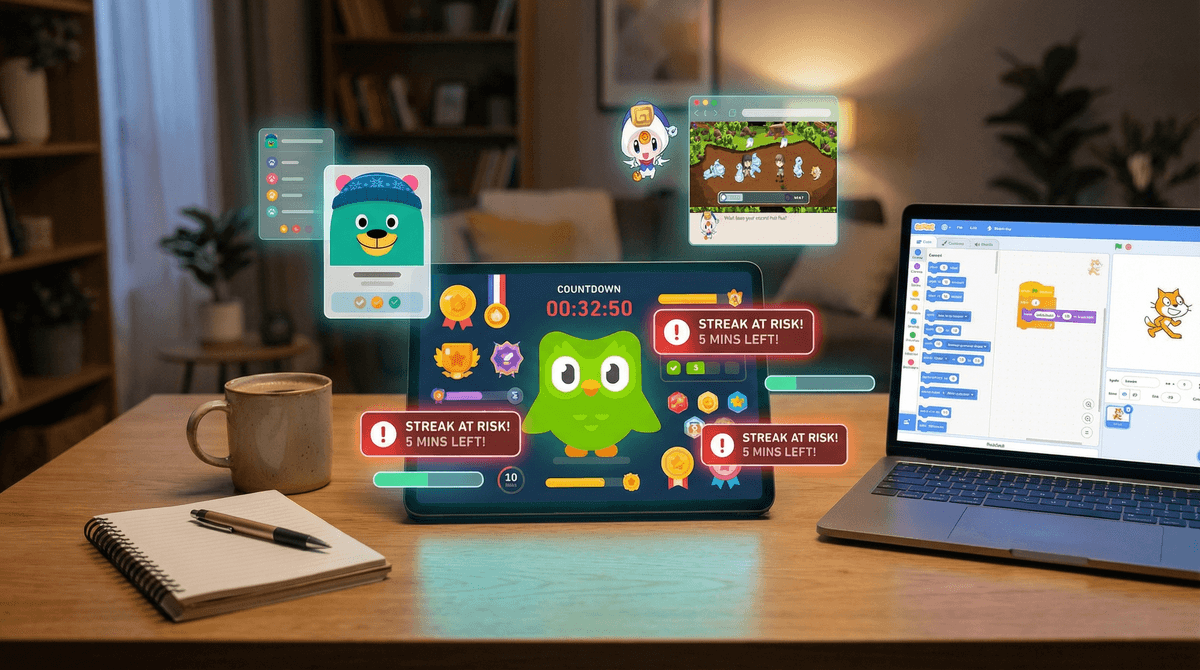
TL;DR: Learning apps use the same "addictive" loops as Fortnite to keep kids engaged. When the "fun" of a 100-day streak turns into a chore, it’s time to pivot. To keep the spark alive without the stress, try low-pressure alternatives like Scratch for creativity, Brains On! for passive learning, or Wingspan for family strategy night.
Ask our chatbot for a personalized list of "stealth learning" games for your child's age
We’ve all been there. It’s 7:45 PM, the kitchen is a mess, and you realize your kid hasn't done their "educational" screen time yet. Suddenly, the house is filled with the frantic chirping of the Duolingo owl or the aggressive combat music of Prodigy.
You feel a sense of relief because, hey, at least they aren’t watching Skibidi Toilet or some "Ohio" meme compilation on YouTube. But then you look at your child’s face. They aren't "learning" with a look of wonder; they have the thousand-yard stare of a corporate accountant during tax season. They are clicking through math problems as fast as humanly possible just to get a digital hat for their avatar.
This is the "Learning App Trap." It’s the moment when educational technology stops being a tool for growth and starts being a source of digital burnout.
Digital learning fatigue happens when the "gamification" of education—the streaks, the leaderboards, the badges, and the daily rewards—becomes the primary focus, rather than the content itself.
In the industry, we call these "dark patterns." They are the same psychological hooks used by Roblox to get kids to spend Robux, but they’re dressed up in the respectable clothing of "Common Core Math" or "Spanish Level 1."
Screenwise community data shows that by 4th grade, approximately 65% of kids begin to associate "educational apps" with "homework" rather than "play." When an app starts threatening a child with a lost "streak" or a lower ranking on a leaderboard, the brain’s stress response kicks in. At that point, the "learning" is effectively over; the "work" has begun.
It’s not all bad. These apps are popular for a reason. They provide:
- Immediate Feedback: Unlike a worksheet that sits in a backpack for three days, Khan Academy Kids tells them they're right right now.
- Agency: Kids get to choose their avatars and paths, which feels great when the rest of their lives are dictated by adults.
- Low Stakes (At First): Getting a math problem wrong in Adventure Academy feels less "scary" than getting a red "X" from a teacher in front of the class.
But eventually, the novelty wears off. The "badges" start feeling like "quotas."
How do you know if your child’s "good" screen time is actually draining them?
- The "Click-Through" Syndrome: They are guessing answers rapidly just to get to the next screen.
- Streak Anxiety: They panic or melt down if they can't access the app for one day because they'll lose their "status."
- The Reward Pivot: They only care about the mini-games after the lesson. In apps like Prodigy, the math is often just a "toll" you have to pay to play a battle game.
- Physical Tension: Hunched shoulders, sighing, or "rage-quitting" a math game. If they’re treating Zearn like it's Elden Ring, something is wrong.
Check out our guide on identifying dark patterns in kids' apps
If you’re seeing the burnout, it’s okay to delete the "drill" apps for a while. You aren't failing their future SAT scores. In fact, pivoting to creative or "stealth" learning can reignite their curiosity. Here are some of our top recommendations for learning that actually feels like a break.
Instead of consuming a game, let them build one. Scratch is a free coding platform from MIT. There are no "streaks" to maintain, just a blank canvas to create animations and games. It’s the ultimate antidote to the "passive clicker" apps.
Sometimes the best "digital" wellness is an analog break that feels like a movie. If your kid is burnt out on screens, read The Wild Robot together. It touches on AI, nature, and survival in a way that’s far more profound than any "coding for kids" app.
This is a beautiful tabletop game about collecting birds. It’s heavy on biology and resource management, but it feels like a high-end strategy game. It’s "stealth learning" at its finest. If your kid loves it, there’s also a Wingspan digital version for the Switch or PC that is surprisingly relaxing.
Podcasts are the ultimate "no-pressure" learning. Wow in the World is hilarious and high-energy. It teaches science without ever asking the kid to "submit an answer." It’s great for car rides or while they’re building with LEGOs.
If your younger child is tired of "learning to read" apps that beep at them for every mistake, try Storyline Online. It’s just famous actors reading great picture books. No quizzes, no points, just the joy of a story.
- Preschool (Ages 3-5): Keep it short. Apps like Khan Academy Kids are great, but 15 minutes is plenty. At this age, "learning" should mostly be physical and social.
- Elementary (Ages 6-10): This is the peak of "Streak Culture." Monitor their emotional state. If they are crying over a Duolingo streak, it's time for a "Digital Reset."
- Middle School (Ages 11-14): They’ll start using sites like Coolmath Games as a way to "look" like they’re working while actually just playing. Honestly? Let them. At this age, they need the mental break.
If you think your kid is feeling the pressure, don't just snatch the iPad away. Have a real conversation. You might be surprised by how much they actually hate the apps they spend so much time on.
Try saying:
- "I noticed you look pretty stressed when the Duolingo owl sends you those notifications. Does it still feel like fun, or does it feel like extra homework?"
- "If we took a break from Prodigy for a week, what would you want to play instead?"
- "I read that some apps are designed to make us feel 'guilty' if we don't log in every day. Do you ever feel that way?"
We want our kids to be "Screenwise"—which means being intentional about how they use tech, not just what they use. If an educational app is making your child miserable, it isn't "educational" anymore; it’s just another source of noise in an already loud digital world.
It is perfectly okay to prioritize your child's mental health over their "Daily Math Goal." Sometimes, 20 minutes of creative play in Minecraft or a family game of Catan will teach them more about problem-solving and resilience than a thousand digital badges ever could.
- Check the Streaks: Look at your kid's most-used "learning" apps. Are they maintaining streaks that cause them stress?
- Audit the "Fun": Ask your child to show you their favorite part of the app. If they skip the "learning" part to show you their avatar's outfit, you know where the value lies for them.
- Introduce a "Slow" Media Option: This week, swap one "drill" app session for a podcast like Brains On! or a creative tool like Scratch.
Learn how to set up a "Digital Wellness" plan for your family
Ask our chatbot about the best educational apps that DON'T use addictive streaks