

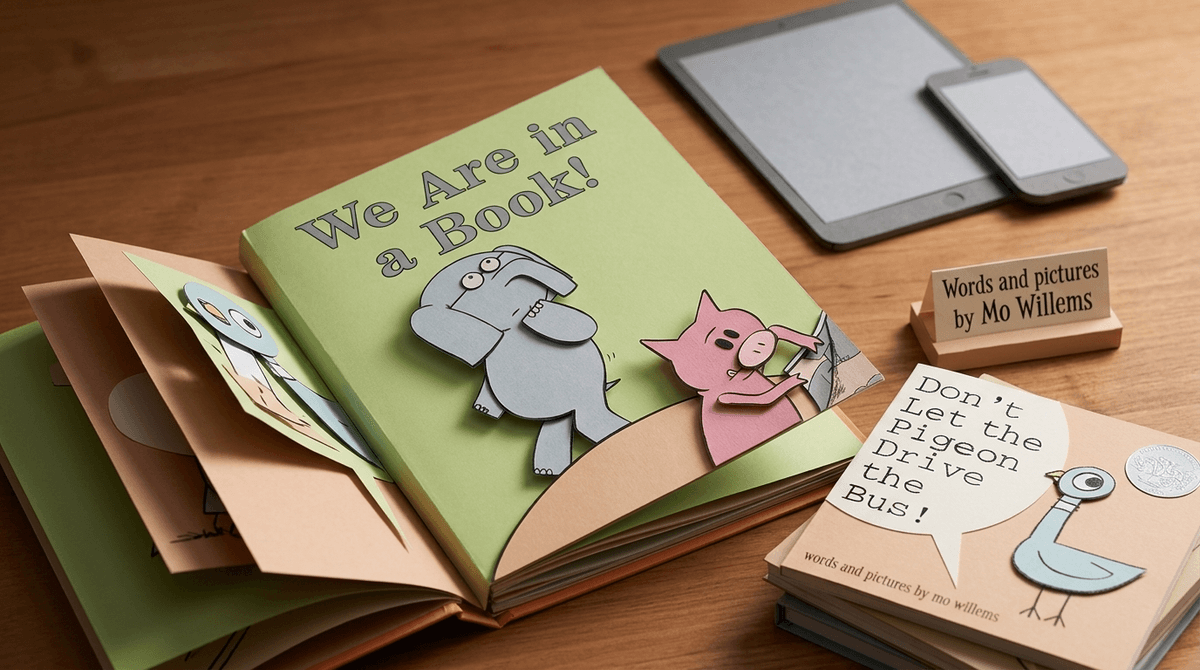
TL;DR: If you’re worried your kid’s attention span has been cooked by 15-second TikToks or the chaotic energy of Skibidi Toilet, Mo Willems’ We Are in a Book! is the ultimate "bridge" media. It uses the same interactive "hacks" as high-stimulation apps—breaking the fourth wall, demanding user input, and meta-humor—to trick "iPad kids" into loving a physical, paper-and-ink book.
Quick Links:
We’ve all seen it: a toddler walks up to a physical window or a TV screen and tries to "swipe" or "pinch-to-zoom." It’s a little bit cute and a lot bit terrifying. We’re raising kids in an era where media is expected to respond to them. If they click it, it should jump. If they shout at it, it should change.
When we try to pivot back to "traditional" reading, the transition can be rocky. To a kid used to the dopamine hits of Roblox or the bright, flashing colors of Cocomelon, a static book can feel, well, "Ohio" (that’s kid-speak for weird or cringe, for those of us still catching up).
Enter We Are in a Book!. Part of the legendary Elephant & Piggie series, this book is essentially a paper app. It’s the perfect tool for intentional parents who want to foster a love of reading without the "this is boring" meltdown.
The premise is simple but brilliant. Gerald (the anxious elephant) and Piggie (the exuberant pig) realize that someone is watching them. They realize they are, in fact, in a book.
Once they realize they have an audience, they start experimenting with their power. They realize they can make the reader say words out loud. They realize they can make the reader laugh. But then, they realize the most horrifying thing a digital-native kid can imagine: the book is going to end.
It’s meta-fiction for the preschool and kindergarten set, and it works because it treats the reader as a participant, not just a spectator.
If you look at the mechanics of a popular app like Toca Boca World or even a basic "touch and feel" digital game, the draw is agency. The kid is in charge.
We Are in a Book! gives them that same hit of dopamine through a few clever tricks:
The "Voice Command" Feature
In the middle of the book, Piggie realizes she can make the reader say a word. She chooses "Banana." When the reader (you, or the kid) says "Banana," the characters lose their minds with joy. For a kid, this is the analog version of hitting a button in Sago Mini World and seeing a character react. It proves that the media is "listening" to them.
The "Low Battery" Anxiety
When Gerald realizes the book ends on page 57, he has a full-blown existential crisis. For kids who are used to the "Low Battery" notification on an iPad or the "Screen Time is up" alert, this is deeply relatable. Mo Willems handles the "end of the fun" with humor, eventually showing the kids they can just "restart" the experience by asking the reader to read it again. It’s the original "Replay" button.
High Engagement, Low Stimulation
Unlike YouTube Kids, which often relies on rapid-fire cuts and high-decibel audio (what we call "brain rot" when it’s low quality), this book is visually minimalist. It’s just two characters on a white background. It teaches kids to focus on expression, dialogue, and timing rather than just being overstimulated by "bright-shiny-thing" syndrome.
If your kid vibed with Gerald and Piggie, you can keep that momentum going with other books that "act" like apps. These are great for building that focused, offline attention span.
This is the gold standard of interactive books. There are no flaps, no batteries, and no touchscreens. It just asks the reader to press a yellow dot, tilt the book, or shake it. When they turn the page, the dots have moved or changed color. It’s pure magic and incredibly effective for kids who need to do something while they read.
This book "hacks" the parent. It forces the adult reader to say ridiculous things like "Blork" or "I am a monkey who taught myself to read." Kids love it for the same reason they love Roblox trolls—it’s about subverting authority and making weird things happen in the "real world."
A classic for a reason. Grover begs the reader not to turn the page. Every page turn is a "click" that progresses the story against the protagonist's wishes. It’s high-stakes, interactive storytelling for the 3-to-5-year-old demographic.
Another Mo Willems masterpiece. The Pigeon spends the whole book trying to negotiate with the reader. It’s basically a "choose your own adventure" where the kid has to repeatedly say "No!" It’s great practice for setting boundaries—something we’re all trying to teach them in Minecraft chats anyway.
- Ages 2-4: They will love the physical interaction. They might actually try to pet the characters. This is a great time to introduce the concept that books are "alive" in their own way.
- Ages 5-7: This is the sweet spot for the humor. They understand the "meta" nature of the book. They’ll start to appreciate the irony of Gerald and Piggie being trapped in the pages.
- Ages 8+: Probably too "babyish" for independent reading, but honestly? Most 8-year-olds still find the "Banana" joke funny if they’re reading it to a younger sibling.
Is this book going to magically fix a kid who is currently three hours deep into a MrBeast marathon? No. But it is a tactical tool in your parenting kit.
The reality is that kids today have "fast brains." They are used to a high "rate of change" in their media. If you hand them a slow-paced, descriptive story about a meadow, they might check out before the first butterfly appears.
We Are in a Book! meets them where they are. It’s fast-paced, it’s funny, and it rewards their attention. It’s a "gateway drug" to longer-form, more traditional reading.
Learn more about the "bridge media" strategy for digital wellness
We Are in a Book! isn't just a cute story; it's a clever piece of media engineering. It mimics the interactivity of a tablet while keeping the "hardware" strictly analog.
If you’re trying to move your family's digital habits toward more "deliberate" consumption, this is a must-own. It proves to kids that the most "interactive" thing in the house isn't the iPad—it's their own imagination (and maybe a book that makes their parents say "Banana").
Next Steps:
- Read it together: Don't just hand it to them. The magic of this book is the interaction between the reader, the child, and the characters.
- Lean into the "Banana" joke: If you don't say it with 100% commitment, the joke fails. Be the "cringe" parent. They'll love it.
- Check out the rest of the series: Once they're hooked on Gerald and Piggie, you have about 25 other books to work through, like There is a Bird on Your Head!.
- Discuss the "End": Use the book's ending to talk about how all media has a beginning and an end—a healthy concept for kids who struggle with "just five more minutes" on the Nintendo Switch.