

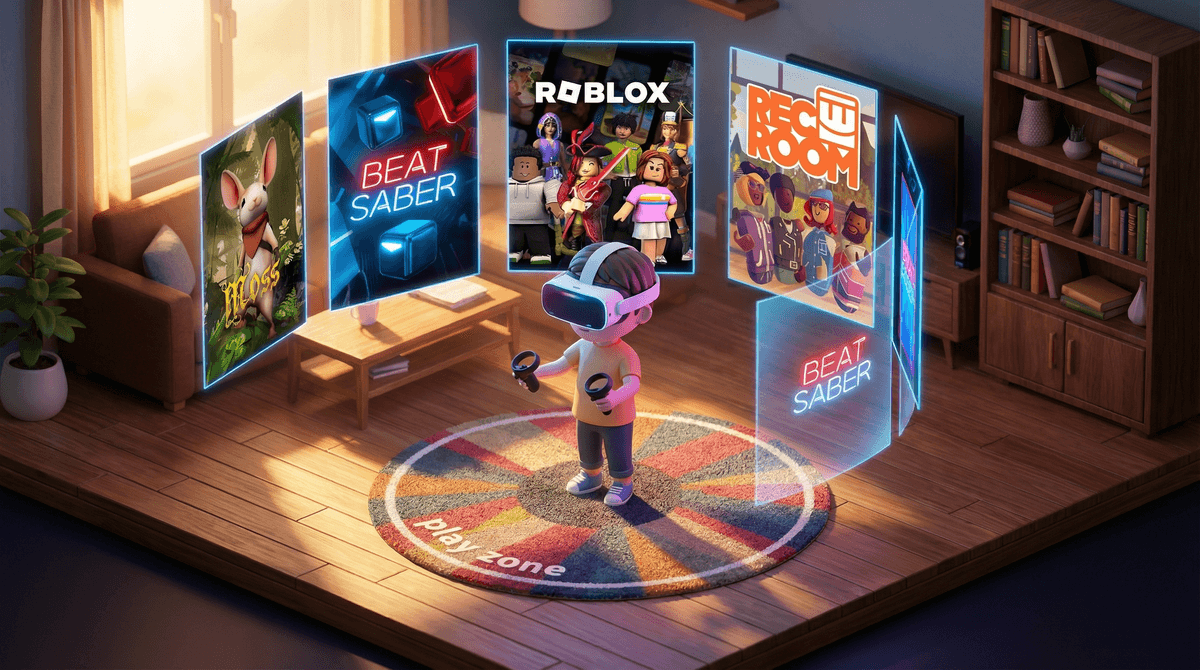
So your kid wants a VR headset. Maybe it was on the holiday list, maybe they tried one at a friend's house, or maybe they've been watching VR gameplay videos on YouTube and are convinced this is the future of gaming. And honestly? They're not entirely wrong. Virtual reality is legitimately cool technology. But before you drop $300-500 on a Meta Quest 3 or PlayStation VR2, let's talk about what VR actually looks like in your living room.
VR headsets are devices that strap to your face and immerse you in a 3D digital environment. Unlike regular gaming where you're looking at a screen, VR puts you inside the game. You turn your actual head to look around, move your actual body to dodge obstacles, and use hand controllers (or sometimes just your hands) to interact with virtual objects. Popular games include Beat Saber (rhythm game where you slice blocks with lightsabers), Gorilla Tag (exactly what it sounds like), and Roblox VR (yes, Roblox has VR support now).
The appeal is obvious. VR is genuinely immersive in a way traditional gaming isn't. But the real-life part of VR in real life? That's where things get interesting.
Kids love VR because it feels like stepping into another world. The immersion is next-level. Playing Minecraft in VR means you're actually in the blocky landscape, building structures at human scale. Social VR spaces like VRChat let kids hang out with friends as avatars in virtual worlds. And active games like Beat Saber provide legitimate exercise disguised as fun.
But you're hesitating because you've heard things. Maybe about kids getting motion sick. Or walking into walls. Or the fact that strapping a screen to a developing brain feels vaguely dystopian. Or that VR isolates kids even more than regular gaming. All valid concerns. Let's dig into them.
Motion sickness is real. Some kids (and adults) get nauseous in VR, especially with games involving smooth locomotion (moving through space without physically walking). It's called VR sickness or simulator sickness, and while some people adapt over time, others never do. Start with stationary experiences or games with teleport movement before diving into fast-paced action.
Space requirements matter. VR needs physical space. Not just "clear a corner of the living room" space, but "move the coffee table, establish boundaries, and accept that your kid will occasionally punch the ceiling fan" space. Most headsets have guardian systems that show virtual boundaries, but kids get excited and boundaries get ignored. Expect some bumps and bruises, especially in the first few weeks.
Eye strain and headset fit. VR headsets are heavy and press against faces. Most manufacturers recommend ages 10+ or 13+ (Meta Quest is officially 13+, though many families ignore this). Younger kids have smaller heads, closer-set eyes, and developing vision. The research on VR's impact on developing eyes is still emerging , but ophthalmologists generally recommend limiting sessions to 20-30 minutes for younger users and taking breaks.
It's actually active. This is the upside. VR gaming is legitimately physical. A 45-minute Beat Saber session can be a genuine workout. Kids who resist traditional exercise often love active VR games. But this also means they'll get sweaty, the headset will get gross, and you'll need to clean it regularly (which nobody does but everyone should).
Here's the paradox: VR can be incredibly social and incredibly isolating, sometimes simultaneously.
On one hand, social VR experiences let kids interact with friends in shared virtual spaces. They can play mini-games together, explore worlds, or just hang out. During the pandemic, VR provided genuine social connection for some kids when in-person interaction wasn't possible.
On the other hand, when your kid is in VR, they're completely checked out of physical reality. They can't hear you calling them for dinner. They don't notice the dog needs to go out. And from the outside, watching someone in VR is deeply weird—they're standing in your living room, wearing a face computer, flailing at invisible objects, occasionally laughing at jokes you can't hear.
The unsupervised social spaces are also a concern. Games like VRChat and Rec Room are essentially unmoderated social platforms where anyone can interact. Kids report encountering inappropriate behavior, language, and content. Unlike text-based chat where you can review logs, VR interactions are ephemeral and voice-based. You can't easily monitor what's happening without literally putting the headset on yourself.
Ages 6-9: Most experts and manufacturers say no. The headsets don't fit well, the content isn't designed for this age, and the physical/developmental concerns are highest. If you do allow it (no judgment, every family is different), keep sessions extremely short (10-15 minutes max), stick to single-player experiences, and supervise closely.
Ages 10-12: This is the gray zone. Some kids are ready, others aren't. Physical fit improves, but social maturity varies widely. Focus on single-player or local multiplayer games rather than open social spaces. Set strict time limits (20-30 minutes initially) and watch for motion sickness or headaches. Games like Beat Saber, Walkabout Mini Golf, and Moss work well for this age.
Ages 13+: This aligns with most manufacturers' recommendations. Teens can handle longer sessions and more complex games, but the social platform concerns intensify. They're more likely to want access to VRChat, Rec Room, and other social spaces where moderation is minimal. Setting up parental controls and having clear conversations about online safety becomes essential.
The headset is just the beginning. Budget for games ($15-40 each), accessories (better head straps, prescription lens inserts if needed), and potentially a larger play space. The Meta Quest 3 is currently the most popular standalone option at around $500, but you'll spend another $100-200 on games and accessories pretty quickly.
Not all VR is gaming. There are genuinely cool educational experiences—virtual museum tours, anatomy exploration, historical recreations. Apps like Wander let you explore the world via Google Street View in VR. But let's be real: kids want it for gaming.
You can't easily monitor what they're doing. Unlike a TV or computer screen everyone can see, VR is private. Some headsets let you cast to a phone or TV so you can watch what they're seeing, but the experience is disorienting to watch and kids know you're not watching every minute. This makes the "trust but verify" approach harder.
The technology is still evolving rapidly. Whatever you buy will feel outdated in 2-3 years. The Meta Quest 3 released in 2023 is already significantly better than the Quest 2 from 2020. If you're on the fence, waiting isn't a bad strategy.
VR isn't inherently good or bad—it's a tool that can provide genuine fun, exercise, and even learning, but comes with real physical and social considerations. The kids who seem to do best with VR are those who:
- Already have balanced screen time habits
- Have physical space to play safely
- Are old enough to self-regulate and report discomfort
- Have parents who stay engaged with what they're playing
If your kid struggles with screen time boundaries, VR will amplify those struggles, not solve them. If they're young enough that you're still managing most of their digital life, they're probably too young for VR.
But if you've got a 12-year-old who loves active gaming, has friends with headsets, and you're willing to set clear boundaries and enforce them? VR can be a legitimately cool addition to your family's digital life. Just move the coffee table first.