

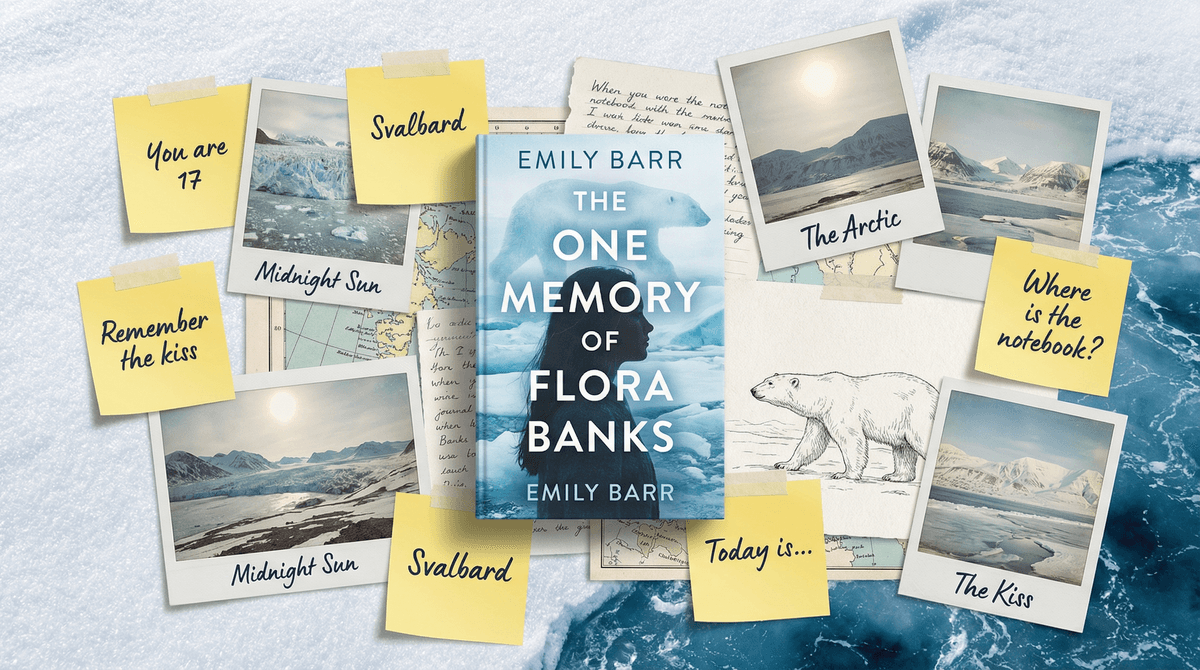
The One Memory of Flora Banks: A Parent's Guide to This YA Thriller About Memory Loss
The One Memory of Flora Banks by Emily Barr is a gripping YA thriller about a 17-year-old girl with anterograde amnesia (she can't form new memories) who suddenly remembers kissing a boy—and embarks on a solo journey to the Arctic to find him. It's best for ages 14+ due to mature themes including medical trauma, sexual content, parental manipulation, and a protagonist making genuinely dangerous decisions. This isn't a light beach read—it's an emotionally intense exploration of memory, identity, autonomy, and what happens when the adults in your life don't trust you to live.
Content heads-up: Sexual situations (not graphic but present), alcohol use, manipulation by trusted adults, and a teen traveling internationally alone while cognitively impaired. The book handles these thoughtfully, but they're central to the plot.
If your teen loved Before I Fall or We Were Liars, this hits similar emotional notes with an unreliable narrator you can't help but root for.
Published in 2017, this debut novel follows Flora Banks, who has had anterograde amnesia since age 10 due to a brain tumor. She can't form new memories—everything resets when she sleeps, and she relies on notes she writes to herself, her phone, and her parents' constant supervision to function. Her life is small, controlled, and safe.
Until one night, she kisses her best friend's boyfriend on a beach. And she remembers it. For the first time in seven years, a memory sticks.
When the boy (Drake) leaves for an Arctic research station in Svalbard, Norway, Flora becomes convinced that being with him is the key to getting her memory back. So she does what any desperate teenager would do: she gets on a plane to the Arctic. Alone. Without telling anyone. While unable to remember why she's there for more than a few hours at a time.
The book unfolds as Flora's journey—both physical and internal—as she tries to hold onto this one precious memory while navigating a world that resets constantly. It's part mystery (what really happened that night?), part coming-of-age story, and part meditation on identity when you can't trust your own mind.
The unreliable narrator hook is catnip for YA readers. Flora writes notes to herself constantly ("You are Flora Banks. You are 17. You had a brain tumor when you were 10..."), and readers piece together the truth alongside her. The repetition could be annoying, but it actually creates this hypnotic, disorienting effect that makes you feel Flora's confusion.
It's about autonomy. Flora's parents have kept her in a protective bubble for seven years—understandably, given her condition, but also suffocatingly. The book asks hard questions about when protection becomes control, and whether someone with cognitive disabilities has the right to take risks. For teens navigating their own pushes for independence, this resonates deeply.
The romance is complicated. Without spoiling anything, the "kissing Drake" memory isn't what it seems, and the book doesn't shy away from how vulnerable Flora is to manipulation. It's not a swoony romance—it's more about how we construct narratives about ourselves and what we want to believe.
The setting is genuinely cool. Svalbard is this remote Arctic archipelago where it's illegal to die (seriously—look it up) and polar bears outnumber people. The stark, beautiful, dangerous landscape mirrors Flora's internal state perfectly.
The Medical Accuracy Question
Emily Barr did her research, but she also took creative liberties. Real anterograde amnesia (like what Henry Molaist had after his famous brain surgery) doesn't work exactly like Flora's does. The "one memory sticks" plot device is... let's call it optimistic. But this isn't a medical textbook—it's a novel exploring what memory means for identity.
If your teen has questions about how memory actually works, this could be a great jumping-off point for learning about neuroscience . The book gets the emotional truth right even if the medical details are simplified.
The Manipulation Storyline
Here's where it gets heavy: Flora's parents have been lying to her. For years. About big things. The book reveals this gradually, and while their motivations are understandable (they're terrified and grieving), the betrayal hits hard. There's also manipulation from other characters who take advantage of Flora's memory loss.
This is actually the book's greatest strength as a conversation starter. It opens up discussions about:
- When is it okay to lie to protect someone?
- How do we balance safety with autonomy for people with disabilities?
- What does informed consent mean when you can't remember giving it?
The Sexual Content
Flora and Drake kiss, and there are references to wanting more. Later, there are situations where Flora is vulnerable to sexual exploitation (nothing graphic happens on the page, but the threat is there). The book handles this thoughtfully—it's not gratuitous—but it's definitely present and might be uncomfortable for younger readers.
Flora also discovers she's been sexually active before losing her memory, which she finds disorienting since she has no memory of it. It's handled with nuance, but it's mature content.
The "Dangerous Decisions" Factor
Flora travels to the Arctic. Alone. With severe cognitive impairment. She could have died. Multiple times. The book doesn't glorify this—it shows how terrifying and risky it is—but it also doesn't condemn Flora for wanting to live a bigger life than her parents allow.
Some teens might read this as inspiration to make their own dramatic gestures. Worth discussing the difference between "taking age-appropriate risks" and "getting on an international flight while cognitively impaired."
Ages 14+: The sweet spot. Readers this age can handle the mature themes and appreciate the nuanced questions about autonomy and identity. They're also old enough to understand why Flora's journey is both brave and genuinely dangerous.
Ages 12-13: Depends on the kid. Mature middle schoolers who've read books like The Fault in Our Stars or Thirteen Reasons Why can probably handle it, but be prepared for conversations about the sexual content and manipulation themes.
Ages 16+: Honestly, older teens might find Flora's voice a bit young and the romance plot frustrating (because it is—intentionally so). But the questions about memory and identity get more interesting the older you are.
If your teen reads this (or you read it together), here are some meaty conversation starters:
-
Flora's parents lied to protect her. Were they right to do so? No easy answers here, which makes it a great discussion.
-
What makes you "you" if you can't remember your past? Flora struggles with this constantly. She can't remember her brother, her childhood, her own personality development. So who is she?
-
The ending reveals [no spoilers] that Flora's memory of kissing Drake might not be accurate. Does it matter? If a memory is false but feels real to you, does it count?
-
How do we balance safety and autonomy for people with disabilities? Flora's parents aren't villains—they're terrified. But they've also infantilized her. Where's the line?
-
Flora does some genuinely dangerous things. Should we admire her courage or be frustrated by her recklessness? Both? Neither? This is the book's central tension.
The One Memory of Flora Banks is not a feel-good story. It's emotionally complex, sometimes frustrating, and asks hard questions without providing neat answers. The ending is... divisive (some readers love it, others find it devastating—I won't spoil which camp I'm in).
But it's also beautifully written, genuinely suspenseful, and features a protagonist who refuses to be defined by her disability even as she navigates its very real limitations. Flora is prickly, impulsive, and makes terrible decisions—and she's also brave, determined, and fighting for her right to exist as more than her parents' tragedy.
For teens ready to grapple with questions about identity, memory, and autonomy, this is a powerful read. For parents, it's a chance to talk about some really important stuff without it feeling like a lecture.
Just maybe don't read it right before your teen asks for permission to travel abroad alone. The timing would be awkward.
Other books in this vein: All the Bright Places, I'll Give You the Sun, Everything, Everything, and for a lighter take on memory loss, What I Lost.
Want to explore more YA books about disability representation? Or discuss how to talk to teens about autonomy and risk-taking? We've got you.