

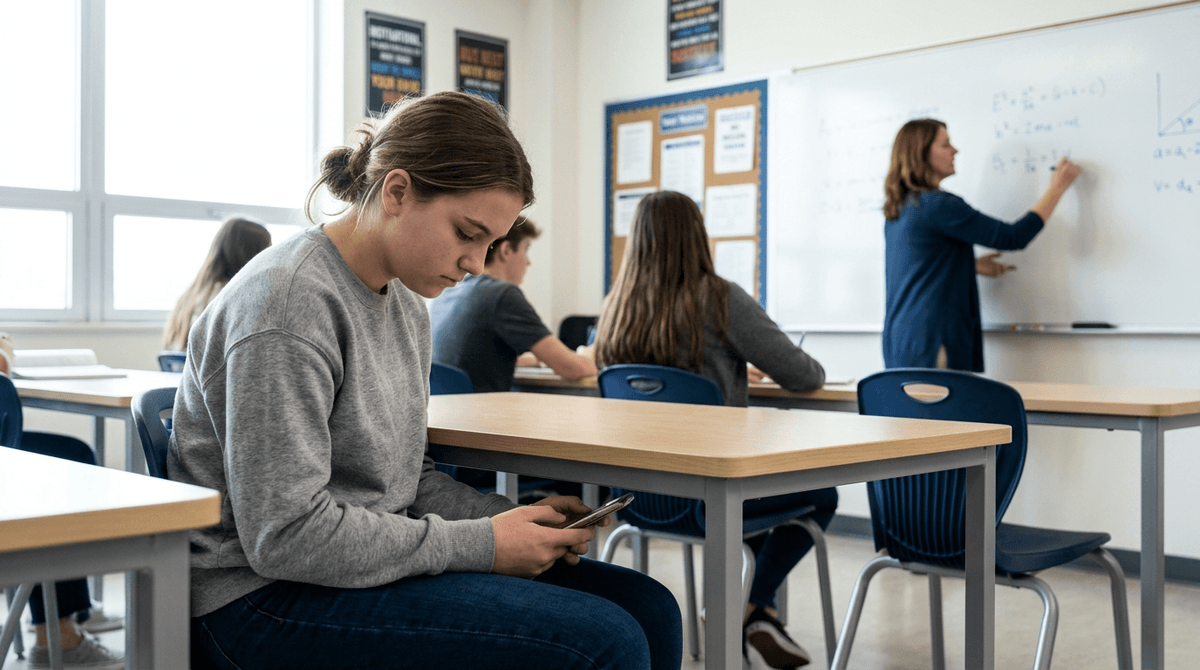
Educational technology works only when it’s a tool for the teacher, not a replacement for them. New global data warns that the presence of smartphones in schools consistently drags down student performance and emotional well-being.
Limit smartphone use in schools to protect student focus and academic progress. While digital tools can provide support when guided by a teacher, much of the evidence for their success is funded by the companies selling the products.
Schools are at a tipping point where "digital-first" is often mistaken for "better." For parents, this means the push for more iPads and apps in the classroom might actually be undermining a child’s ability to concentrate and learn deeply.
The data suggests that the mere proximity of a smartphone distracts students, leading to lower grades and increased anxiety. If a school's curriculum relies heavily on screens without direct teacher interaction, students often miss out on the human element that actually drives cognitive development.
Researchers are sounding the alarm because technology is moving faster than our ability to evaluate its impact. Governments and schools often buy into "modernization" without proof of efficacy, leaving students as the subjects for unproven digital experiments.
There is also a growing concern that the digital divide is widening in unexpected ways. While some families use tech as a supplement, lower-income students are increasingly given screens as a replacement for human instruction, which has long-term negative effects on equity and achievement.
The evidence for technology’s benefits in the classroom is surprisingly thin and frequently biased. Much of the current research showing positive outcomes for educational apps comes from the very commercial entities that profit from their adoption.
- Smartphone bans are on the rise: About one in four countries have now banned or restricted phone use in schools to minimize social and cognitive distraction.
- Distraction is universal: Even having a phone nearby—not even in active use—is linked to decreased academic performance across multiple global studies.
- The human factor remains supreme: Technology is most effective when it supports the teacher-student relationship rather than trying to bypass it.
We are over-relying on "personalized learning" algorithms that can unintentionally isolate children. Education is fundamentally a social process; when that process is outsourced to a tablet, students lose the social-emotional cues that help them retain information and develop empathy.
The "fast-tech" cycle also means that by the time a study proves a tool works (or doesn't), that tool has often been replaced by a newer, equally unvetted version. This creates a permanent state of experimentation in the classroom where the long-term effects on child development are unknown.
This is a massive global review covering 200 countries, which means the findings are broad and may vary by local context. A policy that makes sense in a large urban district may look different than one in a small private or rural school.
Most of the data is observational. While there is a strong correlation between phone use and lower grades, it is difficult to prove that the phone is the sole cause of academic decline. Additionally, the rapid turnover of software makes it difficult to find long-term data on any single specific platform.
- If your child's school allows personal smartphones in the classroom, advocate for "away for the day" policies that require phones to be stored in lockers or signal-blocking pouches.
- If a teacher recommends a new educational app, ask if the evidence for its effectiveness comes from an independent, non-commercial study or the app’s own marketing team.
- If your child is struggling with a specific subject, prioritize human tutoring or teacher office hours over "adaptive" software that claims to solve the problem through more screen time.
- If your child is using a tablet for homework, ensure the device is locked down to educational apps only to prevent the "switch-tasking" that drains cognitive energy and slows down learning.
Technology is a supplement, not a solution. Prioritize human-led instruction and support school policies that remove smartphones from the learning environment to ensure your child stays focused and engaged.
Unknown authors (n.d.). Technology in education.. — unesco.org