

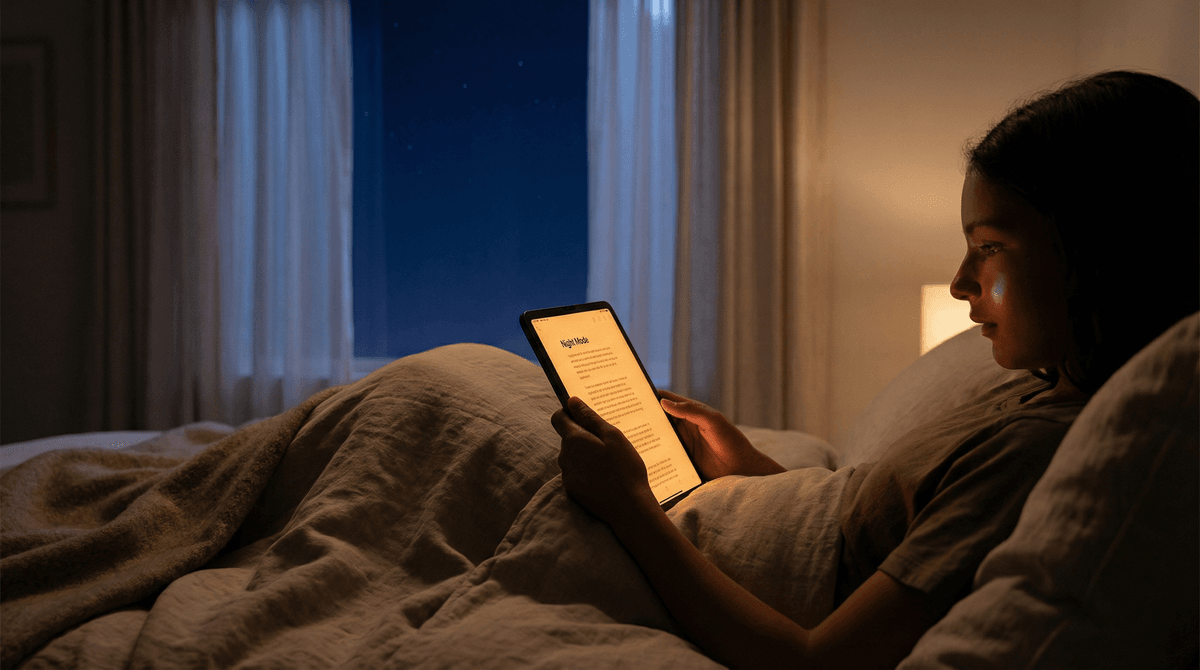
TL;DR: Blue light filters and "Night Mode" are helpful tools, but they aren't a magic fix for late-night screen struggles. While they reduce the "blue" spike that tells the brain it’s daytime, they can’t counteract the dopamine hit of a Roblox win or the "just one more" pull of TikTok. Use the filters, but prioritize low-stimulation content like Calm or Puffin Rock if screens are happening near bedtime.
Check out our guide on digital sleep hygiene for teens
Ask our chatbot about the best low-stimulation shows for toddlers
We’ve all been there: It’s 8:30 PM, your kid is supposed to be winding down, but they’re huddled over an iPad. You see that orange, amber glow on the screen and feel a tiny bit better because "Night Mode" is on. You think, Okay, at least the blue light isn’t frying their brain.
I hate to be the one to break it to you at school pickup, but the marketing hype around blue light filters has outpaced the actual science. It’s not that they’re useless—they’re just not the "get out of jail free" card tech companies want us to believe they are. If your kid is watching a high-octane MrBeast video or stressing over a Fortnite match, that amber tint is basically like putting a band-aid on a broken leg.
Blue light is a short-wavelength, high-energy light. In nature, the biggest source is the sun. It’s actually a good thing during the day—it tells our brains to be alert, focused, and awake.
The problem is that our devices—phones, tablets, and LED TVs—blast this same "wake up!" signal directly into our retinas at 9:00 PM. This suppresses melatonin, the hormone that tells our bodies it’s time to head to dreamland.
Night Mode (or "Night Shift" on Apple devices) works by shifting the color temperature of the display toward the warmer end of the spectrum. It reduces the amount of blue light, but it doesn't eliminate it. More importantly, it doesn't change what the kid is actually doing on the device.
Here’s the "No-BS" take: The light is only half the problem. The other half is psychological arousal.
If your teen is scrolling through "Ohio" memes or watching Skibidi Toilet (yes, it’s still a thing, and yes, it’s still weird), their brain is firing on all cylinders. They are engaged, laughing, or maybe feeling a little FOMO. That mental "on" switch is much harder to flip off than a light setting.
Research shows that while blue light filters might help melatonin levels recover slightly faster, the content is what keeps kids awake. A kid reading a boring e-book on a "bright" screen will likely fall asleep faster than a kid playing Brawl Stars on a "warm" screen.
Learn more about the difference between passive and active screen time
Ages 2-6: The "Low-Stim" Zone
At this age, blue light filters are almost irrelevant because the goal should be zero high-energy content before bed. If they’re watching something, make it "low-stim."
- Avoid: Bright, fast-paced shows like Cocomelon. Even with a filter, the frame-rate is like espresso for their eyes.
- Try: Bluey (the "Sleepytime" episode is a vibe) or Puffin Rock.
- The Filter: Turn it on, but don't rely on it. The best "filter" is a 1-hour screen-free window before bed.
Ages 7-12: The Gaming Peak
This is when Minecraft and Roblox start eating into sleep schedules.
- The Reality: These games are designed to be "sticky." They use variable reward loops that keep the brain in a state of high alert.
- The Fix: Set the "Night Mode" schedule to kick in at 6:00 PM—long before bedtime—so the brain has more time to adjust to the warmer light. But also, have a hard "controllers down" rule 45 minutes before lights out.
Ages 13-18: The Late-Night Scroll
Teens are the champions of the midnight scroll. This is where blue light glasses often enter the conversation.
- The Verdict on Blue Light Glasses: Honestly? Most of them are a gimmick. They might reduce eye strain slightly, but they aren't a substitute for a dark room.
- The Strategy: Encourage them to use f.lux on their laptops or the built-in "Night Shift" on their phones. But talk to them about the "Scroll Hole." If they're on Instagram at 11:00 PM, the blue light filter is just helping them see the content they shouldn't be looking at in the first place.
Technology companies love "Night Mode" because it removes the guilt of late-night usage. If you think the "Amber Glow" is protecting your kid, you’re more likely to let them stay on the device for an extra 30 minutes.
Here is the "Screenwise" reality check:
- Brightness matters more than color: A "warm" screen at 100% brightness is worse than a "blue" screen at 10% brightness. Dim the screen as the sun goes down.
- The "Brain Rot" effect: High-dopamine content (short-form video, competitive gaming) is a stimulant. You wouldn't give your kid a Mountain Dew at 8:00 PM; don't give them TikTok either.
- Audio is the loop-hole: If your kid "needs" a device to fall asleep, move them toward audio-only content. Brains On! or Wow in the World are great for this.
Don't just be the "phone police." Explain the why.
"Hey, I’m turning on this orange setting on your iPad. It helps your brain start to produce melatonin so you don't feel like a zombie tomorrow morning. But even with the orange light, if you're playing Among Us, your brain is still going to be too 'loud' to sleep. Let's switch to a book or a podcast in 10 minutes."
It's about teaching them to read their own body's signals. If they’re rubbing their eyes but still "grinding" for Robux, the filter isn't the solution—the "off" button is.
Blue light filters are a "nice to have," not a "need to have." They are a small part of a larger digital wellness strategy.
Next Steps for Your Family:
- Automate: Set "Night Mode" or "Night Shift" to turn on automatically at sunset on every device in the house (including yours!).
- Dim the Lights: Manually lower the brightness of all screens after dinner.
- Swap the Content: After 7:00 PM, move from "active" games (like Fortnite) to "passive" or "low-stim" media (like reading on a Kindle or listening to a story).
- The Charging Station: The only 100% effective blue light filter is a charger located in the kitchen, not the bedroom.
Ask our chatbot for a personalized evening screen-time routine
Parenting in 2026 is a marathon of small decisions. Don't stress about the "perfect" filter—focus on the rhythm of your home. A little less light and a little more quiet goes a long way, even if your kid thinks your "no screens after 8" rule is totally "mid."