

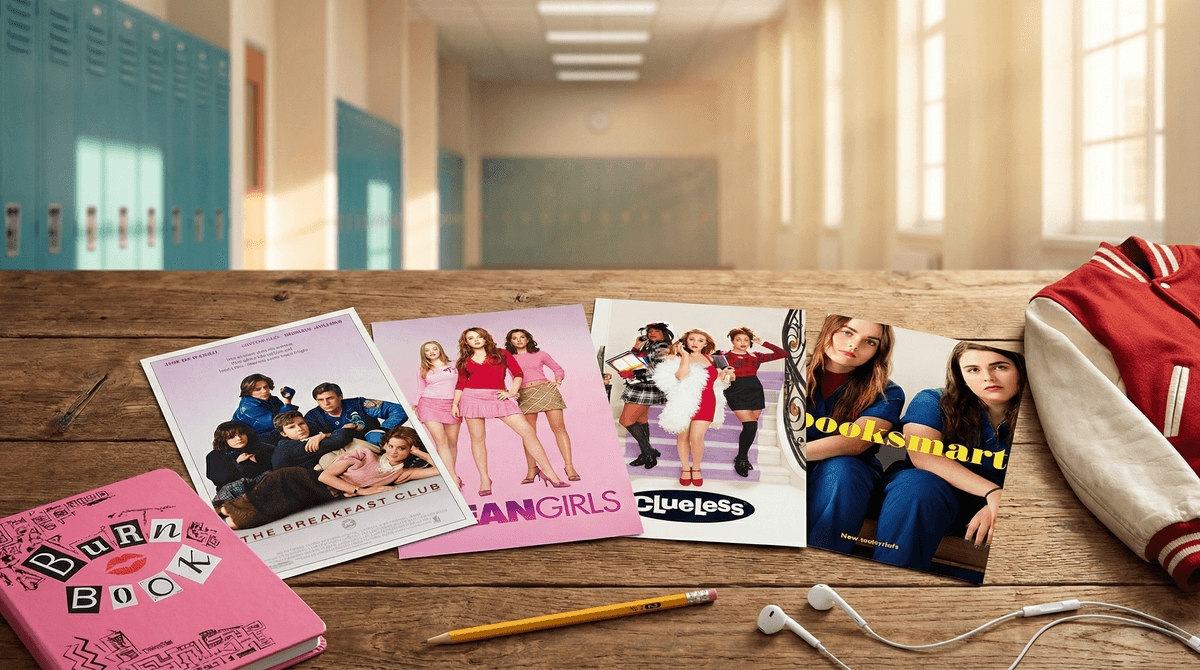
The Ultimate Guide to High School Movies: Classics, Content Warnings & Conversation Starters
TL;DR: High school movies are a rite of passage, but they're also time capsules of their era's attitudes about sex, consent, bullying, and identity. Here's what you need to know about the classics—from The Breakfast Club to Mean Girls—including what holds up, what doesn't, and how to watch them together thoughtfully.
Jump to:
- The Breakfast Club (Ages 13+)
- Ferris Bueller's Day Off (Ages 11+)
- Clueless (Ages 13+)
- 10 Things I Hate About You (Ages 13+)
- Mean Girls (Ages 13+)
- Easy A (Ages 14+)
- The Edge of Seventeen (Ages 14+)
- Booksmart (Ages 15+)
High school movies occupy this weird cultural space where they're simultaneously nostalgic comfort watches for adults and discovery experiences for teens. Your kid's probably heard references to "on Wednesdays we wear pink" or "Bueller? Bueller?" without knowing where they came from. And honestly? These movies can be great conversation starters about social dynamics, identity, peer pressure, and how culture has (or hasn't) evolved.
But let's be real: many beloved high school movies were made in eras with very different attitudes about consent, homophobia, body shaming, and what counts as "romantic" behavior. Watching them now requires some context and willingness to pause and discuss.
High school films capture something universal about adolescence—the social hierarchies, the identity experimentation, the feeling that everything matters SO MUCH right now. They can help kids feel less alone in their experiences and give you shared cultural references to discuss real-life situations.
Plus, watching older films together creates natural opportunities to talk about how social norms have changed. Why was stalking considered romantic in the '80s? Why were gay characters always the punchline? How has our understanding of consent evolved? These aren't just movie conversations—they're cultural literacy lessons.
Ages 13+ | 1985 | R
The gold standard of high school movies follows five stereotypes—the brain, the athlete, the basket case, the princess, and the criminal—stuck in Saturday detention together. It's beautifully acted, genuinely moving, and the "we're all just trying to figure out who we are under our parents' expectations" theme is timeless.
What holds up: The emotional honesty about parental pressure, depression, and the exhaustion of performing your assigned role. Ally Sheedy's character discussing her compulsive lying and John Hughes' understanding that every kid is dealing with something.
What doesn't: The sexual harassment played for laughs (Bender literally looks up Claire's skirt and hides under the desk), the makeover trope that suggests Allison needs to look "normal" to be worthy of attention, and some casual homophobic language.
Talk about it: Why do you think Bender acts so aggressive? What does Claire mean when she says her friends would laugh at her for being friends with them? Do you think they'll actually be friends on Monday?
Ages 11+ | 1986 | PG-13
The most purely fun entry on this list. Ferris is charismatic, clever, and takes a mental health day that becomes an adventure through Chicago with his anxious best friend Cameron and girlfriend Sloane.
What holds up: Pretty much everything. The fourth-wall breaking, the celebration of taking a break from achievement culture, the genuine friendship between Ferris and Cameron, and Matthew Broderick's infectious joy.
What doesn't: Honestly, this one ages better than most. Some '80s fashion crimes and a few dated references, but the core message about not being so caught up in the future that you miss the present is evergreen.
Talk about it: Is Ferris actually a good friend to Cameron, or is he manipulative? When is it okay to break rules? The scene in the art museum is genuinely beautiful—what do you think Cameron is feeling?
Ages 13+ | 1995 | PG-13
A loose adaptation of Jane Austen's Emma set in Beverly Hills, following wealthy, well-meaning Cher as she navigates fashion, friendships, and eventually her own growth. It's smart, funny, and more substantive than it initially appears.
What holds up: The female friendships, Cher's character growth from shallow to self-aware, the surprising progressive politics (Cher argues for accepting Haitian refugees in class), and the way it gently mocks privilege while still being entertaining.
What doesn't: Some fatphobic jokes, a teacher-student relationship played as romantic (gross), and the step-sibling romance that's... fine I guess, but still kind of weird? Also, the extreme wealth is presented as totally normal, which is worth discussing.
Talk about it: How does Cher change throughout the movie? What does she learn about herself? Why do you think she's so invested in "helping" everyone around her?
Ages 13+ | 1999 | PG-13
A Taming of the Shrew adaptation that actually improves on Shakespeare by making Kat (the "shrew") a feminist with legitimate reasons for her anger, not just a woman who needs to be "tamed." Heath Ledger is charismatic as Patrick, the guy initially paid to date her.
What holds up: Kat is allowed to be smart, angry, and complicated without being punished for it. The movie respects her boundaries and interests. The poetry scene is genuinely moving. Julia Stiles is fantastic.
What doesn't: The premise that Patrick is paid to date Kat is still pretty problematic, even though the movie acknowledges it. Some slut-shaming language and the subplot about the younger sister wanting to date an older guy who's clearly a jerk.
Talk about it: Why is Kat so angry at the beginning? Is it fair that she's called "difficult" when she's just being honest? What makes Patrick's feelings eventually become real?
Ages 13+ | 2004 | PG-13
Written by Tina Fey and based on the non-fiction book "Queen Bees and Wannabes," this is the rare teen comedy that's both hilarious and genuinely insightful about female social aggression. Cady moves from homeschooling in Africa to American high school and gets caught up in the popular girl hierarchy.
What holds up: Everything. The writing is sharp, the observations about girl-on-girl bullying are accurate, and the message that "calling each other sluts and whores just makes it okay for guys to call you sluts and whores" is still relevant. The math competition subplot respects Cady's intelligence.
What doesn't: Some jokes that wouldn't fly now (the "fugly slut" joke, some fatphobic humor), and the way Kevin G's character is written as a racial stereotype.
Talk about it: Why do the Plastics have so much power? What makes someone "cool" at your school? Why does Cady start becoming mean herself? The scene where all the girls apologize is kind of unrealistic—do you think real change happens that easily?
Ages 14+ | 2010 | PG-13
A smart, self-aware take on The Scarlet Letter where Olive deliberately embraces her reputation as the school slut to help closeted and unpopular guys. Emma Stone is brilliant, and the movie has surprisingly thoughtful things to say about slut-shaming and religious hypocrisy.
What holds up: The critique of how quickly rumors spread and how girls are judged for their sexuality while boys are celebrated. The supportive parents are refreshing (Stanley Tucci and Patricia Clarkson are perfect). The movie respects Olive's intelligence and agency.
What doesn't: The premise requires a level of social obliviousness that's hard to believe in the smartphone era (though the movie predates widespread social media). Some of the religious characters are a bit cartoonishly hypocritical.
Talk about it: Why do you think the rumor spreads so fast? Why are girls judged differently than boys for the same behavior? What would happen if this happened today with social media?
Ages 14+ | 2016 | R
Possibly the most realistic high school movie ever made. Nadine is awkward, anxious, and dealing with her best friend dating her older brother. It's funny but also genuinely uncomfortable in the way real adolescence is uncomfortable.
What holds up: All of it. Hailee Steinfeld's performance is phenomenal. The movie doesn't make Nadine's problems magically disappear—she's still awkward and anxious at the end, but slightly more self-aware. The teacher-student relationship (Woody Harrelson) is appropriately boundaried and mentoring rather than romantic.
What doesn't: The R rating is for language and some sexual content, but it's not gratuitous—it's realistic to how many teens talk and think. Some parents might find Nadine's behavior too cringeworthy, but that's kind of the point.
Talk about it: Why is Nadine so hard on herself? Have you ever felt like everyone else has it figured out except you? What does she learn about how her actions affect other people?
Ages 15+ | 2019 | R
Two academic overachievers realize on the eve of graduation that they could have been having fun AND getting good grades, so they try to cram four years of partying into one night. It's hilarious, heartfelt, and features a wonderfully normalized queer storyline.
What holds up: The female friendship is the central relationship and it's beautifully written. The movie respects different kinds of intelligence and paths to success. The diversity feels natural rather than tokenized. The stop-motion sequence is inspired.
What doesn't: The R rating is earned—there's drug use, sexual content, and lots of profanity. It's not for younger teens, but for older high schoolers, it's pretty perfect.
Talk about it: Do you think you can be successful AND have fun, or do you have to choose? Why do Amy and Molly assume everyone else is less smart than them? What does real friendship look like when you disagree about something important?
Beyond the classics, some recent entries deserve attention:
Spider-Man: Homecoming (Ages 11+) - The best superhero-as-high-school-movie, with genuine stakes about wanting to prove yourself and academic decathlon team dynamics.
Eighth Grade (Ages 13+) - Technically middle school, but Bo Burnham's directorial debut is painfully accurate about social media anxiety and the performance of confidence.
The Half of It (Ages 13+) - A thoughtful Cyrano de Bergerac adaptation about a shy, queer Chinese-American girl ghostwriting love letters. Beautiful and melancholy.
Love, Simon (Ages 12+) - The first major studio teen rom-com with a gay protagonist. Sweet, funny, and genuinely moving about coming out on your own terms.
Some "classics" have aged so poorly that they're more useful as cultural artifacts than entertainment:
Sixteen Candles - The sexual assault played for laughs and the racist caricature of Long Duk Dong make this basically unwatchable by modern standards.
Revenge of the Nerds - Features actual rape-by-deception presented as romantic. Just no.
American Pie - The webcam scene is a sex crime. The obsession with virginity loss is dated and gross. If your teen has already seen it, fine, but don't introduce it.
She's All That - The entire premise is a cruel bet. The makeover trope is insulting. 10 Things I Hate About You does the same basic story much better.
Ages 11-12: Start with Ferris Bueller's Day Off, Spider-Man: Homecoming, or Love, Simon. These have high school settings but age-appropriate content.
Ages 13-14: Mean Girls, Clueless, 10 Things I Hate About You, and The Half of It are good next steps. Watch The Breakfast Club together and pause for discussions.
Ages 15+: Easy A, The Edge of Seventeen, and Booksmart are mature but worthwhile. These deal with sexuality, mental health, and identity in realistic ways.
Set expectations: "This movie was made in 1985, so some attitudes about relationships and consent are different than what we understand now. Let's watch it and talk about what's changed."
Pause for questions: If something problematic happens, hit pause. "Did that seem okay to you? How would that scene be different if it were made today?"
Ask open-ended questions: Not "this is bad, right?" but "what did you think about that?" Let them form their own opinions.
Connect to their lives: "Do you think your school has social hierarchies like this? What makes someone popular at your school?"
Acknowledge the good parts: You can appreciate the performances and themes while critiquing the problematic elements. Critical viewing doesn't mean joyless viewing.
High school movies are cultural touchstones that can create genuine connection between you and your teen—but they work best when you watch them together and talk about what you're seeing. The classics have earned their status for good reasons (great writing, memorable performances, universal themes), but they also reflect the limitations of their time.
Use these movies as conversation starters about consent, friendship, identity, and how culture evolves. Your kid is going to encounter these references anyway—better to watch together and discuss than have them absorb the messages uncritically from clips on TikTok.
And honestly? Some of these movies are just really good. The Breakfast Club's therapy circle scene still hits. Booksmart's pool scene is hilarious. The Edge of Seventeen perfectly captures the agony of being seventeen. These movies endure because they tap into something true about adolescence, even when the specifics are dated.
Start with what they're curious about: If they've heard Mean Girls references, start there. If they're into superheroes, try Spider-Man: Homecoming.
Make it a regular thing: "Classic movie night" once a month gives you built-in conversation time and shared cultural references.
Let them choose: After watching a few together, ask which ones resonated with them and why. Their choices will tell you a lot about what they're thinking about.
Check out conversation starters for teens if you want more ways to turn movie watching into meaningful discussions.
Explore alternatives to doomscrolling if you're looking for more screen-based activities that actually bring your family together.
The goal isn't to curate a perfect, sanitized viewing experience. It's to help your teen develop critical thinking skills, understand cultural context, and feel comfortable discussing complicated topics with you. High school movies, with all their flaws and brilliance, are actually pretty great tools for that.