

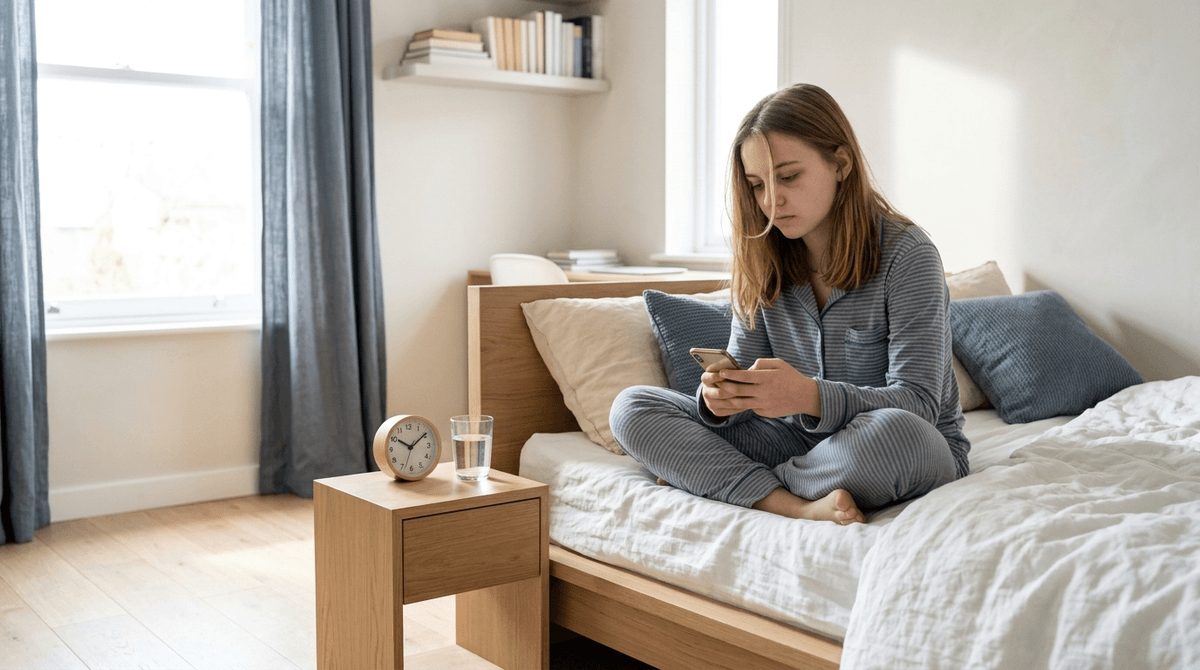
High screen time and insufficient sleep are the primary lifestyle drivers of adolescent depression, with the two habits working together to create a "triple threat" risk for teen mental health. While diet matters, the data suggests that for most teenagers, the battle for their mood is won or lost in the hours between sunset and school.
Prioritize sleep hygiene and screen limits over dietary perfection to protect teen mental health. The combination of more than two hours of daily screen time and chronic sleep deprivation is the single most consistent predictor of depressive symptoms, particularly for girls.
Parents often spend significant emotional energy policing sugar intake while treating "just one more episode" or late-night scrolling as a minor infraction. This research suggests that hierarchy is backward. The mental health cost of a ruined sleep schedule and excessive digital consumption far outweighs the impact of a soda.
Making a decision to pull the phone at 9:00 p.m. isn't just about discipline; it is a direct intervention against depression. This study clarifies that lifestyle factors don't exist in a vacuum; they cluster into patterns that either shield a child's brain or leave it vulnerable to mood disorders.
Researchers wanted to move beyond looking at single habits like "too much TV" or "too much candy." They analyzed how different behaviors—specifically sugar intake, screen time, and sleep duration—combine to impact the adolescent brain.
The goal was to identify which "lifestyle packages" are most toxic to mental health. By studying over 19,000 students, the authors aimed to find out if certain habits, like getting enough sleep, could "cancel out" the negative effects of other habits, like high screen use.
The study found a clear "triple threat" pattern: teens who combined low sugar intake with high screen time and low sleep had the highest risk of depressive symptoms.
- Girls are more vulnerable. Approximately 18% of girls reported depressive symptoms compared to 15% of boys, with risk peaking during senior high school.
- The 2-hour threshold is real. For both sexes, crossing the two-hour mark for daily screen time was independently linked to higher odds of depression.
- Sleep is a buffer for boys, but less so for girls. For boys, getting enough sleep seemed to mitigate some of the damage caused by screens. For girls, high screen time remained a significant depression risk even when they got the recommended amount of sleep.
- The "Sugar Paradox." In a counterintuitive twist, teens who drank at least one sugary beverage daily had 40–50% lower odds of depression than those who avoided them entirely.
The "sugar paradox" is likely a social signal, not a nutritional recommendation. In many adolescent circles, "grabbing a drink" is a primary social activity. Teens who are completely restricted from sugar—or who are too depressed to socialize—may be missing out on the protective benefits of friendship and peer connection.
Furthermore, the "triple threat" of low sugar/high screens/low sleep often describes a teen who is "self-medicating" or "doomscrolling" in isolation. They are using screens to cope with exhaustion and skipping meals or social snacks because of low mood. It's a cycle where the lifestyle isn't just causing the depression; it’s a symptom of it.
This was an observational, cross-sectional study. It can tell us that screens, sleep, and depression are linked, but it cannot prove which one came first. It is entirely possible that depressed teenagers simply have a harder time falling asleep and use screens as a way to numb their feelings.
The data also relies on self-reporting from students in Ningbo, China. Cultural pressures regarding school performance and social media use in a developed Chinese coastal city may differ from rural environments or Western contexts. What "senior high school" stress looks like in Ningbo may be more intense than in other regions.
- If your daughter is spending more than two hours a day on social media, set a firm "screen-free" window even if she is already a "good sleeper." The data shows that for girls, sleep alone doesn't fully neutralize the mental health impact of high screen use.
- If your son is a heavy gamer or late-night scroller, prioritize the "lights out" time above all else. For boys, preserving the sleep window is the most effective way to buffer the brain against the depressive effects of heavy digital use.
- If you have to choose which "health" battle to fight this week, pick the phone over the pantry. The link between sleep/screens and depression was much more consistent and powerful than the link between sugar consumption and mood.
- If your teen is struggling with mood, look at their lifestyle as a "package." Improving just one area (like cutting out soda) is unlikely to help if they are still scrolling until 1:00 a.m. The biggest gains come from addressing screens and sleep simultaneously.
The most effective way to protect a teenager’s mood is to defend their sleep cycle from their smartphone. While we worry about what they eat, the real risk is the "triple threat" of being sedentary, staring at a screen, and staying awake long past the brain's expiration point.
Lin Y, Huang JY, Hu ZB et al. (2026). Sex- specific interplay of combined lifestyle patterns and their association with depressive symptoms among Chinese adolescents: a school-based cross-sectional study. Frontiers in psychiatry. doi:10.3389/fpsyt.2026.1747059 — pubmed.ncbi.nlm.nih.gov