

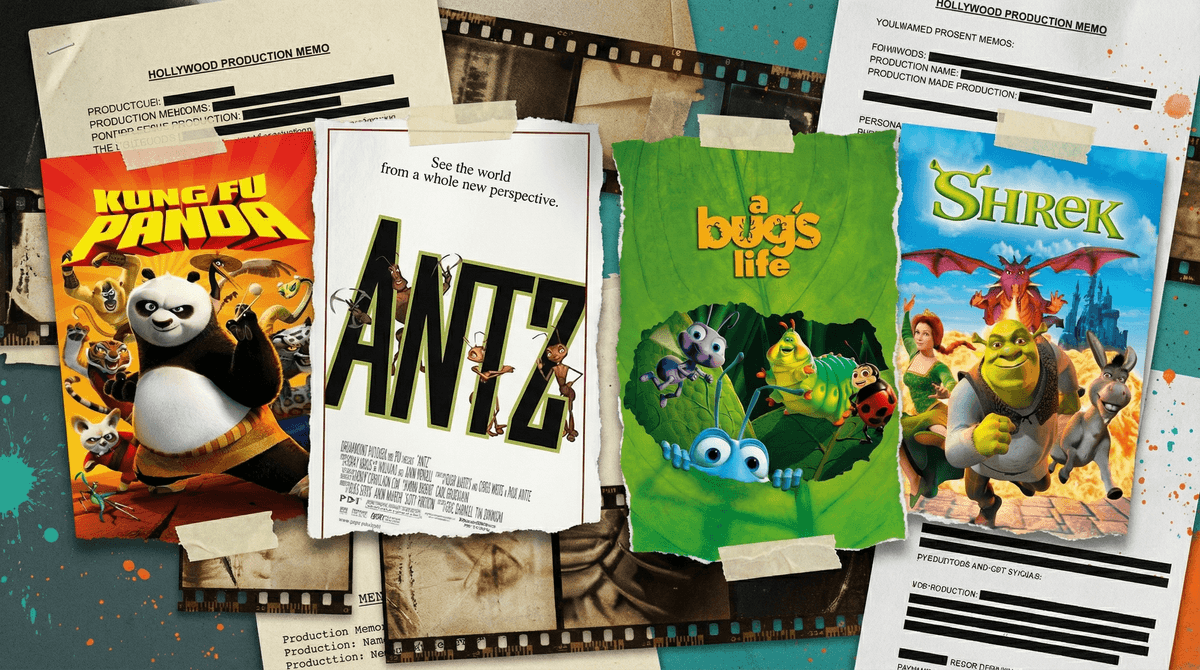
Before there was Shrek, before Kung Fu Panda, before DreamWorks became the studio that could make you cry about a panda finding his dad, there was Antz — a 1998 animated film about a neurotic worker ant named Z (voiced by Woody Allen) who falls for Princess Bala (Sharon Stone) and accidentally becomes a revolutionary hero.
But here's the thing: Antz isn't just DreamWorks' first animated movie. It's the opening shot in one of the most dramatic corporate rivalries in Hollywood history, a story involving ex-Disney executives, dueling bug movies, and a race to theaters that would reshape the entire animation industry.
And if you're wondering why your kid might stumble across this nearly 30-year-old movie on streaming, understanding its backstory actually matters for understanding the landscape of animated films they watch today.
In 1994, Jeffrey Katzenberg left Disney after a very public falling out with Michael Eisner. Katzenberg had been instrumental in Disney's animation renaissance (The Little Mermaid, Beauty and the Beast, The Lion King), and he was not leaving quietly. He teamed up with Steven Spielberg and David Geffen to form DreamWorks SKG, with one very specific goal: compete directly with Disney.
Here's where it gets messy. While still at Disney, Katzenberg knew about a bug-themed animated project in development called A Bug's Life. When he left, he fast-tracked Antz at DreamWorks, assembling an all-star voice cast and pushing for a release date that would beat Pixar/Disney to theaters by two months.
Was this corporate espionage? Strategic business? Petty revenge? Yes to all three, probably. John Lasseter (Pixar's creative lead) felt betrayed. Steve Jobs was furious. The trades called it "the bug wars." It was deliciously dramatic.
DreamWorks won the race — Antz hit theaters in October 1998, while A Bug's Life came out in November. But here's the twist: both movies succeeded. A Bug's Life made more money, but Antz proved that DreamWorks could compete, that there was room for more than one animation studio, and that animated films didn't have to follow the Disney formula.
You might be thinking, "Cool Hollywood gossip, but why should I care?" Fair question. Here's why:
1. Antz established that animated films could be for adults too. Unlike Disney's family-friendly formula, Antz was explicitly marketed to older kids and adults. It had Woody Allen's neurotic humor, political themes about conformity and individualism, and jokes that sailed over kids' heads. This opened the door for everything from Shrek's pop culture references to Spider-Verse's sophisticated storytelling.
2. The "bug wars" created healthy competition. Before DreamWorks, Disney/Pixar had a near-monopoly on quality animation. The rivalry pushed both studios to innovate faster, take bigger creative risks, and ultimately give us a much richer landscape of animated content. Your kid's favorite movies probably wouldn't exist without this competition.
3. It proved there was an audience for "alternative" animation. Antz was darker, more cynical, and more adult than anything Disney was making. It showed that animation could be a medium for different kinds of stories, not just princess tales and hero's journeys.
Let's be real: Antz is fine. It's rated PG, and it holds up better than you'd expect for a movie pushing 30. The animation looks dated compared to modern standards (this was early CG, and it shows), but the voice acting is solid and the story moves.
Age-wise, I'd say:
- Ages 6-8: Probably too talky and abstract. The themes about conformity and social hierarchy will go over their heads, and there's some mild violence in the war sequences.
- Ages 9-12: This is the sweet spot. Old enough to appreciate the humor, young enough to still be entertained by animated bugs.
- Ages 13+: They might find it a bit juvenile, but if they're into animation history or just want something lighter, it works.
Content considerations:
- Some mild language (nothing worse than "damn")
- Battle sequences with ant casualties (not graphic, but present)
- Themes about challenging authority that might spark... interesting dinner conversations
- Woody Allen's voice, which, depending on your family's awareness of his personal controversies, might be uncomfortable
The movie doesn't have the emotional depth of Pixar's best work or the irreverent humor of later DreamWorks films like Shrek. It's a solid B+, a historical curiosity more than a must-watch.
If your kid discovers Antz (it's currently streaming on various platforms), here are some conversation starters:
"Why does this look so different from modern animated movies?" Great opportunity to talk about how animation technology has evolved. Show them a clip from Toy Story (1995) and then something recent like Spider-Man: Into the Spider-Verse to see the progression.
"Why are all the ants so stressed about following rules?" The movie's themes about conformity vs. individualism are actually pretty sophisticated. It's a chance to talk about when following rules makes sense and when questioning authority is important.
"Can we watch A Bug's Life next?" Absolutely! Make it a double feature and let them compare. A Bug's Life is more kid-friendly, funnier, and has better animation, but Antz has more edge. Learn more about comparing these two bug movies .
.
Antz is a fascinating piece of animation history that changed the industry, even if it's not the most rewatchable movie in your streaming queue. It's the scrappy underdog that proved DreamWorks could compete with Disney, kicked off one of Hollywood's most entertaining corporate rivalries, and paved the way for the diverse animation landscape we have today.
Is it essential viewing? No. Will your kid be culturally deprived if they never see it? Also no. But if they're into animation, interested in how movies get made, or just want to watch some neurotic bugs overthrow a fascist government (as one does), it's worth 80 minutes of your time.
And hey, at least it's not Shark Tale.
- Watch it together if your kid is 9+, then compare notes. What worked? What feels dated?
- Follow it up with A Bug's Life for a fun compare-and-contrast session
- Explore the DreamWorks catalog — check out this guide to DreamWorks' best films to see how the studio evolved
- Talk about competition — use this as a jumping-off point to discuss how rivalry can push people and companies to do better work
The "bug wars" gave us better movies. That's a win, even if the ants look a little blocky these days.