

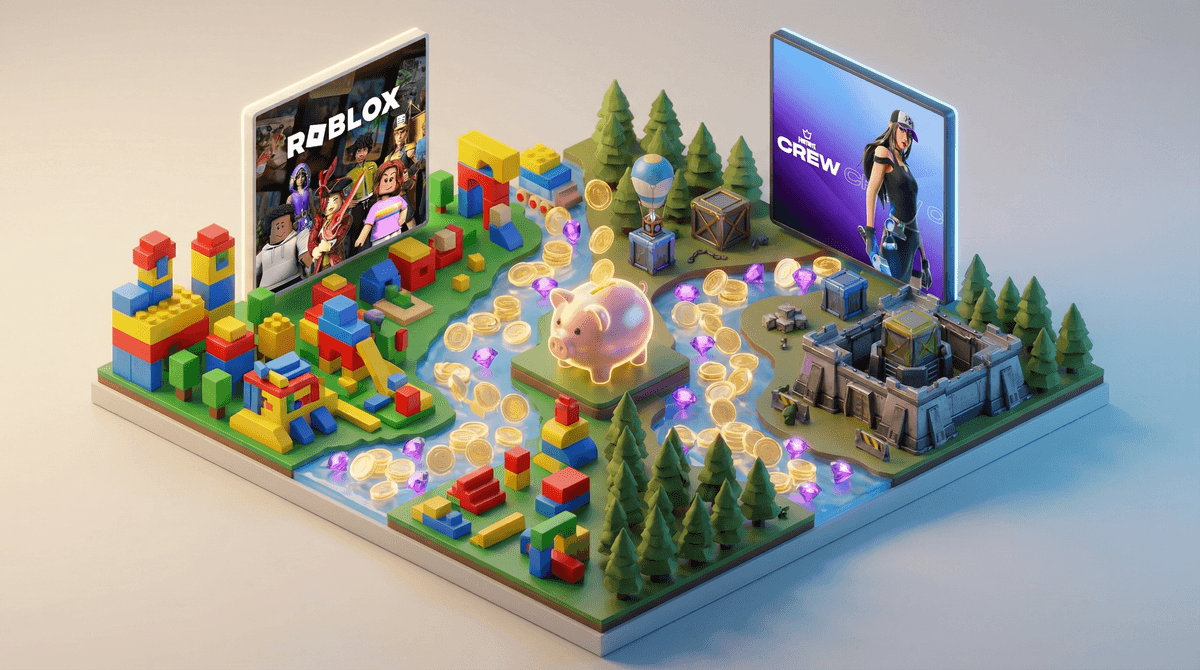
Let's start with the basics: Robux and V-Bucks are virtual currencies used in Roblox and Fortnite, respectively. They're not Monopoly money—they're purchased with real dollars and can be spent on digital items like character outfits (called "skins"), emotes, accessories, and game passes.
Here's the conversion that matters:
- Robux: Roughly 80 Robux = $1 USD (though pricing tiers vary)
- V-Bucks: 1,000 V-Bucks = $7.99 USD
Your kid asking for "just 1,000 V-Bucks" is asking for eight actual dollars. When they say they "need" 400 Robux for that cool outfit, that's about $5. And here's the thing—these purchases add up fast.
Both games are free to play, which is part of their genius business model. Kids can download and play without spending a dime. But once they're in? The entire experience is designed to make them want to spend.
In Roblox, Robux unlocks:
- Exclusive clothing and accessories for their avatar
- Special abilities or game passes in specific experiences
- The ability to create and sell their own items (more on this later)
- VIP servers to play privately with friends
In Fortnite, V-Bucks buy:
- Skins (character outfits) that rotate in and out of the shop
- Emotes (dances and gestures)
- The Battle Pass, which unlocks a progression system with rewards
- Gliders, pickaxes, and other cosmetic items
The psychological hooks are real: limited-time offers, FOMO (fear of missing out), and social status. When everyone at school is talking about the new Fortnite skin that's only available for 48 hours, your kid feels genuine pressure. When their Roblox avatar is a default "noob" while their friends have custom outfits, it stings.

A 2023 survey found that parents spend an average of $38 per month on Roblox alone. Some spend nothing, but plenty spend $50-100+ monthly. Fortnite spending follows similar patterns.
The sneaky part? These games make it easy to lose track:
- Incremental purchases feel small ($5 here, $10 there)
- Virtual currency creates psychological distance from real money
- Seasonal content means there's always something new to want
- Peer pressure is intense—kids see what others have
I've heard from parents who discovered $200+ in charges before realizing their payment info was saved. Others find themselves in a monthly negotiation cycle that's exhausting for everyone.
Here's where Roblox gets interesting: kids can actually create games and items, and earn Robux from other players. Some young developers have made serious money—we're talking thousands of dollars.
But let's be honest: most kids aren't becoming Roblox entrepreneurs. They're consumers. The percentage of Roblox users who earn meaningful Robux is tiny. If your kid is genuinely learning to code, designing experiences, and building something? That's worth supporting. If they're just talking about "maybe making a game someday" while spending your money on outfits? That's a different conversation.
Here's what actually works:
1. Start with a budget
Decide on a monthly amount you're comfortable with—could be $10, could be $25, could be zero. Be clear and consistent. Many families tie this to allowance or chores, giving kids agency over how they spend.
2. Use gift cards, not saved payment info
Buy physical Roblox or V-Bucks gift cards. When the card runs out, it's done. This creates a natural boundary and helps kids visualize their spending. Plus, no surprise charges.
3. Require approval for purchases
Both games allow you to require parental approval for spending. Set up Roblox parental controls and Fortnite parental controls to enable this feature. Yes, you'll get interrupted with requests, but it keeps you in the loop.
4. Talk about the business model
Kids need to understand that these games are designed to make them want to spend. It's not evil, it's just business. Help them recognize the manipulation tactics: limited-time offers, flashy advertisements, social pressure. Media literacy matters here.
5. Distinguish between wants and needs
"I need this skin" is rarely true. Help kids articulate why they want something. Is it because their friends have it? Because it looks cool? Because a YouTuber promoted it? Understanding the "why" builds critical thinking.
6. Consider the Battle Pass model
In Fortnite, the Battle Pass ($7.99 per season, roughly every 3 months) provides tons of content and rewards for playing. Many parents find this a reasonable middle ground—it's a set cost, kids earn rewards through gameplay, and it feels less like endless spending.
Some websites and apps claim to offer free Robux or V-Bucks. These are scams. Full stop. They often steal account information, install malware, or worse. The only legitimate ways to get these currencies are:
- Buying them directly
- Earning Robux by creating popular Roblox content (rare)
- Receiving gift cards
If your kid mentions "free Robux generators," shut that down immediately and explain why it's dangerous.
Ages 8-10: At this age, kids often don't fully grasp that Robux/V-Bucks = real money. They see numbers on a screen. This is the time to be most restrictive and educational. Consider starting with a small gift card for a birthday or holiday, and use it as a teaching moment.
Ages 11-13: Kids understand the value but struggle with impulse control and FOMO. This is when budgets and approval systems are crucial. They can start earning their own virtual currency money through chores or allowance.
Ages 14+: Teens can handle more autonomy, but still benefit from boundaries. Consider giving them a set monthly amount and letting them manage it. If they blow through it in a week, they wait until next month. Natural consequences are powerful teachers.
Robux and V-Bucks aren't inherently bad. They're tools that game companies use to monetize free-to-play games. The problem isn't the currency—it's when spending becomes impulsive, excessive, or driven by social pressure rather than genuine enjoyment.
Your job isn't to eliminate all spending (though that's a valid choice). It's to help your kid develop a healthy relationship with virtual currency, understand marketing tactics, and make intentional choices.
Some families spend $0. Some spend $50/month. Neither is wrong. What matters is that you're making a deliberate decision based on your values, your budget, and your kid's maturity level—not reacting to the latest limited-time skin panic.
-
Check your current spending: Log into your payment accounts and see what's actually been spent on these games. You might be surprised.
-
Have the conversation: Sit down with your kid and talk about virtual currency. Ask what they've been buying and why. Listen without judgment.
-
Set up controls: Configure Roblox parental controls and Fortnite parental controls today. It takes 10 minutes and prevents future headaches.
-
Establish your family's budget: Decide what you're comfortable with and communicate it clearly.
-
Remove saved payment methods: Switch to gift cards for more control.
The goal isn't perfection—it's intention. You've got this.