

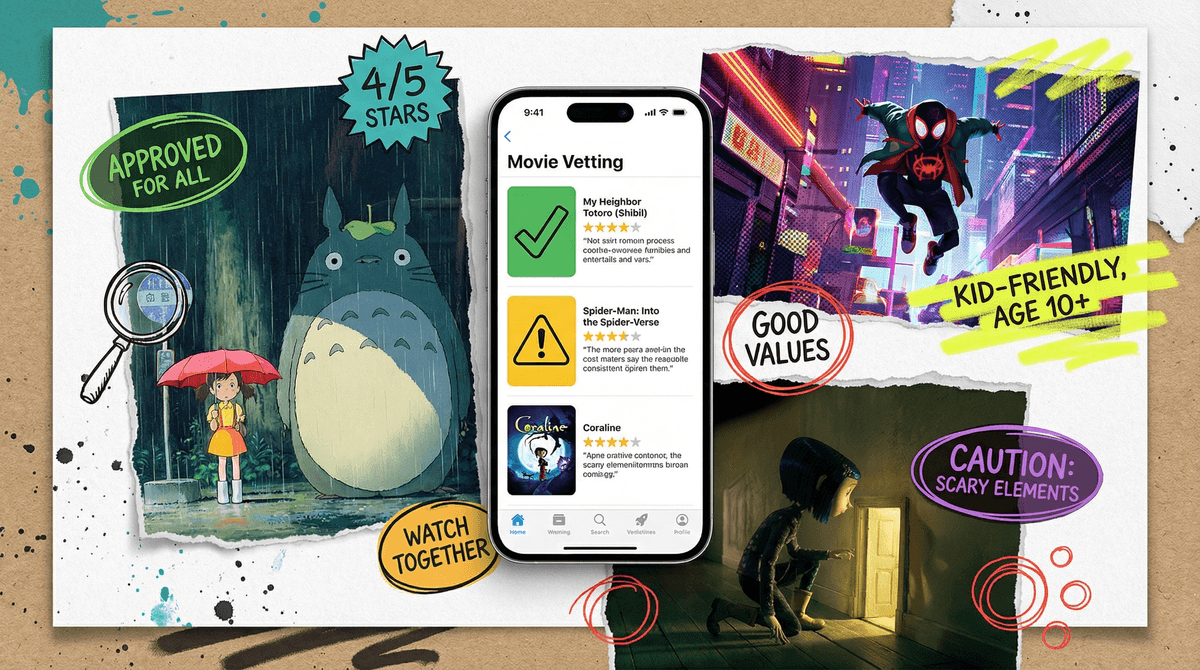
Look, we've all been there. Your kid comes home begging to watch whatever movie "literally everyone" has seen, and you're stuck doing frantic Google searches while they hover over your shoulder asking "Is that a yes? Is it? Can we watch it? Please?"
Or maybe you're scrolling Netflix on a Friday night, trying to find something the whole family can watch that won't bore the adults to tears OR traumatize the 8-year-old. And the rating says PG-13, but what does that even mean anymore?
Here's the thing: movie ratings are basically useless without context. A PG movie from 1984 is wildly different from a PG movie in 2026. And "mild fantasy violence" could mean anything from cartoon bonking to genuinely scary battle sequences that'll have your kid sleeping in your bed for a week.
This guide is about getting the real information you need to make informed decisions about what your family watches—without spending 45 minutes reading through 200 parent reviews or accidentally stumbling across major spoilers.
Movies are different from a lot of other media your kids consume. Unlike YouTube videos they can click through in 30 seconds, or TikToks that disappear, movies are a 2-hour commitment that often becomes part of family culture. Kids quote them, reference them, and yes, they absolutely do talk about them at school.
But here's what's trickier: movies can also pack a lot of emotional intensity into a short time. A single scary scene can stick with a kid way longer than you'd expect. And content that seems "fine" for your 10-year-old might be completely inappropriate for your 7-year-old, even though they both want to watch together.
Plus, let's be real—there's social pressure. When a kid says "everyone has seen it," they might not be exaggerating that much. According to various surveys, popular family movies like the Marvel films or Pixar releases are watched by 60-80% of kids in their target age range within the first few months of release. That peer pressure is real , and you need good information to navigate it.
Common Sense Media (Your New Best Friend)
If you're not already using Common Sense Media, bookmark it right now. Seriously. This is the gold standard for parent-focused movie reviews.
What makes it actually useful:
- Two age ratings: one from experts, one from parents (and they often disagree, which tells you something)
- Specific content breakdowns: exactly what kind of language, violence, scary scenes, sexual content, etc.
- Positive messages section: what kids might actually learn or take away
- Parent and kid reviews: real people sharing what worked or didn't for their family
The key is reading the DETAILS, not just looking at the age rating. A movie rated for ages 11+ might be fine for your mature 9-year-old, or it might be too much for your sensitive 13-year-old. The written review tells you why.
IMDb Parents Guide
This is the unsung hero of movie research. Go to any movie's IMDb page, scroll down to "Parents Guide," and you'll find extremely specific descriptions of potentially problematic content, organized by category (violence, profanity, frightening scenes, etc.).
The beauty of IMDb's guide is that it's crowdsourced and detailed to the point of being almost comically thorough. People will literally describe the exact timestamp of a jump scare. Yes, there are spoilers, but honestly? That's the point. You WANT to know what happens before your kid sees it.
The Actual Ratings System (And Why It's Broken)
Let's quickly decode what those MPAA ratings actually mean:
- G (General Audiences): Basically nothing objectionable. Think classic Disney.
- PG (Parental Guidance): This is where it gets messy. Could be mild cartoon violence or surprisingly mature themes. PG today is way more intense than PG from 20 years ago.
- PG-13: "Parents strongly cautioned." Created literally because of Indiana Jones and the Temple of Doom being too intense for PG. Can include pretty significant violence, some language, brief nudity, drug references.
- R (Restricted): Under 17 requires accompanying adult. Strong language, intense violence, sexual content, drug use.
The problem? The MPAA is notoriously inconsistent. A movie can get PG-13 for one F-bomb but multiple intense battle scenes with implied death. Another PG-13 movie might have minimal violence but mature emotional themes about suicide or abuse. The rating alone tells you almost nothing.
Plugged In (For More Conservative Families)
If your family has more conservative values around media, Plugged In (from Focus on the Family) provides extremely detailed reviews from that perspective. They break down every instance of language, violence, sexual content, and spiritual themes.
Even if you're not particularly conservative, their reviews are useful because they're SO detailed. You'll know exactly what you're getting into.
Does the Dog Die?
This deserves its own mention. DoesTheDogDie.com started as exactly what it sounds like—a database of whether animals die in movies—but has expanded to track all kinds of potentially triggering content: jump scares, vomiting, needles, car accidents, parental death, etc.
If your kid has specific fears or triggers, this site is invaluable. You can filter by exactly what you're concerned about.
Here's the thing nobody wants to say out loud: your kid is not the same as other kids their age, and that's fine.
Some 8-year-olds can handle Spider-Man: Into the Spider-Verse with its intense action and themes of loss. Others will be scared by Coraline well into their preteen years. Neither is wrong.
Ages 5-7: The Sensitivity Years
Most kids this age are still building their ability to separate fantasy from reality. What looks "obviously fake" to you can feel very real to them. Err on the side of caution with:
- Villains that feel too real or threatening
- Parent/child separation themes
- Scary creatures, even in "kid" movies
- Loud, intense action sequences
Safe bets: Most Pixar (though watch out for emotional intensity), classic Disney, Paddington, My Neighbor Totoro.
Ages 8-10: The "I'm Not a Baby" Phase
Kids this age often WANT to watch scarier or more intense movies to prove they're growing up. They might be ready for more, but they also might not admit when something bothers them.
This is a good age for:
- Classic adventure movies with mild peril
- Marvel movies on the lighter side (Ant-Man, Guardians of the Galaxy)
- Movies with more complex emotional themes
- Mild fantasy violence
Watch out for: Jump scares (they're not ready even if they say they are), realistic violence, movies where bad things happen to kids.
Ages 11-13: The Actual Tweens
This is where it gets complicated because the range of maturity is HUGE. Some kids this age can handle legitimate PG-13 content; others still need gentler fare.
Good options:
- Most Marvel/superhero movies
- Action-adventure with stakes but not graphic violence
- Coming-of-age stories (but preview for sexual content)
- Movies that tackle real issues (bullying, mental health, identity)
Still probably not ready for: Graphic violence, intense horror, explicit sexual content, heavy drug use themes.
Ages 14+: The Teen Years
Honestly, by high school, you're mostly making sure they're not watching genuinely traumatizing or exploitative content. Most teens can handle R-rated movies by 15-16, but you're the expert on your kid.
The conversation shifts from "can they watch this" to "let's talk about what you're watching and what it means."
Here's my actual process, and it takes maybe 5 minutes:
- Check Common Sense Media for the age rating and skim the "what parents need to know" section
- Read the IMDb Parents Guide if there are any red flags from step 1
- Watch the trailer (but know that trailers can be misleading—they often hide the scary parts OR make kid movies look more intense than they are)
- Ask other parents if it's a newer release—your school or neighborhood parent group probably has someone who's seen it
If you're still unsure? Watch it yourself first or watch it together and be ready to pause/turn it off if needed. There's no shame in bailing on a movie 20 minutes in.
Different platforms have wildly different quality control:
Netflix: Their age ratings are pretty good, and you can set up profiles with viewing restrictions. BUT their "kids" section sometimes includes stuff that's questionable. Always double-check.
Disney+: Generally the safest bet for younger kids, but even here—some of the older Disney movies have content that hasn't aged well (racism, outdated gender roles, etc.). Worth having conversations about.
Amazon Prime: A total mess. Their kids section includes stuff that absolutely is not for kids. Always research first.
HBO Max/Max: Assume nothing is kid-appropriate unless you've verified it. Their interface sometimes makes it too easy for kids to stumble into adult content.
Apple TV+: Smaller catalog but generally good about age ratings and family-friendly content.
When your kid insists that literally everyone in their class has watched something you're not comfortable with, here's what to say:
"I hear you that it feels like everyone has seen it. That's hard. But every family makes different choices about movies, and in our family, we're waiting until [specific age/time/reason]. What we CAN watch is [offer alternative]."
And then—and this is key—actually follow through with the alternative. Don't just say no; give them something to say yes to.
Also, spoiler alert: "everyone" usually means "3-5 kids in my class," and there are almost certainly other kids who also haven't seen it. Your kid just doesn't know because nobody's bragging about what they haven't watched.
Movie ratings are a starting point, not a finish line. The actual work is reading detailed reviews, knowing your specific kid, and being willing to make different choices for different children even in the same family.
Your 12-year-old might be ready for The Hunger Games while your 10-year-old isn't, and that's not favoritism—it's parenting.
Use Common Sense Media and IMDb Parents Guide as your primary research tools. Bookmark them. Make them as automatic as checking the weather before you leave the house.
And remember: you can always change your mind. If you said no to a movie six months ago, you can say yes now. If you thought something would be fine and it wasn't, you can turn it off. There's no perfect system here—just doing your best with good information.
- Bookmark Common Sense Media and IMDb right now
- Set up age-appropriate profiles on your streaming services (here's how to set up Netflix parental controls)
- Have a conversation with your kids about how your family makes decisions about movies—make it a dialogue, not a lecture
- Create a family movie list together of films you're all excited to watch (here are some great family movie recommendations by age)
And if you want personalized guidance for your specific family situation, Screenwise can help you figure out what makes sense for your kids' ages, sensitivities, and your family values.