

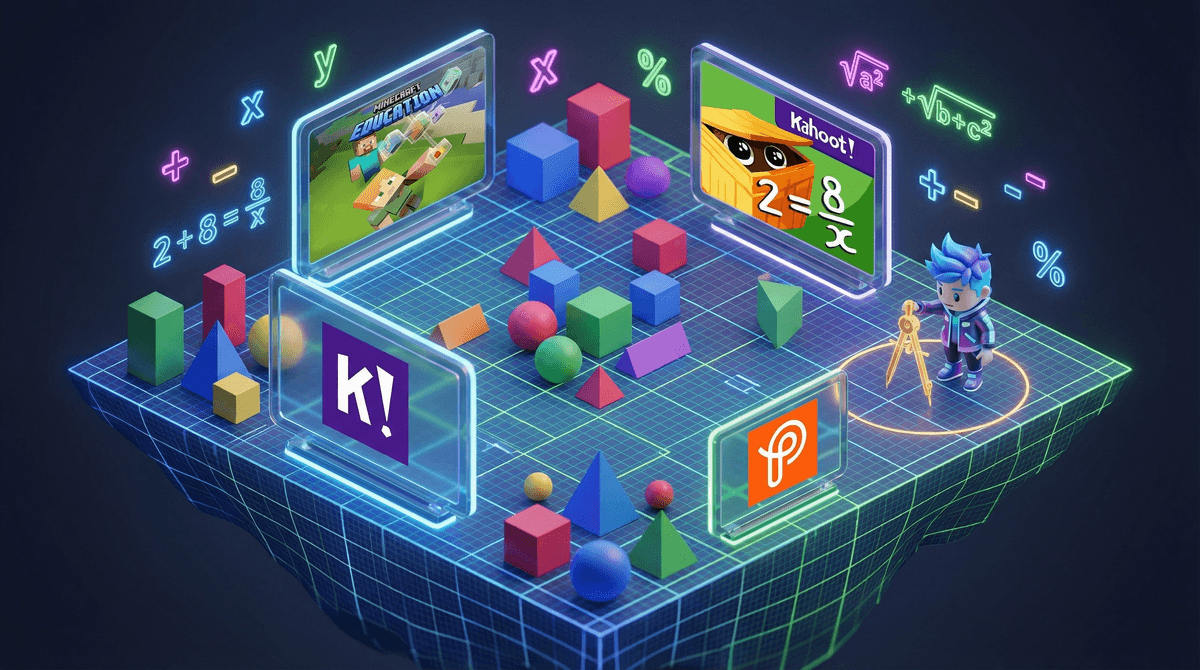
Let's be real: getting a 7th grader excited about math is like trying to make "fetch" happen. It's not going to happen... unless you disguise it as something else entirely.
7th grade math games are digital platforms and apps that teach pre-algebra, algebra, geometry, ratios, proportions, and problem-solving through gameplay mechanics. Think of them as the Trojan horse of education—your kid thinks they're gaming, but they're actually learning how to solve for x.
The best ones don't feel like worksheets with a coat of paint. They're actually engaging, with progression systems, rewards, and challenges that keep kids coming back. And here's the thing: some of them actually work. Research shows that well-designed math games can improve computational fluency, problem-solving skills, and—perhaps most importantly for middle schoolers—reduce math anxiety.
Seventh grade is where math gets real. This is the year that separates the "I'm good at math" kids from the "I'm just not a math person" kids (spoiler: that second category is mostly a self-fulfilling prophecy, not actual ability).
Your 7th grader is dealing with:
- Pre-algebra and algebra foundations (variables, expressions, equations)
- Ratios, proportions, and percentages (the stuff that actually matters in real life)
- Geometry (angles, area, volume)
- Negative numbers and integers (finally, a use for those number lines)
- Data analysis and probability (hello, statistics)
This is also the year where math homework becomes genuinely hard for many parents to help with. If you're staring at your kid's algebra homework thinking "I used to know this," you're not alone. Math games can fill that gap without the tutoring price tag.
Ages: 6-14 | Free with premium option
Prodigy is basically Pokémon meets math class. Kids battle monsters, collect pets, and explore a fantasy world—but to progress, they have to solve math problems aligned to their grade level. The adaptive learning means it meets kids where they are, and the game mechanics are legitimately engaging.
The catch: The free version is solid, but the game constantly pushes kids toward the premium membership ($9.99/month). Your kid will ask. Repeatedly. Learn more about how to navigate Prodigy's membership pressure .
.
Ages: 12+ | One-time purchase
This is the game that makes algebra click. It starts with visual puzzles that don't even look like math, then gradually introduces algebraic notation until—surprise—your kid is solving complex equations without realizing it. It's genuinely clever design.
Why it works: No pressure, no timers, no judgment. Just pure problem-solving that builds intuition before introducing the scary symbols.
Ages: All | Free with premium option
Okay, this one's technically a quiz platform, but hear me out. Many teachers use Kahoot! for math review, and there are thousands of user-created 7th grade math quizzes available. The competitive, fast-paced format gets kids engaged in a way that traditional review doesn't.
Best for: Group learning, family game nights, or review before tests. Not great for learning new concepts.
Ages: PreK-12 | Subscription required
IXL is less "game" and more "gamified practice platform." It's comprehensive, aligned to standards, and provides detailed progress tracking. Kids earn awards and certificates as they master skills.
The real talk: Some kids love IXL. Others find it tedious and stressful (it takes away points for wrong answers, which can be demotivating). It's worth trying the free trial to see which camp your kid falls into.
Ages: 8+ | Subscription required
Yes, really. Minecraft Education Edition has specific math worlds focused on geometry, measurement, and problem-solving. If your kid is already obsessed with Minecraft, this leverages that engagement for actual learning.
Bonus: It also teaches coding, which pairs beautifully with algebraic thinking.
Not all "educational" games are created equal. Here's what to look for:
Adaptive difficulty: The game should adjust to your kid's skill level, not just their grade level. Every 7th grader is different.
Immediate feedback: Kids should know right away if they got something wrong, with explanations of why. This is where games beat worksheets—instant feedback loops.
Low stakes practice: The best math games let kids fail without consequence. They can try again, experiment, and learn from mistakes without anxiety.
Actual math, not just math-themed: Beware of games that are just regular games with math problems slapped on top. The math should be integrated into the gameplay, not an interruption.
Yes, these are on screens. Yes, you're probably already worried about screen time. Here's the nuance: not all screen time is created equal.
Twenty minutes on Prodigy Math is fundamentally different from twenty minutes on TikTok. One is active learning with problem-solving and skill-building. The other is passive consumption designed to hijack attention.
That said, math games shouldn't completely replace other forms of math learning. Think of them as a supplement, not a replacement for:
- Real-world math practice (cooking, budgeting, measuring)
- Traditional problem-solving on paper (there's value in showing your work)
- Conceptual discussions about why math works the way it does
A reasonable approach: 15-30 minutes of math gaming, 3-4 times per week. Enough to build skills and maintain engagement, not so much that it becomes mindless grinding.
Math anxiety is real and contagious. If you say "I was never good at math either," your kid internalizes that math ability is genetic and fixed. It's not. Reframe it as "Math was hard for me, but I didn't have tools like this to practice."
Games can't fix everything. If your kid is genuinely struggling with 7th grade math, a game probably isn't enough. Consider talking to their teacher about whether they need additional support or tutoring.
Let them choose. Show your kid 2-3 options and let them pick which one appeals to them. Autonomy increases engagement dramatically.
Progress tracking is your friend. Most of these platforms provide parent dashboards. Use them. A quick weekly check-in on what skills they're working on gives you conversation starters and shows you're paying attention.
7th grade math games aren't magic, but they're also not just screen time babysitting dressed up as education. The good ones genuinely help kids build fluency, reduce anxiety, and maintain engagement with concepts that might otherwise feel abstract and pointless.
The key is finding the right fit for your kid. Some kids love the fantasy RPG approach of Prodigy. Others prefer the clean, puzzle-based design of DragonBox. Some need the structure of IXL, while others thrive in the open world of Minecraft Education.
Try a few. See what sticks. And remember: if your 7th grader is willingly doing math for 20 minutes without complaining, that's a win. Even if it's on a screen.
- Ask your kid's teacher what specific skills they're working on right now, then look for games that target those areas
- Try free trials before committing to subscriptions—most platforms offer them
- Set up a math game routine (maybe right after school, or before other screen time privileges)
- Check in weekly on what they're learning, not just whether they're "doing it"
Want more specific recommendations? Find math games for your specific situation or explore alternatives to traditional math homework.