

The Traitors: Should Your Teen Watch This Psychological Reality Show?
TL;DR: The Traitors is a genuinely brilliant reality competition show that's part murder mystery, part social strategy game. It's appropriate for most teens 14+ who can handle psychological tension and strategic deception. The show is surprisingly wholesome despite being about lying—no romance drama, minimal profanity, and actual strategic gameplay. If your teen loves Among Us or Werewolf, they'll be obsessed with this show's real-world version of social deduction.
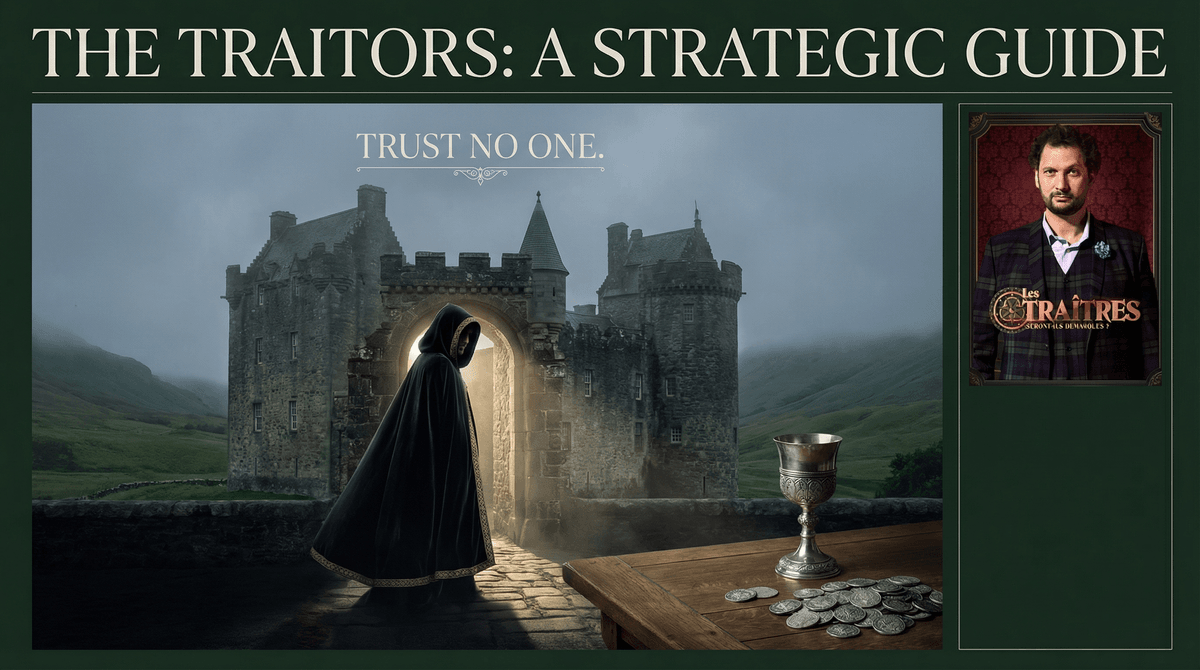
The Traitors is a reality competition show hosted by Alan Cumming (US version) or Claudia Winkleman (UK version) where contestants live in a Scottish castle and compete for prize money. Here's the twist: a few players are secretly designated as "Traitors" while everyone else is a "Faithful."
During the day, everyone works together on challenges to build the prize pot. At night, the Traitors "murder" a Faithful (who leaves the game). Then at a daily "Round Table," everyone votes to "banish" someone they suspect is a Traitor. If all Traitors are eliminated, the Faithfuls win and split the money. If any Traitors make it to the end, they take everything.
It's basically Mafia or Among Us as a high-production reality show, and it's absolutely riveting.
If you've watched your teen play social deduction games for hours, The Traitors is the natural next step. The show has blown up on social media because it delivers what so many reality shows don't: actual strategy.
There's no manufactured romance drama. No one's getting drunk and fighting. No cringeworthy confessionals about "finding themselves." Instead, it's people forming alliances, reading body language, analyzing voting patterns, and trying to outwit each other. It's like watching a live chess match where the pieces are people.
The show has become massive on TikTok and YouTube, with teens breaking down strategies, debating decisions, and creating fan theories. The UK version especially has reached cult status, and the US version (on Peacock) has introduced a whole new generation to the format.
Let's be real: most reality TV is garbage designed to make you feel better about your life by watching people behave terribly. The Traitors is different.
The good stuff:
- Strategic depth: This isn't "who can scream loudest." Players are genuinely trying to read people, form alliances, and make calculated decisions
- Minimal manufactured drama: The format creates natural tension without producers forcing confrontations
- Diverse casting: Age range from 20s to 60s, various backgrounds, actual personality diversity beyond "the villain" and "the nice one"
- No romance subplots: Thank god. Just strategy
- Clever editing: The show doesn't insult your intelligence with obvious villain edits
The concerns:
- Deception is the core mechanic: The entire game rewards lying convincingly
- Psychological pressure: Watching people get falsely accused and eliminated can be genuinely stressful
- Betrayal themes: Friendships formed in the game get destroyed by strategic necessity
- Some mild language: Occasional profanity, though surprisingly minimal for reality TV
Ages 14+: This is the sweet spot. By high school, most teens:
- Understand strategic deception in game contexts vs. real life
- Can appreciate the social psychology on display
- Have likely played social deduction games themselves
- Can handle the psychological tension without it being traumatic
Ages 12-13: Case by case. If your middle schooler:
- Loves Survivor or strategy games
- Can separate game strategy from real-world ethics
- Won't be stressed by watching people get falsely accused
- Has played Among Us or Werewolf and understands the format
Then they're probably fine. But if they're sensitive to social conflict or take deception very personally, wait a year or two.
Under 12: Probably not. The psychological manipulation, even in a game context, is pretty intense. The show isn't inappropriate content-wise, but the themes are mature.
I know what you're thinking: "Should my kid watch a show that celebrates lying?"
Fair question. Here's the nuanced answer: context matters enormously.
The Traitors is explicitly framed as a game with clear rules where deception is part of the agreed-upon structure. Everyone knows some players are lying—that's the whole point. It's no different than bluffing in poker or faking in Coup.
This is actually a great opportunity to talk with your teen about:
- How game deception differs from real-life lying
- Why trust matters in actual relationships
- How people read body language and detect deception
- The ethics of strategy vs. the ethics of relationships
- Why some players struggle more with lying than others (and what that reveals about values)
The show itself often highlights this tension. Players frequently express guilt about lying to people they've bonded with. Some Traitors are terrible at deception because it goes against their nature. These are valuable conversations.
If your teen can't separate "this is a game with rules" from "lying is always fine," then they're not ready for the show. But most teens 14+ absolutely understand this distinction—they've been playing social deduction games for years.
Green flags that your teen is processing this well:
- They analyze strategy and gameplay rather than just rooting for people to suffer
- They discuss the psychology of deception detection
- They recognize when players make smart vs. emotional decisions
- They understand why certain lies work and others don't
Yellow flags to discuss:
- They only focus on the betrayal/drama aspects
- They think the "best liars" are automatically the coolest people
- They seem stressed or anxious watching people get falsely accused
- They start applying Traitors strategy to real-life social situations
Red flags to pause:
- They become genuinely upset watching people get eliminated
- They can't separate game deception from real-world ethics
- They start lying more in daily life and referencing the show
- They're losing sleep or seem preoccupied with the show's themes
The Traitors is actually perfect for co-viewing. Seriously—this might be the rare reality show that's more fun to watch with your teen than alone.
Why it works:
- You can pause and discuss strategy in real-time
- You'll both be wrong about who the Traitors are (it's genuinely hard to tell)
- You can talk about body language, group dynamics, and social psychology
- It's a natural entry point for discussing ethics, trust, and deception
- The show is actually well-made enough that adults enjoy it too
Conversation starters while watching:
- "Why do you think they suspected her?"
- "Would you be better as a Traitor or Faithful?"
- "What would you do differently?"
- "How can you tell when someone's lying?" (Spoiler: you often can't)
- "Is it ethical to betray your alliance to win?"
Both versions are on streaming (UK on Peacock, US on Peacock). The UK version is generally considered superior—better casting, better pacing, Claudia Winkleman's hosting is iconic. The US version is solid but slightly more Americanized (more dramatic music, slightly more obvious editing).
Start with UK Series 1 if you want the best version. It's the one that went viral and created the phenomenon.
If your teen loves The Traitors, they're probably into social deduction games and strategy content:
Games:
- Among Us - the video game version
- Werewolf/Mafia - the original social deduction game
- Secret Hitler - more complex social deduction (note: mature themes)
- The Resistance - team-based deduction
Shows:
- Survivor - the OG strategy reality show
- The Mole - similar deception concept
- Physical: 100 - Korean competition show with strategy elements
The Traitors is one of the rare reality shows that's actually worth your teen's time. It's smart, strategic, well-produced, and surprisingly clean for the genre. The deception element is clearly framed as game strategy, not real-world behavior modeling.
Watch it with your teen if possible. It's genuinely entertaining for adults, and co-viewing turns potential concerns into valuable conversations about trust, strategy, and social dynamics.
For teens 14+, this is totally appropriate and honestly pretty educational in terms of understanding social psychology and strategic thinking. For younger teens, it depends on their maturity and ability to contextualize game deception.
The show isn't going to turn your kid into a manipulative liar. But it might turn them into someone who's really annoying about analyzing everyone's body language at family dinner. You've been warned.
Want to explore more strategy-based content for teens or talk through whether your specific teen is ready for this show ? We're here to help.