

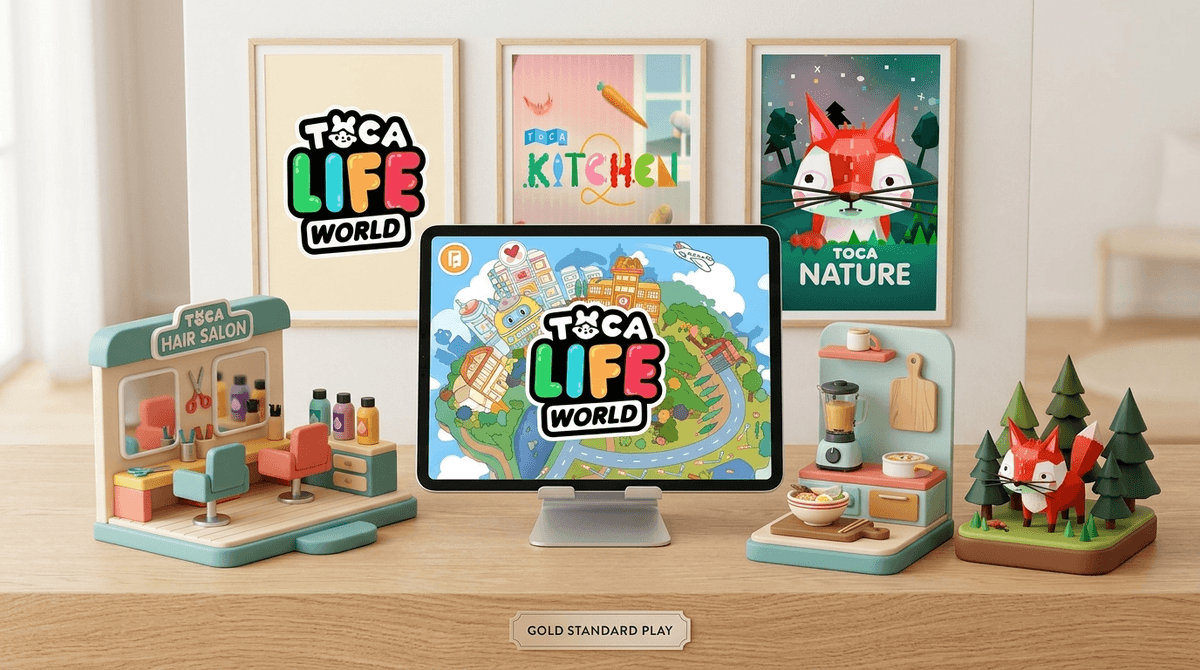
TL;DR: If you’re looking for the "anti-brain rot" app, this is it. Toca Boca—specifically their flagship Toca Life World—is a digital dollhouse that prioritizes creativity over dopamine loops. It’s safe, inclusive, and actually encourages kids to tell stories rather than just mindlessly click.
Quick Links:
- Best for all-in-one play: Toca Life World
- Best for younger kids: Toca Kitchen 2
- Best for nature lovers: Toca Nature
- Best "cozy" alternative: Sago Mini World
If you’ve spent any time at school pickup lately, you’ve probably heard parents venting about Roblox (the "it’s basically a casino" argument) or worrying that their kids are watching too much "Skibidi Toilet" on YouTube. It’s exhausting trying to filter out the digital noise to find something that actually feels good for your kid’s brain.
Enter Toca Boca.
While other apps are busy trying to figure out how to keep your kid’s eyes glued to the screen for six hours a day using dark patterns and loot boxes, Toca Boca has quietly become the "Gold Standard" for intentional parents. It’s the rare app that feels like a toy, not a trap.
Toca Boca isn’t just one game; it’s a Swedish production studio that specializes in "digital toys." Their most popular release, Toca Life World, is essentially a massive, interconnected digital dollhouse.
There are no levels. There are no high scores. There are no "boss battles." There are no winners or losers.
Instead, kids get a world full of locations—apartments, hair salons, malls, hospitals—and a cast of characters they can customize. They can move the characters around, dress them up, put a crumpet in their hand, and make them eat a bowl of ramen. It’s pure, unadulterated pretend play, just moved from the living room floor to the iPad.
You might think an app that looks like a cartoon would only appeal to the preschool crowd, but Toca Boca has a massive "tween" following. If your 10-year-old is suddenly obsessed with things being "aesthetic," they’re probably using Toca Boca to live out their interior design dreams.
- Agency: In a world where kids are told what to do all day, Toca Boca gives them total control. They can turn off all the lights in the city, make a character sleep in a dumpster, or give everyone in the hair salon a neon green mohawk.
- The "Aesthetic" Trend: There is a huge community of kids who spend hours meticulously decorating their "Home Designer" houses in Toca Life World. They aren't just playing; they are practicing spatial awareness and color theory.
- Digital Storytelling: Many kids use the built-in recording feature to create "Toca Stories," which they sometimes share (with varying degrees of production value) as "Toca Mouth" videos. It’s their first foray into being a director.
Learn more about the "aesthetic" trend in kids' digital spaces
When we talk about digital wellness, we’re usually looking for three things: safety, quality of engagement, and inclusivity. Toca Boca nails all three.
True Inclusivity
Toca Boca doesn't do "boy" or "girl" sections. All the clothes, hairstyles, and accessories are available for every character. They were also one of the first major apps to include diverse representations as a standard, not an afterthought—characters with prosthetic limbs, wheelchairs, vitiligo, and various cultural garments are all there. It reflects the real world without making a big deal out of it.
No Social Risk
Unlike Roblox or Minecraft (on public servers), there is no chat feature in Toca Boca. Your child is not going to be contacted by a stranger. They aren't going to see inappropriate language in a chat bubble. It is a solitary or co-play experience (if you're sitting next to them), which removes 90% of the "digital stranger danger" anxiety.
Open-Ended Play
Most apps use "linear" gameplay—do A to get B. Toca Boca is "open-ended." This is crucial for brain development because it requires the child to generate the ideas. If the kid stops thinking, the game stops moving. It’s the opposite of the passive consumption they get from Netflix.
If you’re just starting out, here is where you should put your money (and your storage space):
This is the "hub." It’s free to download and comes with a few basic locations (a house, a food court, a hair salon). Most families end up buying "packs" to add new locations like the Hospital or the University.
- Ages: 4–12
- Parent Tip: This app can get expensive if you buy every pack. Set a "one pack a month" rule or save the big "Mega Bundle" for a birthday.
This is a classic. You cook food for various characters and see their reactions. It’s hilarious, gross (you can blend a raw fish with a strawberry), and great for younger kids who might find the "World" interface too complex.
- Ages: 3–7
This one is a bit different. It’s a quiet, beautiful simulation where you grow forests, create mountains, and watch animals interact. It’s basically a "cozy game" for the younger set.
- Ages: 4+
If you have a kid who loves styling, this is the one. It’s surprisingly sophisticated—you can cut, color, grow back hair, and apply makeup.
- Ages: 4–10
While Toca Boca is generally "safe," here’s how to approach it based on your kid’s age:
- Preschool (Ages 3-5): Stick to the standalone apps like Toca Kitchen 2. Toca Life World can be overwhelming with its many menus.
- Early Elementary (Ages 6-9): This is the sweet spot. They will spend hours building "families" and acting out school scenes. This is a great time to talk about digital spending.
- Tweens (Ages 10-12): They will likely focus on the "Home Designer" aspect. You might see them looking up "Toca Boca House Ideas" on Pinterest. This is a great bridge to more complex creative tools like The Sims 4.
No app is perfect. Here is the no-BS breakdown of the downsides:
- The Shop Icon: In Toca Life World, there is a big, shiny "Shop" button. It is very easy for a kid to click it and see all the cool things they don't have. You must have your App Store password protections turned on.
- The "Toca News": The home screen often features videos or updates. While usually harmless, it’s a bit of "advertainment" designed to get them to want the newest location pack.
- Third-Party Content: While the app itself has no chat, many kids go to TikTok or YouTube to watch "Toca Stories." Some of these fan-made stories can be "edgy" or inappropriate (think: Toca characters acting out high school dramas with "dating" or "bullying" themes).
Toca Boca isn't "draining the bank account" in the same predatory way some Roblox games do with their "limited edition" items, but it is a "freemium" model.
The base game is a "hook." To get the "Cool School" or the "Modern Mansion," you’re going to pay anywhere from $0.99 to $9.99 per pack.
How to talk about it: Use Toca Boca to teach the "Wait 24 Hours" rule. If they want a new pack, they have to wait 24 hours. If they still want it tomorrow, and they have the "commission" (chore money) saved up, then you can talk. It’s a low-stakes way to teach digital consumerism.
Toca Boca is the rare digital experience that actually feels like it was designed by people who like kids, rather than people who like data points. It’s a "yes" app.
- Yes, it’s safe.
- Yes, it’s creative.
- Yes, it’s worth the few dollars for a pack if it means 45 minutes of quiet, imaginative play while you finally drink a coffee that isn't lukewarm.
If you’re looking for a step up from Toca, or if your kid has "aged out," consider looking into cozy games for kids like Animal Crossing: New Horizons.
- Download the base version of Toca Life World and sit with your kid for 15 minutes. Let them show you their house.
- Check your settings. Ensure "In-App Purchases" require a password every single time.
- Use our list maker if you’re unsure about a specific "Life" pack or if you want to find apps with similar vibes for older kids.