

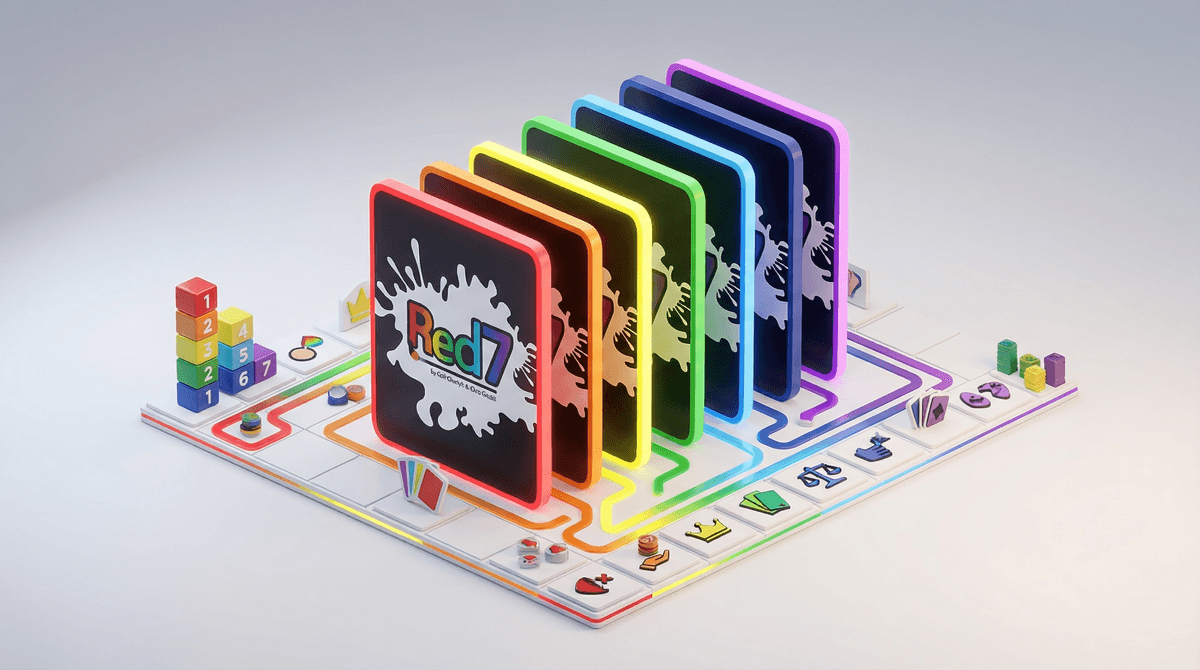
Red 7 Card Game: The Fast-Paced Strategy Game That Teaches Kids to Think on Their Feet
Red7 is a deceptively simple card game that will absolutely melt your brain in the best way possible. It's perfect for kids 9+ who can handle constantly shifting rules and some friendly competition. Games take 5-10 minutes, which means you can squeeze in a round before dinner or play best-of-five on a rainy afternoon. If your family loves Uno but wants something that actually requires strategic thinking, this is your next purchase.
Quick Stats:
- Ages: 9+ (though sharp 8-year-olds can handle it)
- Players: 2-4 (best with 3-4)
- Game Time: 5-10 minutes per round
- Price: Around $15
- Brain Engagement Level: High
Red7 is a card game where the rules change every single turn. Yeah, you read that right. The core premise: if you can't play a card that makes you winning under the current rule, you're out. The last player standing wins.
The deck has cards numbered 1-7 in seven different colors (red, orange, yellow, green, blue, indigo, violet). Each color represents a different rule for what "winning" means:
- Red (7): Highest card wins
- Orange (6): Most cards of one number wins
- Yellow (5): Most cards of one color wins
- Green (4): Most even cards wins
- Blue (3): Most different colors wins
- Indigo (2): Most cards in a row wins
- Violet (1): Most cards below 4 wins
On your turn, you play a card to your "palette" (your personal scoring area) and/or play a card to change the active rule. The catch? You must be winning at the end of your turn, or you're eliminated.
It sounds confusing written out, but after two rounds, kids totally get it. The strategic depth is wild for such a small deck.
It's chaos, but controlled chaos. Kids who thrive on games like Exploding Kittens or Sushi Go will appreciate how Red7 keeps everyone on their toes. You can't zone out for even one turn because the entire game state can flip.
Games are SHORT. This is huge. When a game only takes 5-10 minutes, kids are way more willing to try "just one more round." It's also perfect for families with shorter attention spans or when you need something quick before bedtime.
It feels like you're outsmarting everyone. There's something deeply satisfying about changing the rule to one that suddenly makes you winning when everyone thought you were toast. Kids love that "gotcha" moment.
No reading required. Once you know what the colors mean (and honestly, the reference card makes this easy), younger players can jump right in. The numbers and colors do all the work.
The Learning Curve Is Real
The first game will be rough. Everyone will be confused. Someone will probably play an illegal move. That's totally normal. By game two or three, the lightbulb goes on and suddenly everyone's a tactical genius.
Pro tip: Play the first game with hands face-up so everyone can see each other's cards and talk through strategy together. This removes the competitive pressure and lets everyone learn the mechanics.
It Teaches Genuine Strategic Thinking
This isn't just mindless card-flipping. Kids learn to:
- Plan ahead: You need to think 2-3 turns out about which rules you might need to activate
- Adapt quickly: Your perfect strategy becomes useless when someone changes the rule
- Manage risk: Sometimes you need to play defensively just to survive another turn
- Pattern recognition: Spotting which cards work well together is key
These are the same skills that make Chess and Azul so valuable, but in a much more accessible package.
Competitive Kids Might Struggle at First
Because you can get eliminated early and then just... watch everyone else play, some kids find this frustrating. If your kid melts down when they lose at Mario Kart, they might need some coaching around Red7.
The good news? Games are so short that being eliminated doesn't feel like a huge punishment. You're back in action in 5 minutes. But it's worth noting if you have a particularly competitive household.
It's Actually Better Than "Gateway" Games Like Uno
I'm going to say something controversial: Uno is boring. There, I said it. Once kids hit 8 or 9, Uno becomes pure luck with minimal strategy. Red7 occupies that same "easy to learn, quick to play" space but actually rewards smart play.
If your family has outgrown Uno but isn't ready for heavier strategy games like Catan, Red7 is the perfect bridge.
Ages 6-8: Probably too young unless they're already comfortable with multi-step strategy games. The constantly shifting rules can be overwhelming.
Ages 9-11: Sweet spot. They're old enough to track the rule changes but young enough that the quick gameplay keeps them engaged.
Ages 12+: Will absolutely love it, especially if they're into games with emergent strategy. Teens often get really into the mind-game aspect of trying to predict what opponents will do.
Adults: Don't sleep on this one. Red7 is legitimately fun for adults. Game night with other parents? This is a great filler game between heavier stuff.
Once your family has the basics down, there are advanced rules that add even more depth:
- Playing cards to an "actions" area for special powers
- Scoring systems for tournament play
- Variant rules that change how elimination works
You can ignore all of this for months and still have a blast, but it's nice to know the game can grow with your family.
vs. Uno: Red7 requires way more strategic thinking but is just as easy to teach.
vs. Exploding Kittens: Both are quick and chaotic, but Red7 has less randomness and more skill expression.
vs. Sleeping Queens: Sleeping Queens is better for younger kids (6-8), while Red7 is better for older kids who want more challenge.
vs. Sushi Go: Different mechanisms entirely, but both are excellent "next step" games after Uno. Sushi Go is better for teaching drafting strategy; Red7 is better for teaching adaptability.
The whole game fits in a box smaller than a deck of playing cards. Throw it in your bag for:
- Restaurant waiting times
- Road trips (though probably not for the driver)
- Camping trips
- Waiting rooms
- Coffee shop hangouts
If you're looking for travel games for kids, Red7 is an absolute winner.
Red7 is one of those rare games that's genuinely fun for both kids and adults, teaches valuable cognitive skills, and doesn't overstay its welcome. At around $15, it's an incredible value for the amount of gameplay you'll get out of it.
Buy it if:
- Your kids are 9+ and enjoy strategic thinking
- You want something more engaging than Uno but less complex than Catan
- You need a quick game that actually requires brainpower
- Your family likes games where the rules can change (looking at you, Fluxx fans)
Skip it if:
- Your kids are under 8 (try Sleeping Queens instead)
- Your family prefers cooperative games over competitive ones
- Anyone in your house has a really hard time with elimination-style games
Ready to add Red7 to your game collection? You can find it on Amazon, at local game stores, or wherever board games are sold.
Looking for more games that teach strategic thinking without being overwhelming? Check out our guides to strategy board games for kids and quick card games for families.
And if Red7 becomes a hit in your house, consider exploring other games by designer Carl Chudyk—he's known for creating brain-bending card games with deceptively simple rules.