

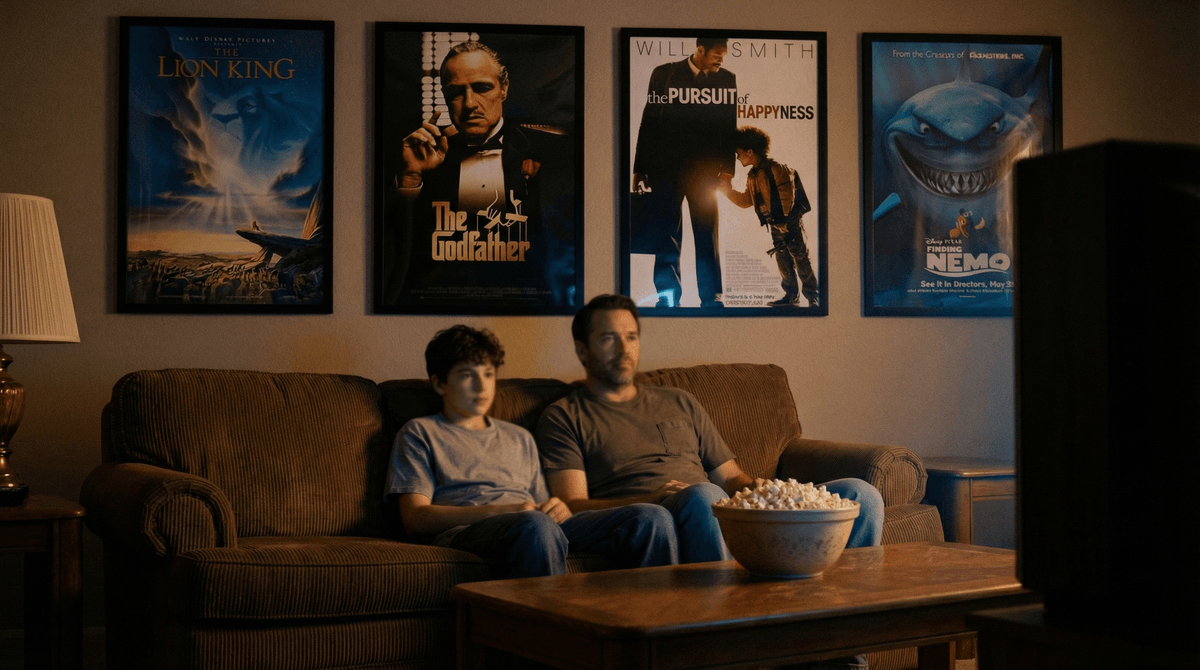
The Most Memorable Father-Son Movie Duos: From Mufasa to The Godfather
TL;DR: These father-son movie relationships give you a starting point for conversations about masculinity, legacy, sacrifice, and what makes a good dad—without the awkward "we need to talk" energy. From The Lion King to Finding Nemo to The Pursuit of Happyness, these films show different versions of fatherhood that can spark genuine dialogue.
Movie dads run the full spectrum from "literally ate his own son" (looking at you, Greek mythology) to "crossed an ocean to find his disabled kid." And somewhere in that range are the father-son relationships that stick with us—the ones that made us cry in the theater, the ones we quote with our own dads, the ones that shaped how we think about what fathers owe their sons and what sons owe their fathers.
These aren't just feel-good family films (though some are). They're entry points for talking about hard things: What does it mean to live up to a legacy? When is sacrifice heroic versus martyrdom? How do you repair a broken relationship? What does healthy masculinity actually look like?
The beauty of using movies for these conversations is that you're not lecturing. You're just watching a story together. And then maybe, during the credits or on the drive home, someone says "that part where he..." and suddenly you're having a real conversation.
The Lion King (1994)
Ages 5+ | The father-son duo: Mufasa and Simba
This is the one that destroyed an entire generation of kids in 1994 and continues to wreck children today. Mufasa's death scene is seared into our collective consciousness, but the real power of this relationship is in what comes after—how Simba carries his father's legacy, runs from it, and eventually learns what "remember who you are" actually means.
What makes it memorable: The "Circle of Life" speech isn't just beautiful—it's a masterclass in teaching humility and responsibility. Mufasa shows Simba the kingdom and then immediately humbles him: "Everything you see exists together in a delicate balance." He's teaching his son that being king isn't about power, it's about stewardship.
Conversation starters:
- "Why do you think Simba ran away instead of going back to Pride Rock?"
- "What do you think Mufasa meant by 'you are more than what you have become'?"
- "Is there anything your parents have taught you that you didn't understand at first but makes sense now?"
Finding Nemo (2003)
Ages 4+ | The father-son duo: Marlin and Nemo
Marlin is an anxious, overprotective dad who has to learn that keeping his son safe and letting his son grow up are sometimes in tension. The whole movie is basically exposure therapy for helicopter parents, and it works because Marlin's fear is so understandable—he lost his wife and all his other children. Of course he's terrified.
What makes it memorable: The movie doesn't shame Marlin for his fear. It shows him learning, failing, trying again. And Nemo isn't a perfect kid—he's rebellious specifically because of his dad's overprotection. It's honest about how parent anxiety affects kids.
Conversation starters:
- "Do you ever feel like I'm too worried about you? What does that feel like?"
- "When Nemo touches the boat, is he being brave or foolish? What's the difference?"
- "What's something you want to try that feels scary to me?"
Big Hero 6 (2014)
Ages 7+ | The father figure: Tadashi (older brother, but fills the father role)
Okay, technically Tadashi is Hiro's brother, but he's the father figure in Hiro's life after their parents died. And his death—another Disney trauma bomb—sets up the entire emotional arc of the film. What's powerful here is how Hiro processes grief and how Tadashi's influence continues even after he's gone.
What makes it memorable: Tadashi's legacy isn't just Baymax (though that's pretty great). It's the question he always asked: "What would help?" Not "what's cool" or "what's powerful"—what would actually help people? That's the value system he passed to Hiro.
Conversation starters:
- "How do you think people we love stay with us even after they're gone?"
- "What do you think Tadashi would say about how Hiro used Baymax for revenge?"
The Pursuit of Happyness (2006)
Ages 10+ | The father-son duo: Chris and Christopher Gardner
Will Smith and his real-life son Jaden play a father and son experiencing homelessness while Chris fights to build a better life. This movie will wreck you. The bathroom scene—you know the one—is devastating. But it's also a powerful story about resilience, sacrifice, and a father who never stops showing up for his kid even when everything falls apart.
What makes it memorable: Chris Gardner doesn't lie to his son about how bad things are, but he also protects him from the full weight of their situation. He's constantly balancing honesty with hope. And the basketball scene—"Don't ever let somebody tell you you can't do something. Not even me."—is one of the best parenting moments in film.
Conversation starters:
- "What do you think Christopher understood about their situation?"
- "When is it okay for parents to protect kids from hard truths, and when should they be honest?"
- "What does it mean that Chris got the job but they still had a long road ahead?"
Field of Dreams (1989)
Ages 10+ | The father-son duo: Ray and John Kinsella
"Hey Dad, you wanna have a catch?" If you can get through that line without crying, you might be a robot. This movie is about a son who had a complicated relationship with his father, and through building a baseball field in his corn field (as one does), he gets a chance to reconcile with his dad's ghost.
What makes it memorable: It's not about the baseball. It's about all the things Ray never got to say to his father, all the ways they misunderstood each other, and the grace of getting a second chance. The movie understands that father-son relationships are often full of unspoken regret.
Conversation starters:
- "Why do you think Ray and his dad had such a hard time talking to each other?"
- "Is there anything you wish you could say to someone you've lost?"
- "What do you think the baseball field represents?"
The Road (2009)
Ages 14+ | The father-son duo: The Man and The Boy
Fair warning: this movie is bleak. Post-apocalyptic, humanity-is-dying bleak. But the relationship between the unnamed father and son is one of the most moving depictions of parental love in cinema. The father's entire existence is about keeping his son alive and, more importantly, keeping him good—keeping him human in an inhumane world.
What makes it memorable: "You have to carry the fire." The father teaches his son that survival isn't enough—you have to maintain your humanity, your compassion, your goodness, even when the world gives you every reason not to. It's about what values we pass down when everything else is gone.
Conversation starters:
- "What do you think 'carrying the fire' means?"
- "How do you stay good when the world around you isn't?"
- "What values do you think are most important to hold onto no matter what?"
The Godfather (1972)
Ages 16+ | The father-son duo: Vito and Michael Corleone
This is the gold standard for complicated father-son dynamics. Vito Corleone built an empire and wanted his sons—especially Michael—to stay out of the family business. Michael wanted nothing to do with it. And then, through a series of tragic events, Michael becomes exactly what his father both wanted and didn't want him to be.
What makes it memorable: The tragedy is that Vito's love for Michael is genuine, and Michael's transformation into his father is both inevitable and devastating. It's about how we inherit our parents' sins and strengths, whether we want to or not.
Conversation starters:
- "Do you think Michael had a choice, or was he always going to end up like his father?"
- "What does it mean that Vito wanted something different for Michael but also needed him to protect the family?"
- "How do you think our family's history shapes who we become?"
Ages 10+ | The father-son duo: Henry and Indiana Jones
Sean Connery and Harrison Ford as a father and son who can barely stand each other but have to work together to find the Holy Grail. Their relationship is prickly, competitive, and full of old wounds. Henry was so obsessed with his work that he neglected Indiana as a child. Indiana became an archaeologist to get his father's attention and has spent his life both following in his father's footsteps and resenting him for it.
What makes it memorable: The moment when Henry calls him "Indiana" instead of "Junior" for the first time. That tiny acknowledgment—that he sees his son as his own person, not just an extension of himself—is everything. Also, the scene where Indiana has to choose between the grail and saving his father is a perfect reversal of priorities.
Conversation starters:
- "Why do you think Indiana became an archaeologist like his dad even though they didn't get along?"
- "What does it mean when Henry finally calls him Indiana?"
- "Have you ever felt like you had to do something to get someone's attention?"
Boyz n the Hood (1991)
Ages 14+ | The father-son duo: Furious and Tre Styles
Furious Styles is the kind of father every kid deserves but not every kid gets—present, engaged, teaching his son how to navigate a world that's stacked against him. This movie doesn't shy away from the reality of raising a Black son in America, and Furious's parenting is intentional, political, and deeply loving.
What makes it memorable: The scene where Furious teaches Tre and Ricky about gentrification and systemic racism isn't preachy—it's a father preparing his sons for the world they live in. And when Tre is ready to seek revenge and Furious stops him, it's not about weakness. It's about breaking cycles.
Conversation starters:
- "What do you think Furious means when he talks about how the system is designed?"
- "Why does Furious stop Tre from going after the shooters?"
- "What does it mean to be a good father in a world that's unfair?"
About Time (2013)
Ages 13+ | The father-son duo: The Father and Tim
This movie masquerades as a romantic comedy but is actually a meditation on father-son love and mortality. Tim learns he can time travel, and he uses it mostly to fix awkward moments and win over a girl. But the real story is his relationship with his father, and the impossible choice he has to make when his dad dies.
What makes it memorable: The scene where Tim goes back to play ping-pong with his dad one last time, knowing it's the last time, is absolutely gutting. It's about accepting that we can't keep our parents forever, and that's what makes the time we have sacred.
Conversation starters:
- "If you could go back and relive one day with someone you love, which day would you pick?"
- "Why do you think Tim's dad told him the secret of time travel was just to live every day well?"
- "What does it mean that Tim had to choose between seeing his dad and having his daughter?"
Ages 11+ | The father figure: Yondu (not biological father, but the real dad)
"He may have been your father, boy, but he wasn't your daddy." Yondu's funeral speech might be the most emotionally devastating moment in the entire MCU. Star-Lord spends the whole movie trying to connect with his biological father, Ego, only to realize that Yondu—the blue space pirate who kidnapped him—was his real father all along.
What makes it memorable: It's a reminder that biology doesn't make you a parent. Showing up does. Sacrifice does. Yondu was a terrible person who did terrible things, but he loved Peter and ultimately died to save him. It's complicated and beautiful and real.
Conversation starters:
- "What's the difference between a father and a daddy?"
- "Why do you think Peter didn't see Yondu as his dad until it was too late?"
- "Can someone be a good parent even if they make a lot of mistakes?"
Ages 4-7: Stick with the animated films—The Lion King, Finding Nemo, Big Hero 6. These handle heavy themes but in ways young kids can process. Be ready for questions about death, especially with Mufasa and Tadashi.
Ages 8-12: Add Indiana Jones and the Last Crusade, Field of Dreams, and The Pursuit of Happyness. These introduce more complex family dynamics and real-world challenges. The bathroom scene in Pursuit of Happyness is particularly emotional—be prepared for that conversation.
Ages 13-15: About Time, Guardians of the Galaxy Vol. 2, Boyz n the Hood (note: violence and strong language, but important themes). These films deal with mortality, systemic injustice, and chosen family in ways that resonate with teens.
Ages 16+: The Godfather, The Road. These are heavy, complex, and don't offer easy answers. The Road in particular is extremely dark—make sure your teen is ready for that level of bleakness.
The magic of these movies isn't just watching them—it's the conversations they unlock. Here's the thing: you don't need to force it. Don't pause the movie every ten minutes to ask "and what do we think about THAT?" Just watch together. Pay attention to what moments make your kid react—a laugh, a gasp, a "wait, what?"
After the movie, you might try:
- "What did you think?" (Revolutionary, I know, but it works)
- "What was your favorite part?"
- "Was there anything that surprised you?"
- "Did any of it remind you of us?"
And then—this is key—actually listen to the answer. Don't jump in with your interpretation. Let them process. Sometimes the best conversations happen in the car on the way home, or the next day at breakfast, when they've had time to think.
If your kid doesn't want to talk about it, that's okay too. Sometimes the value is just in watching it together, in sharing that experience. The conversation might happen later, or it might just live in their head, shaping how they think about fathers and sons and what they owe each other.
These father-son movie relationships matter because they give us language for things that are hard to talk about directly. It's easier to discuss Marlin's overprotectiveness than your own. It's less confrontational to analyze Furious Styles's parenting than to have a direct conversation about race and safety. It's safer to cry about Mufasa than to acknowledge our own mortality.
But here's what's actually happening: you're building a shared vocabulary. You're creating reference points. Later, when something hard comes up, you might find yourself saying "remember in The Pursuit of Happyness when..." and suddenly you're having the real conversation.
These movies aren't substitutes for actual communication, but they're damn good starting points. And honestly? Sometimes the best parenting move is just sitting on the couch with your kid, watching a movie about a dad who's trying his best, and letting them know—without saying it directly—that you're trying your best too.
Want to explore more films that spark meaningful conversations? Check out our guides on movies about grief and loss, coming-of-age films, or films that teach emotional intelligence.