

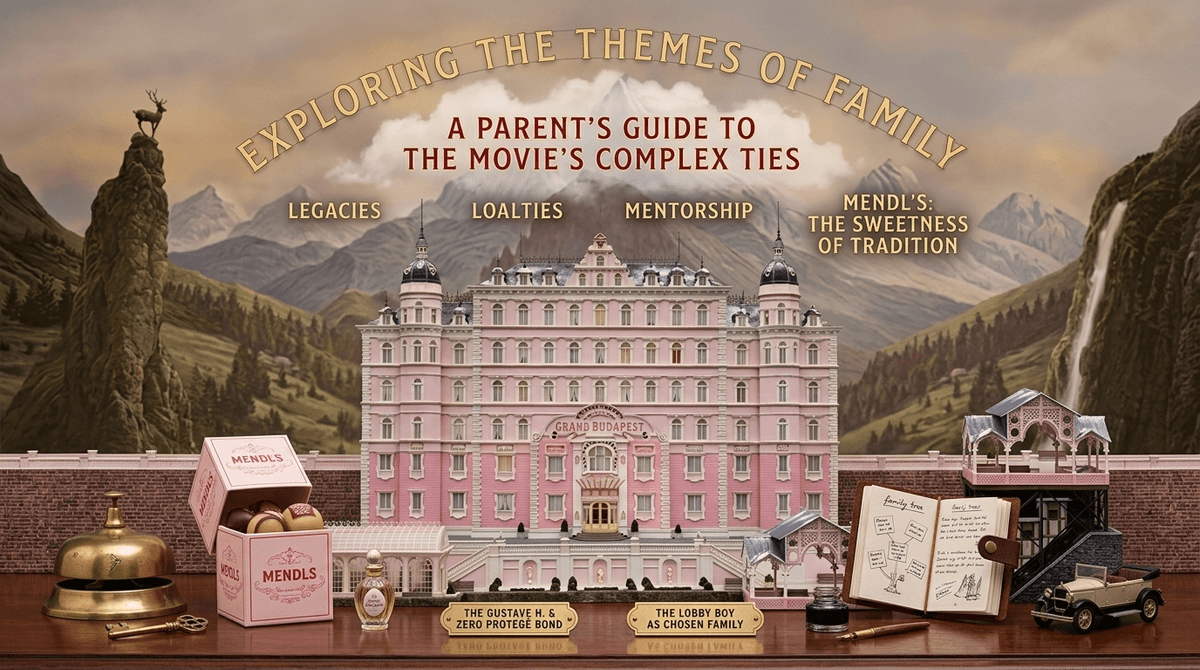
TL;DR
The Grand Budapest Hotel is a visual masterpiece that looks like a pink-frosted cake but tastes like a sophisticated cocktail with a bit of a bite. It’s rated R for a reason—mostly language and some stylized violence—but for mature teens (14-15+), it’s an incredible entry point into "prestige" cinema.
Quick Recommendations:
- If they love the aesthetic but aren't ready for R: Fantastic Mr. Fox or Moonrise Kingdom.
- If they want more stop-motion quirk: Isle of Dogs.
- If you want a family-friendly intro to symmetrical filmmaking: The Accidentally Wes Anderson book.
Directed by Wes Anderson, this 2014 film is essentially a story within a story within a story. It follows the adventures of Gustave H., a legendary concierge at a famous European hotel between the first and second World Wars, and Zero Moustafa, the lobby boy who becomes his most trusted friend.
The plot involves a stolen Renaissance painting, a massive family fortune, and the encroaching shadow of a fictionalized version of fascism. It’s fast, it’s funny, and it’s arguably the "most" Wes Anderson movie he’s ever made. If your teen has spent any time on TikTok or Instagram, they’ve likely seen the "Wes Anderson challenge" filters or trends—this movie is the blueprint for that entire aesthetic.
In a world of "brain rot" content and 15-second clips, The Grand Budapest Hotel is the literal opposite. It’s intentional, meticulously crafted, and requires actual attention to follow the shifting timelines and dense dialogue.
It’s also a great way to talk about history without it feeling like a lecture. While the country (Zubrowka) is fictional, the themes of the "death of the old world" and the rise of authoritarianism are very real. It’s a "safe" way to explore the vibes of pre-WWII Europe through a lens that feels more like a storybook than a textbook.
Let’s be real: sometimes the MPAA is a bit dramatic, and other times they’re spot on. For The Grand Budapest Hotel, the R rating is "soft" compared to something like a slasher flick, but it’s definitely not a family movie for the elementary crowd.
Language
This is the biggest factor. Gustave H. is highly eloquent and poetic, but he also has a very "salty" mouth when he’s stressed. There are several F-bombs used for comedic effect. If your household is a "no swearing ever" zone, this will be a dealbreaker. If your teen hears worse at school (which, let’s be honest, they do), it’s mostly just part of the character’s charm.
Violence
The violence is "Wes Anderson violence," which means it’s stylized and often happens in wide shots, but it’s still there. There is a scene involving four severed fingers in a doorway, a cat being thrown out of a window (it’s played for dark comedy, but sensitive kids will hate it), and a brief, bloody shot of a character found dead in a bathtub. It’s not "gore" in the traditional sense, but it’s sharp and sudden.
Sexual Content and Nudity
There is a scene featuring a painting of a nude woman (the "Boy with Apple" painting is the plot driver, but there’s a different, more explicit drawing used as a prank). There is also a brief scene in a hotel room that shows a woman’s breasts. It’s handled artistically rather than pornographically, but it’s something to be aware of if you’re watching with your 13-year-old.

Ages 0-12: Skip It
Even though it looks like a cartoon in some scenes, the pacing and dialogue will go over their heads, and the sudden violence/swearing isn't worth it. Stick to Fantastic Mr. Fox.
Ages 13-14: Parent’s Choice
This is the "maybe" zone. If you have a kid who is into photography, art, or history, they will likely appreciate the craft. If they are sensitive to animals or sudden violence, maybe wait a year. We recommend a "co-watch" for this age group so you can talk through the historical context of the "SS" style soldiers (the "ZZ" in the film).
Ages 15+: Green Light
At this age, most kids are ready for the themes and the "edge" of the film. It’s a fantastic movie to watch before they head off to a film study class or just to expand their horizons beyond the latest Marvel release.
If your teen watches this and suddenly starts wanting to reorganize their bedroom by color or asks for a vintage film camera, don't be surprised. Anderson's style is infectious. This movie is a gateway drug to:
- Art History: Talking about the Renaissance and the Dutch Masters.
- Cinematography: Learning about the "rule of thirds" and symmetry.
- Literature: The film was inspired by the writings of Stefan Zweig, a Jewish-Austrian writer who saw the world he loved disappear.
If they liked the quirk but want something that feels more like a "coming of age" story, this is the one. It’s PG-13 and follows two runaway kids on an island. It’s sweet, weird, and visually stunning.
For older teens (16+), this is a deeper dive into family dysfunction. It’s also R-rated and deals with some heavier themes like depression and suicide, so definitely check the guide on that one first.
If you decide to watch it with your teen, here are a few conversation starters that aren't "So, what did you think?":
- "Gustave tries so hard to maintain 'civilization' while the world is falling apart. Do you think that’s brave or just delusional?"
- "Why do you think the director used different screen sizes (aspect ratios) for the different time periods?" (Hint: It matches the film tech of that era!)
- "Did the violence feel out of place compared to how 'pretty' the rest of the movie was?"
The Grand Budapest Hotel is a 10/10 movie that deserves its accolades. It’s not "brain rot," it’s not "mid," and it’s definitely not just for hipsters. It’s a story about friendship, loyalty, and the importance of being kind even when the world is becoming unkind.
As long as you’re okay with a few F-bombs and some "blink and you’ll miss it" nudity, it’s one of the best cinematic experiences you can share with your older teen.
- Watch the trailer with your teen to see if the "vibe" clicks.
- Check your streaming services—it often hops between platforms like Max and Hulu.
- If they love the music, check out the soundtrack by Alexandre Desplat; it’s great for "study vibes" without lyrics.
Check out our guide to the best movie soundtracks for studying