

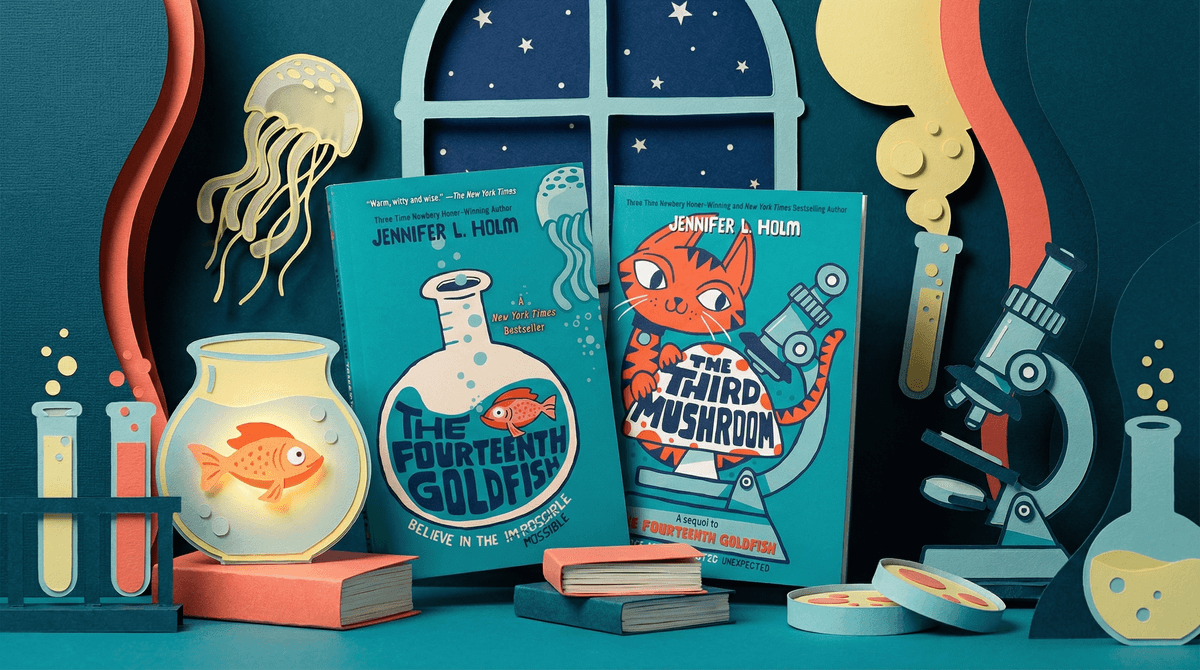
The Fourteenth Goldfish is a middle-grade novel by Jennifer Holm that hits that sweet spot where science fiction meets real family drama. The premise is wonderfully weird: 11-year-old Ellie's scientist grandfather discovers a way to reverse aging and shows up at her door as a teenager. Suddenly, she's dealing with a moody 13-year-old boy who happens to be her 76-year-old grandpa—complete with all his memories, wisdom, and curmudgeonly personality trapped in an adolescent body.
It's quirky, it's funny, and honestly? It opens up some of the best dinner table conversations you'll have with your middle schooler about science, aging, family relationships, and what it really means to grow up (or not).
Here's what makes this book special: it sneaks in big ethical questions without feeling like homework. Your kid thinks they're reading about a bizarre science experiment gone right (or wrong?), but they're actually wrestling with questions about mortality, the value of aging, scientific ethics, and whether youth is actually all it's cracked up to be.
The science is real enough to spark curiosity—the book touches on jellyfish that can reverse their life cycle (yes, that's actually a thing ), cellular biology, and what it might mean if we could actually stop or reverse aging. But it's wrapped in a story about a girl navigating middle school, her parents' divorce, and suddenly having to babysit her teenage grandfather.
Age range: Perfect for ages 8-12, though mature 7-year-olds and even young teens might enjoy it. The reading level is accessible (around 4th-5th grade), but the themes have enough depth to engage older kids too.
This isn't a preachy book, but it does have a perspective. Grandpa Melvin is obsessed with youth and believes his discovery is humanity's greatest achievement. But through Ellie's eyes, we see what he's lost—the wisdom, perspective, and acceptance that come with age. The book gently argues that aging isn't just something to fix, it's part of what makes us human.
Some things to be aware of:
- Divorce is part of the background: Ellie's parents are recently divorced. It's handled matter-of-factly, not dramatically, but it's there.
- Scientific method vs. shortcuts: Grandpa Melvin is brilliant but also kind of a jerk about it. He's impatient, dismissive of non-scientists, and willing to break rules. This actually becomes a great conversation starter about scientific ethics.
- Teenage awkwardness: There's something deeply uncomfortable (in a good way) about a 76-year-old dealing with teenage hormones and social dynamics again. It's played for humor but also raises questions about identity.
The book doesn't have any content concerns—no violence, romance is barely mentioned, no language issues. It's genuinely appropriate for the age range.
Kids who'll dig this:
Kids who might bounce off:
- Action-seekers looking for fast-paced adventure (this is more contemplative)
- Kids who prefer pure fantasy over science fiction
- Readers who want clear good-guys-vs-bad-guys plots (this is more nuanced)
This is where the book really shines. After reading, you can talk about:
The science: "Do you think we should try to cure aging if we could?" This gets into some fascinating territory about what problems we should solve with science vs. what makes us human.
Growing up: "Why do you think Grandpa Melvin wanted to be young again so badly?" This opens up conversations about what they're excited or nervous about as they get older.
Family relationships: "How do you think it felt for Ellie to see her grandpa as a teenager?" Great for talking about how we see older family members and what we learn from different generations.
Scientific ethics: "Should Grandpa have tested his discovery on himself without permission from other scientists?" Hello, conversations about rules, safety, and why we have scientific review processes.
The Fourteenth Goldfish is one of those rare books that's genuinely fun to read while also being sneakily meaningful. It's not going to change your kid's life, but it might spark some really good conversations about aging, family, and what it means to grow up—conversations that feel natural rather than forced.
If your kid is in that middle-grade sweet spot and you're looking for something that's neither brain rot nor tedious "important literature," this is a solid choice. Bonus: it's a quick read (under 200 pages), so even reluctant readers can knock it out without feeling overwhelmed.
Next steps: If your kid loves this, Jennifer Holm has written several other great middle-grade books. The Fourteenth Goldfish also has two sequels (The Third Mushroom and The Eighth Octopus) that continue exploring science and ethics. And if they're hungry for more science-meets-story content, check out this guide to science-focused books for middle schoolers.