

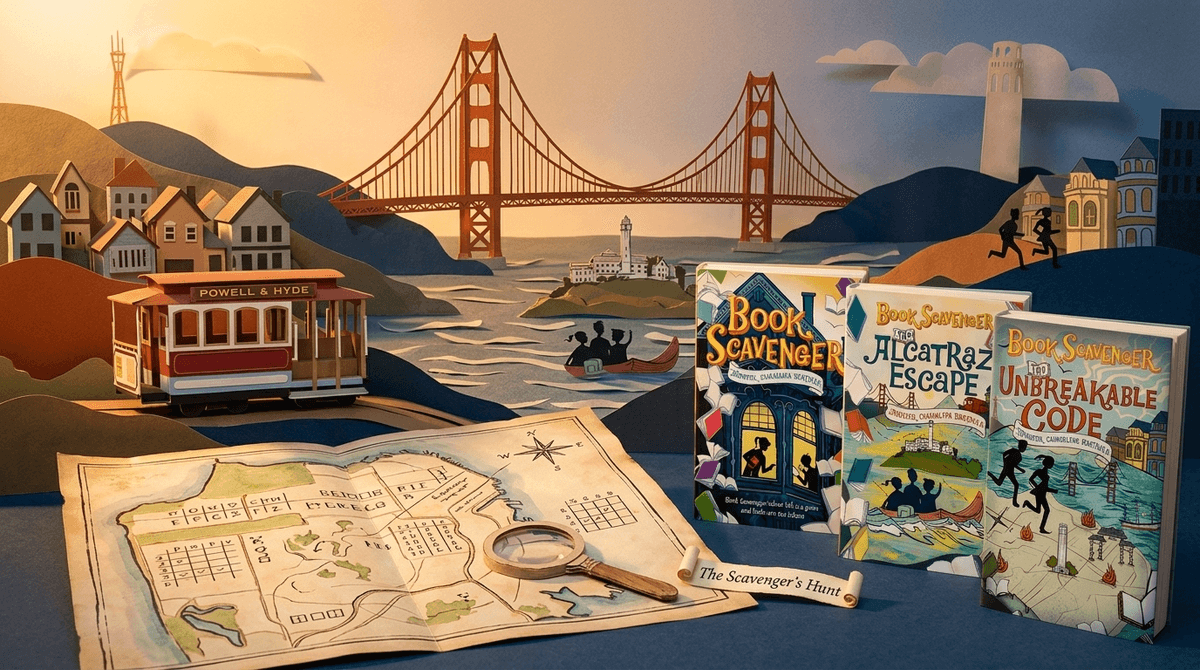
TL;DR: If your kid loves Minecraft for the logic or Roblox for the community challenges, but you’re desperate to see them hold a physical object made of paper, The Book Scavenger by Jennifer Chambliss Bertman is your secret weapon. It’s a middle-grade mystery series that turns reading into a global geocaching game. Think National Treasure meets the library.
Quick Links for the Puzzle-Obsessed:
Imagine a world where people hide books in public places and leave coded clues online for others to find them. That’s the premise of "Book Scavenger," a game created by the eccentric (and fictional) Garrison Griswold.
The story follows 12-year-old Emily, whose family moves to San Francisco—the headquarters of the game. Just as she arrives, Griswold is attacked and slips into a coma, leaving behind a mysterious, top-secret book that contains a puzzle no one has ever solved. Emily teams up with her new neighbor, James (who sports a very cool cowlick and an even cooler obsession with ciphers), to solve the mystery before the bad guys do.
It’s a fast-paced, high-stakes adventure that actually teaches kids how to crack real-world codes like the Caesar Cipher and the Gold Bug Cipher. If your kid is currently saying everything is "Ohio" (weird/cringe) or complaining about "brain rot" YouTube, this is the intellectual "glow up" their bookshelf needs.
We talk a lot about "gamification" in apps like Duolingo, but Jennifer Chambliss Bertman managed to gamify the actual experience of being a reader.
1. The "Geocaching" Vibe Kids today are used to digital layers on top of the real world (think Pokémon GO). This book validates that desire for adventure. It makes the local park or the corner bookstore feel like a level in a video game.
2. Interactive Problem Solving The puzzles aren't just fluff; they are printed in the book. Your kid can actually stop reading, grab a pencil, and try to decode the message alongside Emily and James. It gives that same dopamine hit as finishing a difficult level in Portal or Baba Is You.
3. The "Underdog" Dynamic Emily and James aren't superheroes. They’re just smart, slightly socially awkward kids who are really good at one specific thing. For the tween who feels like they don’t quite fit the "standard" middle school mold, Emily’s journey is incredibly validating.
One of the reasons I love recommending The Book Scavenger is that it respects the digital world kids live in. Emily uses a website to track her points and find book locations. It doesn't treat "being online" as the enemy of "reading books."
Instead, it shows how tech can be a tool for discovery. If you’re trying to move your kid away from mindless scrolling on TikTok and toward something more constructive, this series is a perfect bridge. It uses the same "leveling up" mechanics they love in games but applies them to literary history and cryptology.
Target Age: 8–12 (Grades 4–7)
- The Sweet Spot: 10-year-olds are the prime demographic here. They’re old enough to handle the slightly more complex ciphers but young enough to still find the idea of a secret book-hiding society absolutely magical.
- For the Younger Crowd: A strong 8-year-old reader will enjoy the plot, though they might need a little help with the actual math/logic of the codes.
- For the Older Crowd: 13 and 14-year-olds who enjoyed The Westing Game or The Selection might find it a bit "young," but if they like puzzles, they’ll still blast through it in a weekend.
Content Note: The series is very "clean." There’s some mild peril (the bad guys are threatening, and there’s a scene involving a physical altercation in a subway station), but nothing that will cause nightmares. It’s much more about the intellectual chase than physical violence.
If your kid finishes the trilogy and is begging for more, here is the "Screenwise-approved" pipeline for puzzle-loving tweens:
This is the gold standard for "smart kids solving impossible problems." It’s a bit denser than Book Scavenger, but the payoff is huge. There’s also a Disney+ show which is actually quite good and stays true to the "quirky academic" vibe.
If Book Scavenger is a mystery, Lemoncello is a wacky game show. It’s loud, colorful, and filled with puns. It’s basically the Roblox of the book world—fast-paced and high energy.
While not a "puzzle" book in the traditional sense, it appeals to the same kids who like logic and systems. It’s about a robot named Roz who has to "program" herself to survive in the wilderness.
This is the real-world version of the game in the book. You can download the app and find physical containers hidden in your neighborhood using GPS. It’s the ultimate "get off the couch" activity for digital-native kids.
Check out our full guide on how to start geocaching with kids
Here’s the thing: the first book is fantastic. The second book, The Unbreakable Code, is also very strong. By the third book, The Alcatraz Escape, the formula starts to feel a little familiar, but for a 10-year-old, that's usually a feature, not a bug. They like the reliability of the characters.
Also, be prepared: this book mentions a lot of classic literature, specifically Edgar Allan Poe. Don't be surprised if your kid starts asking to read "The Gold Bug" or "The Raven." It’s a great way to introduce classics without it feeling like a homework assignment.
One minor "warning": the "Book Scavenger" website mentioned in the books actually exists in real life (run by the author/publisher). It’s a safe, moderated space where kids can track books they’ve hidden or found. It’s one of the few corners of the internet that feels genuinely wholesome, but as always, keep an eye on any "community" features.
If you want to engage with your kid while they’re reading, don't just ask "what happened?" Ask them about the logic:
- "Have you figured out the cipher Emily is working on yet? Don't tell me the answer, just tell me how it works."
- "If we were going to hide a book in our town for the Book Scavenger game, where would be the hardest place to find it?"
- "Do you think Garrison Griswold is more like Elon Musk or more like Willy Wonka?" (This usually leads to a great conversation about eccentric billionaires and ethics).
The Book Scavenger is a rare win for parents. It’s a "smart" book that doesn't feel like a "school" book. It respects your kid's intelligence and their digital habits while giving them a reason to look up from their screens and engage with the physical world.
In a world of "brain rot" content and mindless clicks, Emily and James are the role models we actually want for our kids—curious, persistent, and unafraid to tackle a problem that seems impossible.
- Grab the first book. Check your local library or order it here.
- Download the Geocaching app. Spend a Saturday afternoon finding a couple of local caches to show them that "real-life puzzles" actually exist.
- Print out a Caesar Cipher wheel. You can find them online for free. Use it to leave a coded note in their lunchbox. If they can decode it, they get to pick the Friday night movie.
Learn more about how to encourage "analog" hobbies in a digital world