

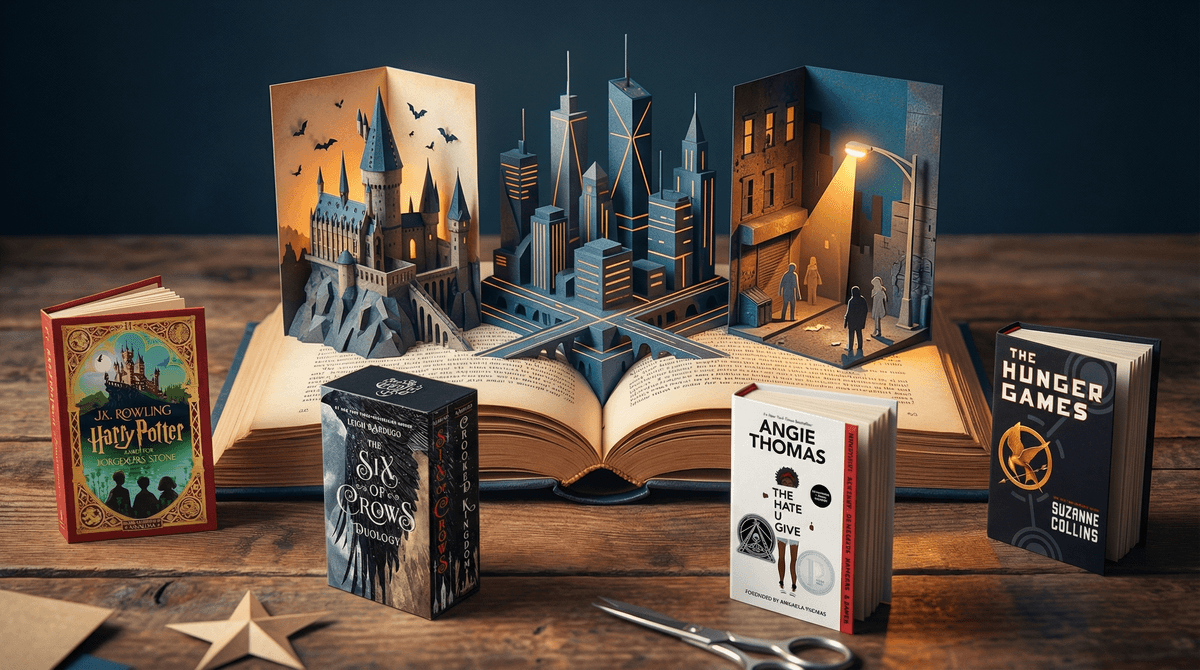
Young Adult (YA) book series are multi-book stories written specifically for readers aged 12-18, though let's be honest—plenty of adults are reading them too. These aren't your childhood chapter books. YA series tackle complex themes like identity, power, injustice, first love, and mortality, often set in fantastical worlds or dystopian futures that feel surprisingly relevant to real life.
The best YA series create immersive universes that keep readers coming back book after book. They're the literary equivalent of binge-watching a great series, except they're actually building vocabulary, empathy, and critical thinking skills while your teen is glued to the page instead of a screen.
Here's the thing about YA book series: they're often the bridge between childhood reading and adult literary appreciation. A kid who devours all seven Harry Potter books is learning how to commit to a long narrative arc, remember complex details across hundreds of pages, and develop theories about what might happen next.
But beyond the reading skills, these series tackle genuinely hard topics. The Hunger Games is about authoritarian governments and class warfare. The Hate U Give confronts police brutality and systemic racism head-on. Six of Crows features disabled characters, LGBTQ+ representation, and discussions of trauma and addiction.
These books give teens a framework for understanding the world's complexity in a way that feels less preachy than a lecture from parents or teachers.
Harry Potter (Ages 10+)
Yes, J.K. Rowling's later comments have complicated this series for many families, but there's no denying its cultural impact. Seven books following a boy wizard fighting fascism (essentially) while navigating friendship, loss, and growing up. The early books are lighter; by book 4, characters are dying and the themes get significantly darker. If your kid is reading these, know that books 5-7 deal with torture, war, and pretty intense violence.
The Hunger Games (Ages 13+)
Suzanne Collins' trilogy about teens forced to fight to the death on live TV is brutal but brilliant. It's a searing critique of reality TV, war, propaganda, and inequality. The violence is significant—kids literally killing kids—but it's never gratuitous. If your teen is ready for honest conversations about power and resistance, this series delivers. Just know: the protagonist Katniss ends the series with serious PTSD, which the books don't shy away from.
Percy Jackson and the Olympians (Ages 9+)
Rick Riordan's series about a kid with ADHD and dyslexia who discovers he's the son of a Greek god is genuinely fun while sneaking in actual mythology education. The humor is on point, the representation (especially of neurodivergent kids) is meaningful, and the adventure keeps pages turning. This is one of those rare series that reluctant readers will actually finish. Bonus: Riordan has expanded into Roman, Egyptian, and Norse mythology series, so there's plenty to explore.
The Hate U Give (technically standalone, but part of a connected universe) (Ages 14+)
Angie Thomas' novel about a Black teenager who witnesses her friend's death at the hands of police is required reading, full stop. It's contemporary, unflinching, and incredibly important. If your teen is navigating questions about race, justice, and activism, this book provides both mirrors and windows. Yes, there's strong language. Yes, the content is heavy. That's the point.
A Court of Thorns and Roses (Ages 16+)
Sarah J. Maas' fantasy romance series is wildly popular with older teens and has... let's just say it has some very spicy content by the second and third books. Think fairy tale retelling meets high fantasy meets romance novel. The first book is relatively tame; by book 2, there are explicit sex scenes. If your 14-year-old is reading this, you should know what they're getting into. That said, the series also features complex female characters, discussions of trauma and healing, and genuinely engaging world-building.
The Giver Quartet (Ages 11+)
Lois Lowry's dystopian series starts with a seemingly perfect society that's actually deeply disturbing. The first book is often assigned in middle school, but the full quartet gets progressively more complex and philosophical. These books ask hard questions about memory, choice, emotion, and what makes us human.
Six of Crows Duology (Ages 14+)
Leigh Bardugo's heist fantasy features a diverse cast of morally gray characters planning an impossible robbery. It's Ocean's Eleven meets fantasy, with exceptional disability representation (the main character uses a cane), LGBTQ+ characters, and frank discussions of addiction and trauma. The violence is present but not gratuitous, and the found-family dynamics are chef's kiss.
Let's talk about the elephant in the room: YA books often contain content that makes parents nervous. Violence, sex, drugs, strong language, and heavy themes are common.
Here's my take: teens are already thinking about this stuff. They're encountering it at school, online, in the news, and in their own lives. YA books provide a safer space to explore these topics with characters they care about, often with more nuance than they'll get from social media or their peers.
That said, you know your kid. A mature 12-year-old might be ready for The Hunger Games while a 15-year-old might find it too intense. Age ratings are guidelines, not rules .
.
If you're worried about a specific book, here's a radical idea: read it yourself or at least skim a detailed review on Common Sense Media. Better yet, read it together or have a standing agreement that your teen can talk to you about anything that comes up in their reading without judgment.
Older YA series (looking at you, Twilight) are pretty homogeneous: white, straight, able-bodied characters dominating the landscape. Newer YA has gotten significantly better at representation, though there's still work to do.
Series like Children of Blood and Bone (African-inspired fantasy), The Shadowhunter Chronicles (LGBTQ+ characters throughout), and Legendborn (Black girl protagonist in Arthurian legend) are expanding what YA can be. If your teen only sees themselves reflected in media or only sees people different from them, that's worth paying attention to.
Many of these series have been adapted for screen, which can be either a great entry point or a disappointment, depending on the adaptation. The Percy Jackson show on Disney+ is actually good and faithful to the books. The Hunger Games movies are solid. The Shadow and Bone Netflix series combines multiple Leigh Bardugo series and takes liberties with the source material.
Some kids will read the book first and be disappointed by the adaptation. Others will watch the show and then devour the books. Both paths are valid.
The best YA book series aren't just entertainment—they're tools for understanding complex emotions, navigating moral ambiguity, and building empathy. They're also just really good stories that happen to be in book form instead of on a screen.
If your teen is reading a multi-book series, even if it's not "literary fiction," they're building sustained attention, narrative comprehension, and a reading habit that will serve them for life. That's worth celebrating, even if the books have fairies or dystopian governments or teenage romance.
Start a conversation: Ask your teen what they're reading and actually listen to their answer. Don't judge, don't critique—just be curious about what they're connecting with and why.
Create a reading-friendly environment: Audiobooks count. Reading on a device counts. Rereading the same series five times counts. Just get them reading.
Read together: Pick a series you can both enjoy and discuss. It's a built-in conversation starter that doesn't feel like an interrogation.
Use books as a bridge to harder topics: If your teen is reading about dystopian governments, that's an opening to talk about current events. If they're reading romance, that's a chance to discuss healthy relationships.
And remember: a teen reading anything is better than a teen reading nothing. Even if it's not your cup of tea, if it's getting them to turn pages instead of doomscrolling, that's a win.