

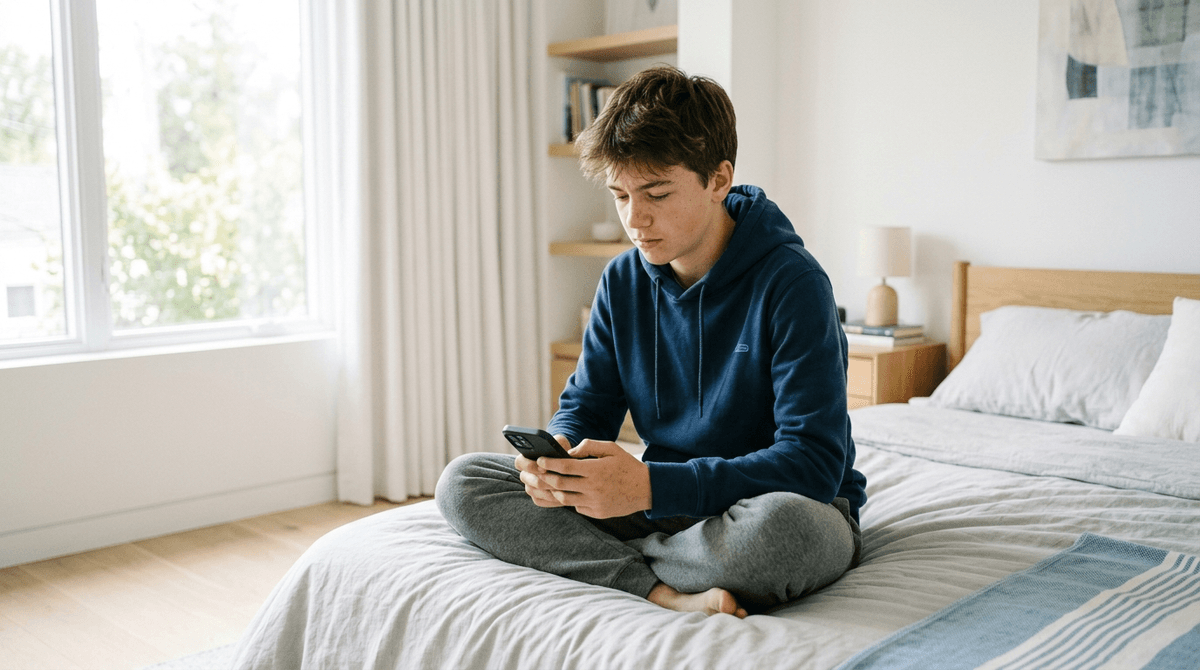
Poor sleep quality in teenagers is a warning sign for nearsightedness, but the real culprit is likely the screen time and lifestyle habits that disrupt sleep in the first place. While a tired teen is more likely to need glasses, fixing the sleep alone won't fix the vision.
Teenagers with poor sleep quality are more likely to be nearsighted, but sleep itself isn’t the cause of the vision loss. Researchers found that the link between sleep and myopia (nearsightedness) essentially vanishes once you account for screen time and body mass index. Sleep quality is a "marker" for a lifestyle that strains the eyes, rather than an independent risk factor.
Myopia is reaching epidemic levels globally, and parents are looking for any lever they can pull to protect their children's eyesight. If sleep were a direct cause, the solution would be simple: enforce an earlier bedtime. However, this data suggests that obsessing over sleep cycles is the wrong target.
This finding changes the priority for parents of teens. Instead of viewing sleep as a standalone cure for vision health, it should be treated as a red flag for a cluster of habits—specifically excessive digital device use and lack of outdoor time—that are the true drivers of eye elongation and vision decline.
Researchers have been investigating the "sleep-myopia" connection to determine if biological sleep mechanisms, like melatonin production or circadian rhythms, directly influence how the eye grows during adolescence. Because the eye continues to develop into the late teens, identifying modifiable risks is critical for public health.
The study aimed to untangle whether kids are nearsighted because they don't sleep, or if the things they do instead of sleeping are the real problem. By using a large, national dataset, the authors were able to adjust for variables that previous, smaller studies often missed, such as family income and physical activity levels.
Sleep duration has no statistical impact on the risk of nearsightedness in adolescents aged 16 to 19. Analyzing data from nearly 1,000 teenagers, the researchers found that simply getting more hours of shut-eye did nothing to change the odds of needing a stronger prescription.
The findings highlight a specific distinction between sleep quantity and sleep quality:
- Poor sleep quality was initially linked to higher myopia rates, but that connection was "attenuated"—it mostly disappeared—when researchers factored in screen time and BMI.
- The data suggests that sleep quality is a proxy for "near-work" habits; teens who sleep poorly are often the ones spending the most time on phones and tablets late into the night.
- Socioeconomic factors, such as family income, play a significant role in vision health, often dictating the types of environments and digital access a teen has.
The study implies that the biological "sleep-vision" link is secondary to environmental exposure. In the world of vision science, the "outdoor light" hypothesis is currently king. When teens spend more time indoors—often correlated with both poor sleep and high screen use—they miss out on the bright, natural light that triggers dopamine release in the retina, which is known to prevent the eye from growing too long (the cause of myopia).
This research suggests that the "tired teen with glasses" is a result of a lifestyle package. If a teen is staring at a screen for six hours a day, the screen is the primary stressor on the eye. The resulting poor sleep is just another symptom of that same screen-heavy environment.
The data used for this analysis was collected between 2005 and 2008. This was the very beginning of the smartphone era, meaning adolescent screen habits have shifted dramatically since the study participants were surveyed. Today’s teenagers likely have even higher rates of "near-work" and even more disrupted sleep quality than those in the study.
Furthermore, the sleep data was self-reported by the teenagers. Self-reporting is notoriously prone to error, as teens often underestimate screen time and overestimate sleep duration. While the sample size of 966 is robust, the cross-sectional nature of the study means it can only show a correlation, not a cause-and-effect relationship. It cannot prove that screen time caused the myopia, only that they tend to occur together.
- If your teenager is complaining of blurry vision and chronic fatigue, prioritize a "digital sunset" 60 minutes before bed rather than just enforcing a strict lights-out time.
- If you are worried about your child’s myopia progressing, focus on increasing their midday outdoor light exposure, which has a stronger evidence base for vision protection than sleep duration.
- If your teen is a high achiever with significant homework (near-work) loads, treat their poor sleep as a signal to implement the 20-20-20 rule: every 20 minutes, look at something 20 feet away for 20 seconds.
- If your child’s BMI is high and they are sedentary, recognize that this contributes to a metabolic profile that, combined with low sleep quality, is strongly associated with vision changes.
You cannot sleep your way to better vision if the rest of the day is spent inches from a screen. Sleep quality is a powerful indicator of your teen's overall digital health, but the screens—not the lack of rest—are the primary threat to their eyesight.
Xu Z, Chen D, Tao Z et al. (2026). Sleep Quality, Sleep Duration, and Adolescent Myopia: A NHANES Cross-Sectional Study with Implications for Ocular Photodiagnostic Screening. Photodiagnosis and photodynamic therapy. doi:10.1016/j.pdpdt.2026.105527 — pubmed.ncbi.nlm.nih.gov