

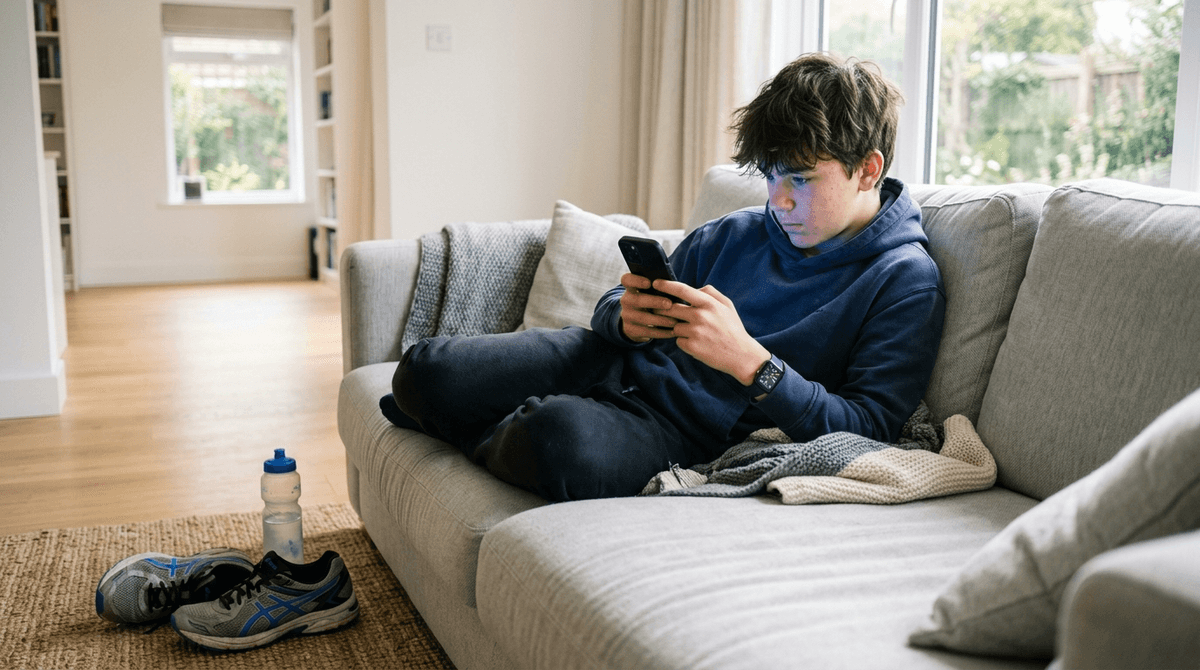
Teenagers nearly double their screen use on weekends, creating a "displacement effect" that consistently edges out sleep and physical exercise. This surge is particularly pronounced among boys and children in dual-income households, where screen time often functions as a default activity in the absence of structured supervision.
Adolescents surge from 2.5 hours of screen time on weekdays to over 4 hours on weekends, a habit that statistically guarantees they will fail to meet basic sleep and movement requirements. This "weekend spike" is strongly linked to higher BMI, increased need for corrective lenses, and a significant drop-off in face-to-face socializing.
The weekend "binge" isn't a harmless way to decompress; it's a structural threat to teen health. For parents, this study clarifies that screens aren't just "extra" time—they are actively replacing the fundamental pillars of development. If a teen spends more than four hours on a screen, they are statistically unlikely to get the eight hours of sleep their brain requires to regulate mood and learning.
These habits correlate with physical markers that parents can see, specifically higher body mass index (BMI) and deteriorating eyesight. Monitoring the "displacement" of activity is now more critical than monitoring the content itself. When screen time goes up, physical activity and homework time are the first things to vanish.
Researchers are tracking a post-pandemic "new normal" where sedentary digital behavior has solidified into a permanent lifestyle. There was a long-standing hope that increased screen access might lead to higher academic engagement, but this study confirms the opposite.
Despite the prevalence of tablets and laptops for school, academic use accounted for less than 30 minutes of the daily total. The rest is purely recreational, driven by a lack of structured alternatives on weekends and a decrease in parental supervision in households where both parents work full-time.
The data shows a stark divide in how different demographics consume media, with boys and private-school students facing the highest risks.
- The weekend jump is massive. Average usage climbs from 2.45 hours on weekdays to 4.21 hours on Saturdays and Sundays.
- Gender plays a major role. About 80% of boys exceed the recommended two-hour daily limit, compared to only 30% of girls.
- Supervision is a primary factor. Teens with two working parents are much more likely to have excessive screen time (70%) than those with one parent at home (42%).
- Health markers are declining. High screen use is significantly associated with physical inactivity (67% of high-users were inactive) and a greater likelihood of wearing glasses.
- Academic use is negligible. Most of the time spent on devices is for entertainment, not schoolwork or skill-building.
The "homework gap" is largely a myth in the context of total screen time. When parents justify a teen’s device use because "they need it for school," they are often ignoring the four hours of recreational use layered on top of that 30 minutes of work.
The study also suggests that the weekend is becoming a "health vacuum." Without the structure of the school day, teens default to screens as their primary environment. This implies that the solution isn't just "less tech," but more "enforced structure." In dual-income households especially, the screen has become the most accessible and cheapest form of childcare, even for 17-year-olds.
This study was cross-sectional, meaning it provides a snapshot of a moment in time. While it shows that high screen use and obesity go together, it cannot prove that screens caused the weight gain—it could be that less mobile teens simply gravitate toward screens.
The data was also collected via self-reported questionnaires from 610 students in Chennai, India. Self-reporting often leads to undercounting actual screen time, meaning the problem may be more significant than the numbers suggest. Additionally, cultural pressures in one specific urban center may not perfectly mirror the habits of teens in different geographic or economic environments.
- If your teen is a boy in a private school... implement a "weekend cap" that mirrors weekday limits, as this demographic is the most likely to lose control of their schedule on Saturdays.
- If you and your partner both work full-time... establish a "movement first" rule for the after-school gap, requiring 30 minutes of physical activity before any recreational device use begins.
- If your teen is sleeping less than eight hours... treat the four-hour screen mark as a hard ceiling. The study shows that crossing this threshold is the primary predictor of chronic sleep deprivation.
- If you notice your teen's eyesight or weight changing... audit their weekend usage specifically. The health impacts found in the study were more closely tied to the sheer volume of hours than the specific apps being used.
Screen time is no longer just a digital habit; it is a physical health intervention. To protect a teen's sleep and growth, parents must treat weekend screen spikes as a manageable risk rather than an inevitable part of modern life. Structure the weekend with movement and sleep as the non-negotiable foundations, and recreational tech as the reward that comes last.
Amuthan S, Mohan R, Ravichandran L et al. (2026). Screen time and its determinants among adolescents in Chennai: A cross-sectional study. Journal of family medicine and primary care. doi:10.4103/jfmpc.jfmpc_442_25 — pubmed.ncbi.nlm.nih.gov