

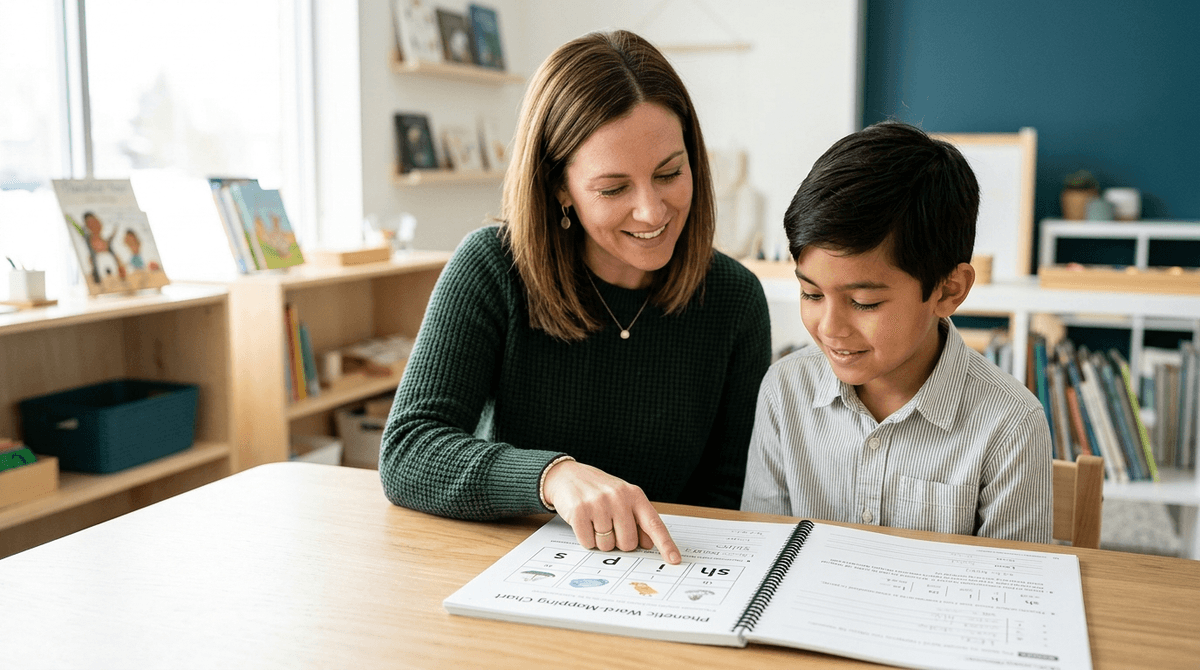
A teacher’s deep understanding of how the brain processes text is a more powerful predictor of student success than their years of experience or the brand of curriculum they use. When teachers possess high levels of specialized knowledge in the science of reading, their students achieve significantly better comprehension scores.
Good reading instruction isn't just about following a script; a teacher's deep, underlying knowledge of reading science acts as a silent multiplier, significantly boosting how well students actually understand what they read. This effect persists even when teachers appear to be using the same classroom techniques or quality of instruction.
Parents often focus on the "visible" parts of a school—the brand name of the curriculum, the number of books in the classroom, or whether a teacher has a Master’s degree. This research suggests those are the wrong metrics to track. If you want to know how well your child will read, you should be looking at how well their teacher understands the cognitive mechanics of how the brain decodes and processes text.
A teacher with "high knowledge" is able to pivot and explain concepts in multiple ways when a child gets stuck. Without that deep background, a teacher is often limited to simply repeating the curriculum’s instructions, which doesn't help a child who is struggling with the underlying logic of the language.
Educators and administrators have long struggled to explain the "achievement gap" between classrooms that seem to be doing the exact same things. Researchers wanted to know if the "invisible" factor—what the teacher actually knows about the cognitive process of comprehension—mattered as much as their visible classroom performance. By isolating teacher knowledge from classroom behavior, they could see which one actually moved the needle on student test scores.
The study found a clear, measurable link between what a teacher knows and how well their students perform on standardized reading tests.
- Even when two teachers delivered what observers rated as equally "good to excellent" instruction, students of the highly knowledgeable teachers scored significantly higher on the Gray Silent Reading Test.
- A teacher's specific pedagogical understanding of reading had a direct impact on student scores that could not be explained by other factors.
- Formal credentials like advanced degrees, years in the classroom, or specific certification types did not substitute for specialized knowledge of reading mechanics. A teacher with twenty years of experience but low specific knowledge of reading science was less effective than a newer teacher with deep technical training.
- The study involved a massive sample of 103 upper elementary school teachers and over 3,500 students, providing a high level of statistical power to these findings.
This suggests that "teaching to the script" has a ceiling. A teacher who follows a high-quality curriculum perfectly but doesn't understand why certain strategies work—such as how mental models are formed or how vocabulary depth impacts sentence processing—cannot pivot effectively.
The most knowledgeable teachers are likely making hundreds of micro-adjustments during a single lesson. They recognize the exact moment a student’s comprehension breaks down and can offer the specific cognitive "hook" needed to fix it. This expertise is invisible to most observers but is clearly visible in the student's end-of-year performance.
This was an observational study, which means it shows a strong connection but does not technically prove that the teacher's knowledge caused the higher scores. There could be other related factors at play. Furthermore, all the teachers in this study had recently participated in literacy professional development. This means the results might not be the same in a district where teachers haven't had any recent training. Finally, the tool used to measure teacher knowledge (the TKRC) was developed for this study; while it proved reliable, it is not yet the universal industry standard for testing teachers.
- If your child is struggling with reading comprehension... look for a tutor or specialist who can explain the cognitive science of reading (concepts like "schema theory" or "inference making") rather than someone who just supervises more minutes of practice reading.
- If you are evaluating a new school or classroom... ask the principal what specific "Science of Reading" professional development the teachers receive annually, rather than just asking which textbook or curriculum brand they purchased.
- If you are attending a parent-teacher conference... ask the teacher to explain their "mental model" for how they teach comprehension. A knowledgeable teacher should be able to tell you exactly how they help kids move from literal understanding to deeper, inferred meaning.
- If your school board is discussing budget cuts... advocate for protecting teacher professional development funds over buying new classroom technology or software. The teacher's internal knowledge is the more effective "software" for your child's brain.
Who is teaching your child matters more than what they are teaching from. A teacher’s specific expertise in the science of reading is the primary engine for student growth, significantly outperforming general classroom experience or advanced degrees. Prioritize schools and programs that invest heavily in specialized teacher training and cognitive science over those that simply buy the newest, flashiest curriculum.
Alida K. Hudson (2021). Elementary Teachers' Knowledge of Reading Comprehension, Classroom Practice, and Students' Performance in Reading Comprehension. ProQuest LLC. — http://gateway.proquest.com/openurl?url_ver=Z39.88-2004&rft_val_fmt=info:ofi/fmt:kev:mtx:dissertation&res_dat=xri:pqm&rft_dat=xri:pqdiss:29241860