

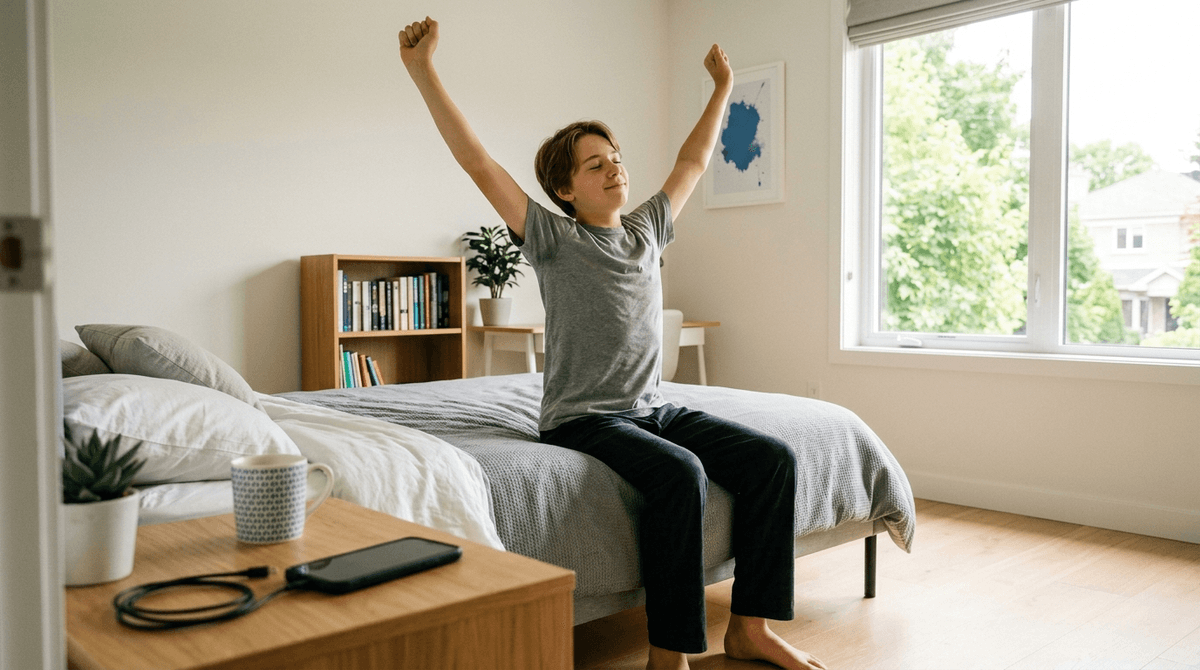
Trading just 10 minutes of daily screen time for exercise or sleep is linked to a measurable drop in adolescent depression symptoms. Even tiny shifts in how a teenager spends their day can predict significant changes in their mental health.
Trading 10 minutes of screens for movement or sleep reduces depression risk
A small reallocation of time away from devices toward physical activity or rest correlates with lower depression scores. Swapping 10 minutes of screen time for moderate-to-vigorous exercise, light activity, or sleep was associated with a decrease in depression scores by 0.07, 0.05, and 0.03 points, respectively. Conversely, replacing those same 10 minutes of exercise or sleep with screen time was linked to an increase in depression scores of up to 0.09 points.
Sleep is the most powerful lever for protecting teen mental health
Adequate rest showed the strongest protective association against depression, yet the vast majority of teenagers are chronically sleep-deprived. Fewer than 43% of middle schoolers and only 30% of high schoolers in the study met the recommended nine hours of sleep per night. Because sleep has a higher correlation with mood than even intense exercise, protecting the bedtime window from digital intrusion is the most effective way to support a teen’s emotional well-being.
Low-effort movement is just as valid as intense exercise
Swapping screen time for light activity like household chores or casual walking yields mental health benefits similar to a structured workout. While vigorous exercise had the single largest impact per minute, any movement that got teens away from a screen was associated with lower depression scores. You do not need a gym membership or a sports team to see a benefit; simply trading a YouTube video for a short walk or a few chores moves the needle.
What this means for your family
- Focus on micro-swaps. You do not need a complete lifestyle overhaul; reallocating just 10 to 15 minutes of screen time to a brisk walk or an earlier bedtime can yield positive mental health benefits.
- Prioritize the sleep window first. Since sleep has the strongest negative correlation with depression symptoms, making the bedroom a screen-free zone is the most impactful change you can make.
- Value "boring" movement. Don't worry about the intensity of your teen's activity—swapping screen time for light physical activity like walking the dog or helping with dinner counts.
- Look for patterns. Over half of the teens studied reported some level of depressive symptoms, suggesting that mood struggles are widespread and closely tied to how they balance their daily "time budget."
Honest caveats
The study is observational and cross-sectional, meaning it cannot prove that screen time causes depression; it is equally possible that depressed teens simply withdraw into their screens more often. All data was self-reported by the adolescents, which is prone to recall errors and the tendency to give "correct" answers. The physical activity questionnaire did not capture short, fragmented bursts of movement under 10 minutes, and the results from urban China may not generalize perfectly to rural or Western populations where academic pressures and social norms differ.
Where this comes from
Guo H, Man M, Hu Z et al. (2026). Screen time, physical activity, sleep, and depression risk in adolescents: an observational study based on the compositional isotemporal substitution model. Frontiers in public health. doi:10.3389/fpubh.2026.1782512 — https://pubmed.ncbi.nlm.nih.gov/42158198/