

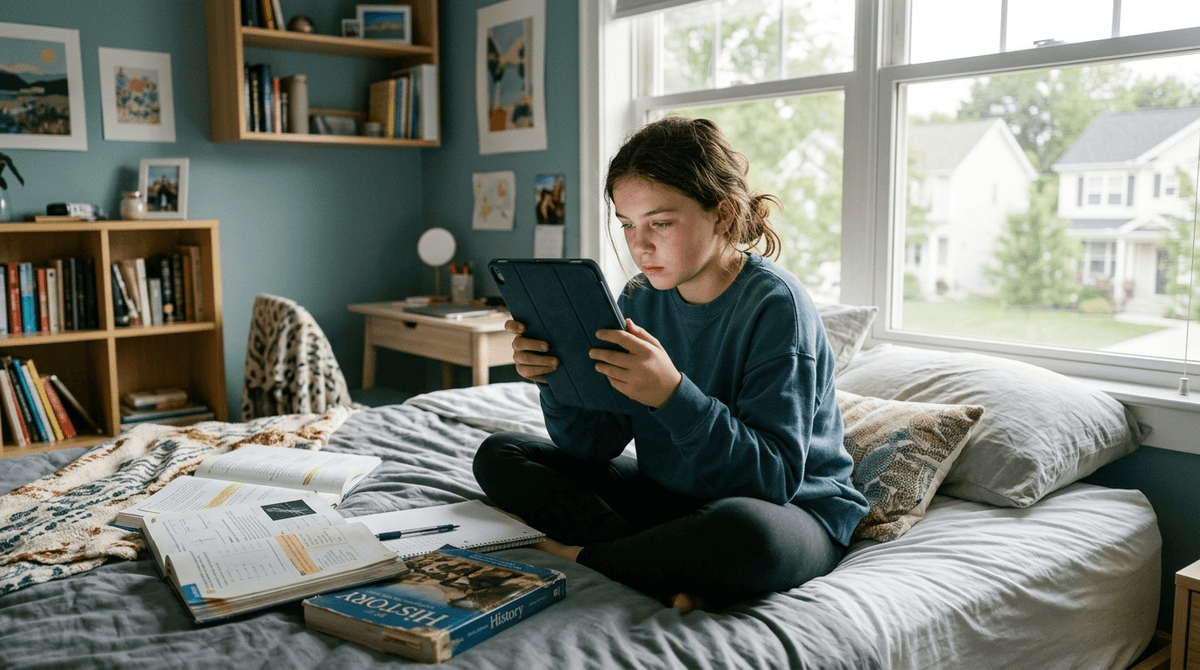
The U.S. Surgeon General is sounding the alarm on childhood screen use, identifying sleep deprivation and developmental delays as the primary prices children pay for digital immersion. This advisory shifts the conversation from "screen time limits" to a broader public health framework focused on protecting the biological essentials of growing up.
The Surgeon General warns that childhood screen use is now a significant risk factor for developmental and mental health, with sleep disruption acting as the primary driver of harm. To mitigate these risks, parents should implement the five-D framework: Discuss, Do, Delay, Divert, and Disconnect.
This isn't just about "too much phone time" or annoying habits; it's about the physical and cognitive infrastructure of your child’s brain. When screen use replaces sleep or face-to-face interaction, it directly impairs a child’s ability to learn, regulate their emotions, and maintain physical health.
For parents, this advisory provides the medical "permission" to set hard boundaries that might feel counter-cultural. It moves the needle from screen use being a personal parenting style to being a documented public health concern, similar to secondhand smoke or bicycle safety.
Public health officials are reacting to a decade of declining pediatric mental health and educational performance that mirrors the rise of hyper-personalized algorithms. There has been a growing gap between what parents see in their living rooms and what official health guidelines were willing to state.
Researchers are specifically concerned about "displacement"—the idea that screens aren't just bad because of what's on them, but because of what they replace: sleep, physical movement, and deep-focus reading. This advisory seeks to fill the gap with a synthesis of the most current clinical evidence.
The report highlights that screen exposure is not a neutral activity. It is an "environmental exposure" with specific outcomes across different age groups.
- Toddlers: Early-life exposure is linked to poorer language development because screens replace the "serve and return" verbal interactions with caregivers that build neural pathways.
- School-age kids: Excessive use correlates with weaker educational performance and poorer physical health, often due to a sedentary lifestyle and a lack of varied sensory experiences.
- Teens: Heavy social media use is tied to distinct mental health challenges, including increased rates of anxiety and depression, particularly when it facilitates social comparison or sleep loss.
- The Sleep Factor: Across all ages, the single most consistent harm is sleep disruption. Screens in the bedroom lead to later bedtimes, shorter sleep duration, and lower quality rest, which degrades the brain’s ability to consolidate memories and regulate mood.
The advisory implies that the popular distinction between "educational" and "entertainment" content may be a red herring. If a child is watching an educational video during a time when they should be sleeping or talking to a parent, the net result is still a developmental loss.
The report also suggests that the "boredom" children feel when screens are removed is actually a critical developmental threshold. When we use devices to "divert" children from every moment of stillness, we prevent them from developing the internal tools needed for self-regulation and creative thought.
This advisory is a synthesis of existing research, not a new controlled laboratory study. Because much of the underlying data is observational, it identifies strong correlations—like the link between screens and poor sleep—rather than proving that the screen is always the sole cause.
Additionally, the technology moves faster than the science. Much of the research reviewed by the Surgeon General involves platforms or usage patterns from several years ago, meaning the specific impact of the newest AI-driven, short-form video algorithms may be even more intense than current data reflects.
- If your child is under the age of three... delay screen exposure entirely to protect the critical window for language development and sensory-motor skills.
- If your child is struggling with mood swings or school focus... enforce a strict, screen-free window at least 60 minutes before bedtime and move all charging stations out of the bedroom.
- If your child complains of being "bored" when the tablet is away... use the "Divert" strategy by having a pre-planned list of offline activities, like chores, sports, or physical books, to act as the default response.
- If you find yourself constantly checking your own phone during family time... model the "Disconnect" phase by designating mealtimes as phone-free zones for everyone, including adults.
- If your teenager is spending hours on social media... initiate a "Discuss" session to help them identify how specific apps make them feel, moving from passive consumption to an active, critical awareness of how algorithms work.
The Surgeon General has moved screens from a lifestyle choice to a public health priority, emphasizing that protecting sleep is non-negotiable for child development. Parents are encouraged to act as the "digital gatekeeper," using structured boundaries to ensure technology serves the family rather than the other way around.
Unknown authors (2026). The Harms of Screen Use. HHS.gov. — https://www.hhs.gov/surgeongeneral/reports-and-publications/screen-use-harms/index.html