

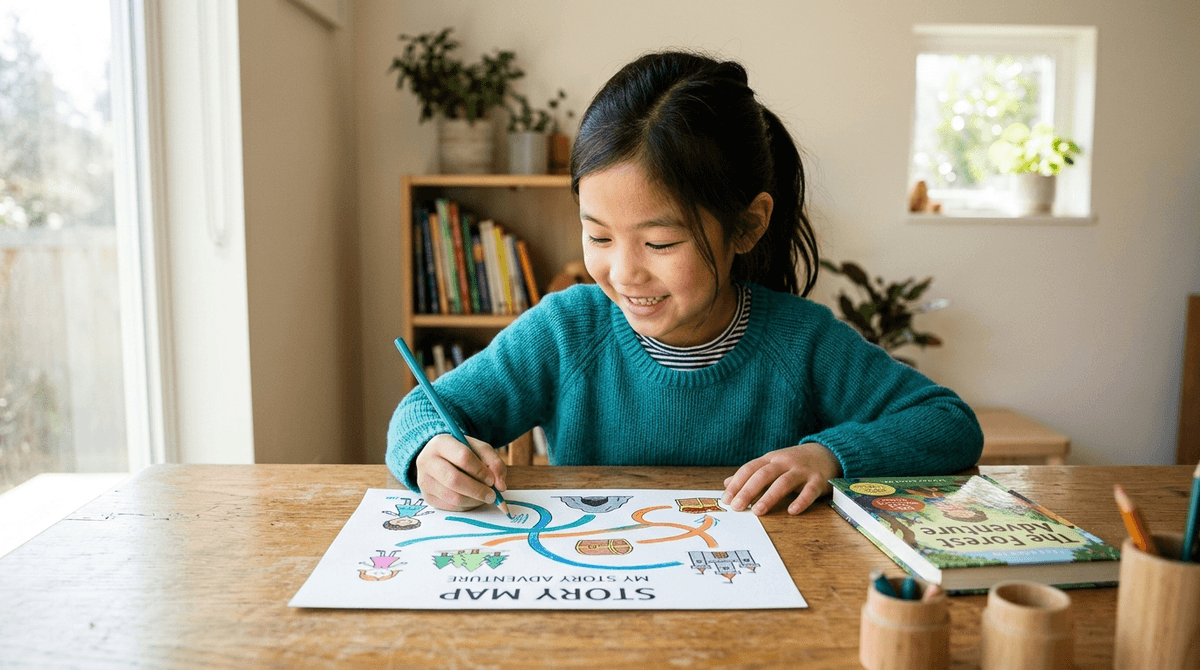

First-graders process stories better when they draw them out. Mapping a plot visually turns abstract words into a concrete structure they can actually remember.
Visual "story maps"—simple diagrams of characters, settings, and plots—boost reading comprehension and foster a more positive attitude toward books in early readers.
Reading at age six or seven is often a mechanical struggle to decode letters into sounds. When children spend all their "brain power" just sounding out words, they often lose the thread of the actual story.
This finding offers a low-tech way to help kids shift from "What word is this?" to "What is happening here?" Using visual organizers prevents the frustration that leads kids to give up on reading before they’ve even started. It turns a taxing mental chore into a spatial puzzle they can solve.
Many first-graders hit a wall where they can read a sentence aloud perfectly but have no idea what it meant. Researchers wanted to see if a visual organizer could bridge the gap between phonetic skills and actual understanding. By moving beyond traditional "read and repeat" methods, they looked for a way to help students internalize the "grammar" of a story—how characters, settings, and problems link together.
Students who used story maps significantly outperformed their peers in both listening and reading tests. The mapping strategy showed consistent benefits across 26 different narrative texts taught during the study.
- Comprehension spiked: The group using visual maps scored significantly higher on comprehension assessments than the control group.
- Attitudes shifted: Children in the mapping group showed a measurable increase in reading enthusiasm.
- Consistency mattered: The visual benefit held up over time, suggesting it is a reliable tool for different types of stories, not just a one-time novelty.
The study utilized the "Garfield Picture" scale to measure how kids felt about reading. The results suggest that reading comprehension isn't just a cognitive skill—it's an emotional one. When a child understands the "why" of a story through a map, they stop feeling overwhelmed. This reduction in cognitive load makes reading feel "easier," which directly correlates to whether a child identifies as a "reader" or someone who hates books.
The study was small, tracking only 69 first-graders in a single elementary school. The research was also quasi-experimental, meaning they matched students rather than using a true random lottery, which makes it harder to rule out other factors like teacher personality or existing classroom dynamics. Additionally, the study was conducted in Turkey using a specific local curriculum; while the logic of story mapping is universal, the exact level of improvement might vary across different languages or writing systems.
- If your child can read the words but can't summarize the plot... sketch four circles on a piece of paper labeled "Who," "Where," "The Problem," and "The End" and have them draw or write the answers as you go.
- If your child is reluctant to start a new chapter book... create a "character map" together on the inside cover to help them keep track of the names and relationships, reducing the mental effort required to stay engaged.
- If you are reading aloud to a child who isn't reading independently yet... draw the story map together during the reading session to build the mental habit of structural thinking before they ever pick up a book alone.
- If your child seems bored or frustrated by reading homework... swap the verbal questioning for a visual map to make the comprehension check feel more like an art project and less like a quiz.
You don't need an expensive app or a specialized tutor to improve your child's reading; you just need a pencil and a piece of paper. Turning a story into a map helps early readers see the big picture, making them more capable, confident, and eager to keep reading.
Beyhatin, Fatma, Özdemir, Olcay (2023). Effects of Story Map Method on Listening and Reading Comprehension of 1st Grade Elementary School Students. International Journal of Education and Literacy Studies. — https://eric.ed.gov/?id=EJ1398299